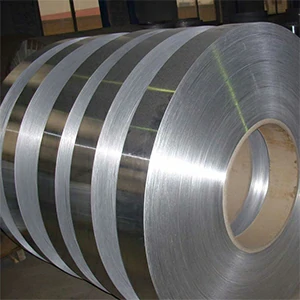
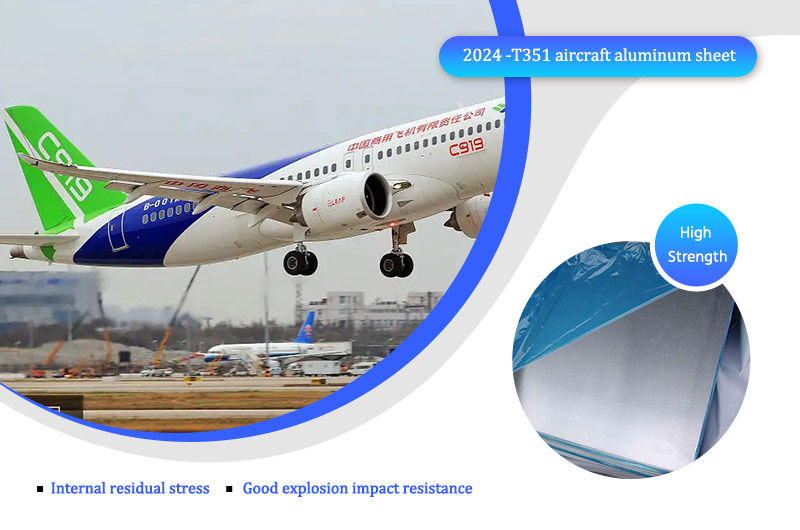
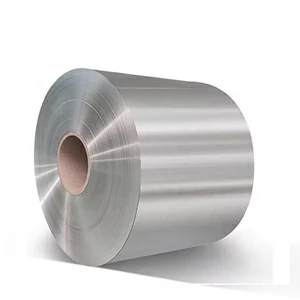
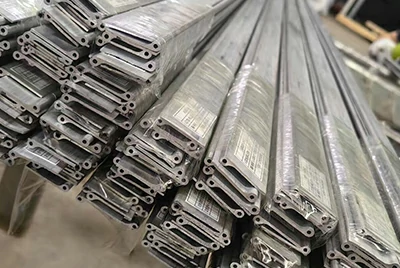
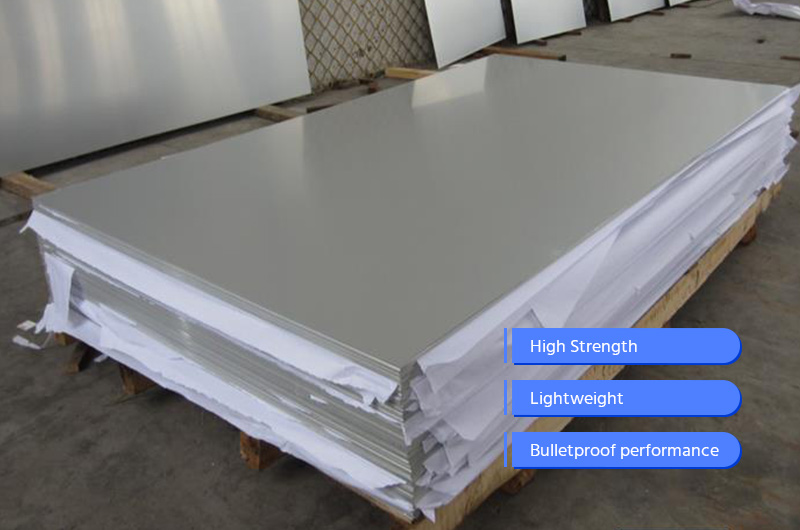
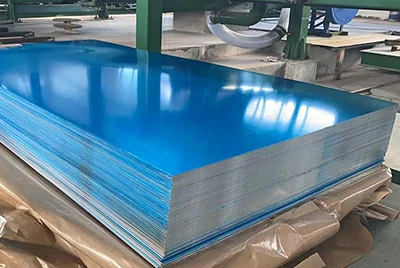
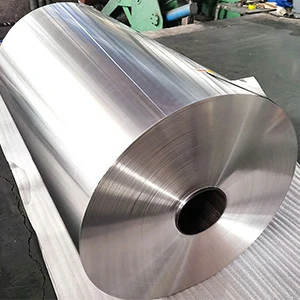
Chalco supplies high-formability aluminum sheet, aluminum strip, and aluminum coil for internal structural components in 3C electronics, suitable for products such as LED back plates, display back plates, keyboard plates, mobile phone middle plates, backlight plates, internal brackets, conductive components, and heat dissipation parts.
High-formability aluminum sheet is well suited for stamping, bending, stretching, deep drawing, and complex structural forming, helping to reduce cracking, springback, warping, and dimensional instability during processing. For thin, lightweight, and precision-assembled 3C electronic internal components, the material's flatness, elongation, residual stress, and post-forming stability directly affect part quality.
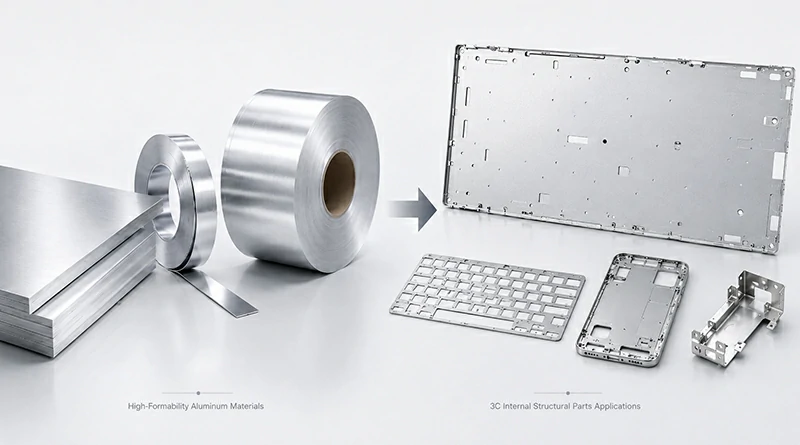
Chalco can supply aluminum alloys including 1050, 3104, 5050, 5052, 5754, 5B59, 6063, 6101, 6061 and 7075, and can determine the optimal supply solution based on part drawings, thickness, temper, strength requirements, forming methods, and application scenarios. These internal-structure requirements differ from exterior housing projects, where 3C digital housing aluminum sheet provides a more direct shell-material route, while projects combining higher structural requirements with an anodized exterior finish can further evaluate high-strength anodized aluminum for electronics housings.
Typical applications of high-formability aluminum in 3C internal components
High-formability aluminum sheet is primarily used for 3C electronic internal parts requiring stamping, stretching, bending, or complex forming. The material maintains stable flatness and dimensions before and after processing, improving assembly consistency and reducing risks of deformation, warping, and rework.
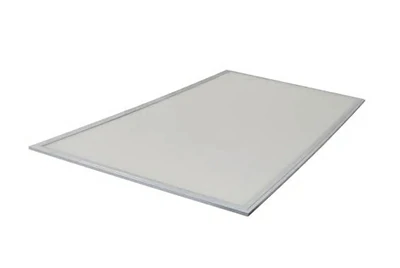
LED back plate
LED back plates typically require good flatness, heat dissipation performance, and stamping stability. Aluminum alloys such as 3104, 5050, and 5052 can be used for LED back plate products with varying size and structural requirements.
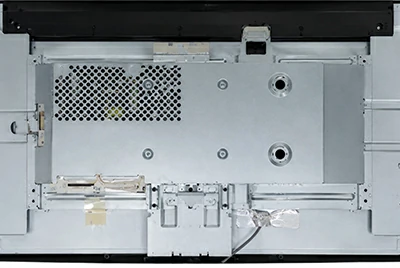
Display back plate
Display back plates demand high flatness, dimensional stability, and post-forming flatness. Materials like 1050/1060/1070 3C aluminum sheet and strip, 3104, and 5050 are suitable for back plates of displays, screens, and electronic display modules.
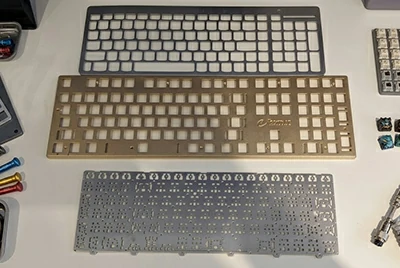
Keyboard plate
Keyboard plates require stable flatness and excellent stamping formability to minimize post-processing deformation, warping, and assembly issues. Alloys such as 5050 and 5052 3C aluminum sheet and strip are options for thin-sheet stamped structural components.
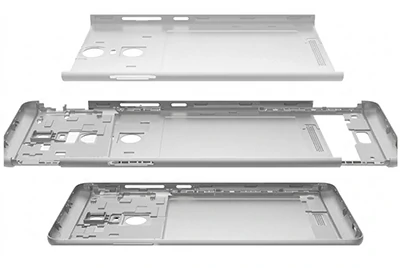
Mobile phone middle plate
Mobile phone middle plates require thin gauges, high strength, forming stability, and flatness. Alloy 5B59 suits thin 3C structural components, while 7075 aluminum for mobile phone middle plates provides a high-strength machined route for specific part requirements.
Backlight plates and internal brackets
Backlight plates and internal brackets must balance formability, dimensional stability, and structural strength. Alloys such as 5052, 5754, and 5B59 can be selected based on part geometry, stamping depth, and strength requirements.
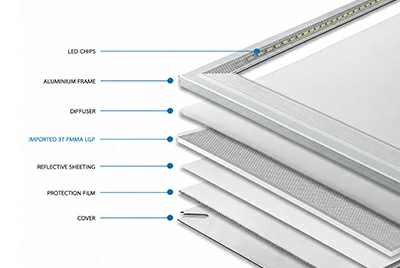
Why do 3C electronic internal components require high-formability aluminum sheet?
3C electronic internal structural components are typically thin and geometrically complex, requiring processes such as stamping, bending, stretching, piercing, trimming, and reshaping. Unstable material formability can lead to cracking, springback, warping, dimensional deviations, and poor assembly fit.
High-formability aluminum sheet offers excellent ductility, flatness stability, and process adaptability, making it ideal for parts like LED back plates, display back plates, keyboard plates, mobile phone middle plates, backlight plates, and internal brackets.
Reduced stamping cracks
High-formability aluminum sheet provides superior elongation and deformation capacity, lowering the risk of cracking during bending, stretching, and complex stamping—especially suitable for multi-stage forming and thin-sheet processing.
Maintained flatness stability
Stable flatness and surface flatness help minimize post-processing warping, waviness, and localized distortion, enabling easier assembly of back plates, middle plates, keyboard plates, and similar components.
Minimized residual stress effects
Low-residual-stress materials are less prone to deformation after cutting, stamping, piercing, and reshaping, enhancing dimensional consistency in mass production.
Suitable for slim and lightweight structural designs
High-formability aluminum sheet combines light weight, strength, and processability, making it ideal for 3C internal components with strict requirements on thickness, weight, flatness, and structural stability.
Chalco can provide aluminum solutions tailored for stamping, bending, stretching, and complex forming based on part drawings, thickness, temper, forming method, and performance requirements.
Recommended high-formability aluminum alloy selection
Different 3C internal components have varying requirements for formability, strength, flatness, and functionality. Chalco can recommend suitable alloys—including 1050, 3104, 5050, 5052, 5754, 5B59, 6063, 6101, and 7075—based on part geometry and processing methods.
| Alloy | Key features | Suitable 3C internal components |
| 1050 | Good formability, low cost, stable thermal performance | Small back plates, lighting parts, display structural parts |
| 3104 | Higher strength than 1050, good formability and heat dissipation | LED back panels, display back plates, stamped back plates |
| 5050 | Good flatness, stable forming performance, suitable for thin sheet processing | Back plates, keyboard plates, stamped structural parts |
| 5052 | Balanced strength and formability, suitable for bending, stamping and drawing | Internal brackets, structural parts, deep-drawn components |
| 5754 | Good deformation performance, suitable for complex forming | Complex stamped parts, bent parts, internal structural components |
| 5B59 | High strength, good flatness, suitable for thin and lightweight structures | Mobile phone middle plates, backlight plates, high-strength thin structural parts |
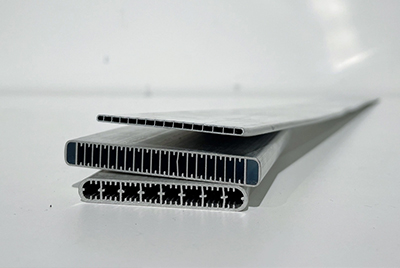
| 6063 | Good structural performance and heat dissipation performance | Heat dissipation structures, support parts, electronic structural components |
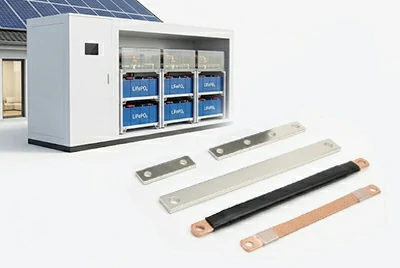
| 6101 | Good electrical and thermal conductivity with certain strength | Conductive parts, heat dissipation parts, functional structural components |
| 7075 | High strength, suitable for demanding structural requirements | High-strength support parts, special structural components |
The 6063 and 6101 options above cover projects where structural, thermal, or conductive performance becomes more important alongside forming requirements. If the project moves further toward a higher-strength 6xxx sheet route, high-strength 6000-series aluminum sheet should be evaluated separately from grades selected primarily for maximum forming performance. Similarly, high-strength, high-toughness 7-series aluminum sheet for 3C electronics serves a different strength-led selection route.
Available tempers and performance parameters for high-formability aluminum sheet
-
1050 aluminum
Temper: H14 / H24
Thickness: 0.3–3.0mm
Tensile / yield strength: ≥95MPa
Application: Small back plates, lighting parts, display structural components
-
3104 aluminum
Temper: H111
Thickness: 0.3–2.0mm
Tensile / yield strength: ≥170MPa / ≥85MPa
Application: LED back panels, display back plates, stamped back panels
-
5050 aluminum
Temper: H32
Thickness: 0.2–1.0mm
Tensile / yield strength: 150–190MPa / >110MPa
Application: Back plates, keyboard plates, thin stamped parts
-
5052 aluminum
Temper: O / H32 / H34
Thickness: 0.3–3.0mm
Tensile / yield strength: 180–260MPa / 80–206MPa
Application: Internal brackets, structural parts, deep-drawn components
-
5754 aluminum
Temper: O / H111 / H32
Thickness: 0.3–3.0mm
Tensile / yield strength: 190–270MPa / confirmed by temper
Application: Complex stamped parts, bent parts, internal structural components
-
5B59 aluminum
Temper: H32–H39
Thickness: 0.15–0.5mm
Tensile / yield strength: 310–460MPa / 190–430MPa
Application: Mobile phone middle plates, backlight plates, high-strength thin structural parts
-
6063 aluminum for 3C housings
Temper: O / T6
Thickness: 0.2–3.0mm
Tensile / yield strength: 120–310MPa / 55–290MPa
Application: Heat dissipation structures, support parts, electronic structural components
-
6101 aluminum
Temper: T6
Thickness: 0.15–4.0mm
Tensile / yield strength: ≥185MPa / ≥150MPa
Application: Conductive parts, heat dissipation parts, functional structural components
-
6061 aluminum
Temper: O / T4 / T6
Thickness: 0.40–12.50mm (3C sheet offering; confirm selected temper)
Tensile / yield strength: T6 ≥260MPa / ≥210MPa (3C sheet reference)
Application: CNC-machined precision structural parts
Processing compatibility for 3C internal components
High-formability aluminum sheet is compatible with common 3C internal component processes—including stamping, bending, stretching, piercing, trimming, and secondary operations—helping parts maintain stable shape, clean edges, and good assembly performance.
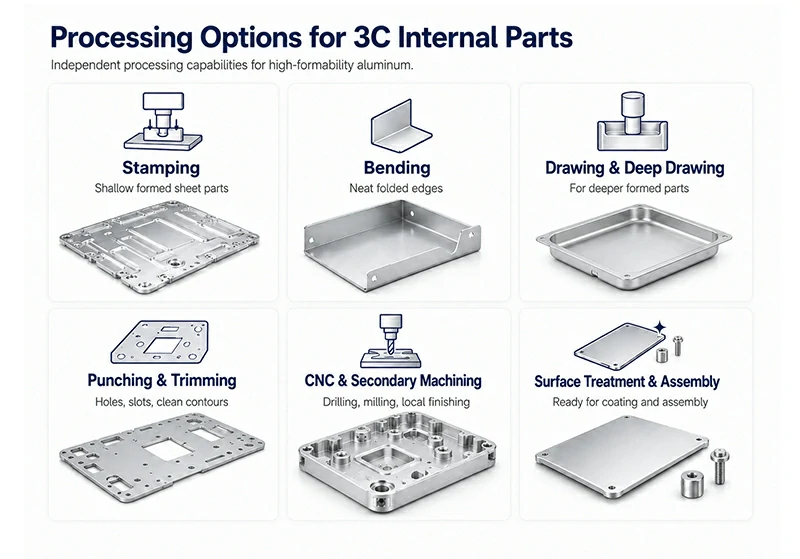
Stamping
Suitable for back plates, keyboard plates, brackets, and thin-sheet structural components. Stable material properties help reduce cracking, wrinkling, and dimensional variation in high-volume stamping. Where precision-stamped exterior housing parts are required instead of internal back plates or brackets, GM55 precision-stamping aluminum sheet can be assessed as a separate product route.
Bending
Excellent bendability ensures neat, consistent edge geometry, ideal for internal frames, support plates, and components with bent features.
Stretching and deep drawing
For parts with significant draw depth or complex geometry, alloys like 5052 and 5754 offer superior formability, reducing the risk of edge cracking.
Piercing and trimming
Stable flatness and low residual stress minimize distortion after piercing, cutting, and edge trimming—ideal for parts with holes, slots, locating features, and tight assembly tolerances.
CNC and secondary machining
For parts requiring drilling, milling, trimming, or localized machining, the appropriate alloy and temper can be selected based on structural and dimensional requirements to enhance post-machining dimensional stability. The aluminum CNC precision machining guide helps assess this secondary-machining route alongside forming requirements.
Surface finishing and assembly
A smooth, clean aluminum surface supports subsequent bonding, painting, aluminum anodizing, film lamination, label adhesion, and component assembly. When anodizing is part of downstream processing, substrate and finish requirements can be reviewed together within broader aluminum anodizing solutions. For components where the final anodized appearance becomes a primary acceptance requirement, aluminum selection for anodized appearance parts provides a separate material-selection route.
Type III hardcoat represents a different functional direction from the high-formability sheet route discussed here. Where wear resistance and a hard-anodized rod or bar form become the primary requirements, Type III hard-anodized aluminum bar should be evaluated separately.
Chalco supplies aluminum sheet, aluminum strip, and aluminum coil suitable for stamping, bending, drawing, perforating, trimming, and secondary processing, and can confirm alloy, temper, thickness, flatness, and surface requirements based on 3C internal component drawings.
Surface quality and dimensional control
3C electronic internal components typically require precise assembly with screens, backlight modules, batteries, motherboards, keyboards, and housing structures. The surface quality, flatness, and dimensional stability of aluminum sheet directly affect stamping formability, bonding, positioning, and mass assembly performance.
Flatness control
Consistent flatness minimizes warping, waviness, and localized deformation in back plates, mid-frames, keyboard plates, and bracket-type parts after processing, making subsequent bonding and assembly easier.
Thickness and width tolerance
Stable thickness and width tolerances improve consistency in high-volume stamping, making the material suitable for automated stamping, progressive die operations, and 3C internal components requiring precise positioning.
Surface cleanliness
The aluminum sheet surface should be free from visible scratches, dents, oil stains, oxidation spots, and foreign residue to minimize quality issues during subsequent stamping, film lamination, adhesive bonding, painting, and assembly.
Edge quality
Good edge quality reduces the risk of cracking, burrs, and poor trimming, making it suitable for thin structural components requiring bending, drawing, perforating, and precision assembly.
Batch-to-Batch consistency
Materials within the same batch should maintain consistent temper, strength, elongation, plate shape, and surface quality to reduce trial-run adjustments, processing variability, and mass rework.
Available forms and customization capabilities
Chalco offers aluminum sheet, aluminum strip, and aluminum coil tailored for 3C electronic internal components, supporting specification confirmation based on drawings, part geometry, processing methods, and volume production requirements.
- Aluminum sheet: Suitable for stamped and formed structural components such as back plates, keyboard plates, smartphone mid-frames, backlight plates, and internal brackets. Cut-to-size sheets can be provided according to part dimensions to reduce customers' secondary cutting efforts. The broader aluminum sheet and plate range provides a separate purchasing entry for sheet and plate specifications.
- Aluminum strip: Ideal for continuous stamping, die-cutting, perforating, and high-volume forming. Width, coil weight, and edge condition can be confirmed based on die width, feeding method, and processing cycle time.
- Aluminum coil: Suitable for high-volume production and automated stamping lines. Thickness, width, inner diameter, outer diameter, coil weight, and packaging can be customized according to customer equipment requirements.
- Cut-to-length processing: Custom cutting, slitting to width, and specification tailoring can be provided based on customer drawings or samples to facilitate subsequent stamping, bending, drawing, and assembly.
- Surface and packaging requirements: Surface quality, protective film, interleaving paper, moisture-resistant packaging, and export packaging can be specified based on part application to minimize scratches, dents, and oxidation during transportation, storage, and processing.
Chalco can confirm the appropriate temper, thickness range, and delivery form based on application requirements for materials such as 1050, 3104, 5050, 5052, 5754, 5B59, 6063, 6101, and 7075.
Related Anodized Aluminum Products

Anodized Aluminum Sheet
Anodized Aluminum Coil
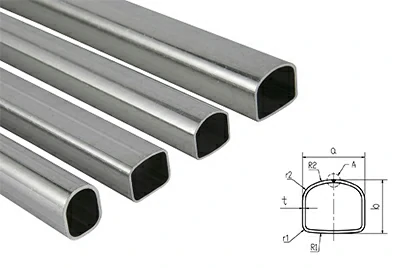
Anodized Aluminum Extrusions
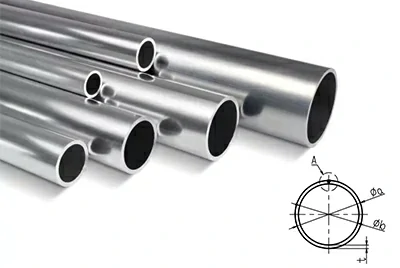
Anodized Aluminum Tubing
Anodized Aluminum Wire
Inspection documentation and quality certifications
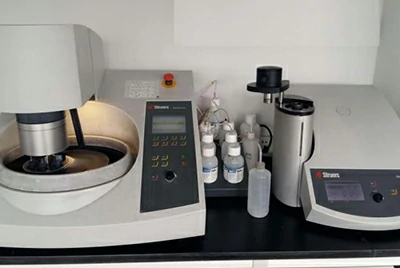
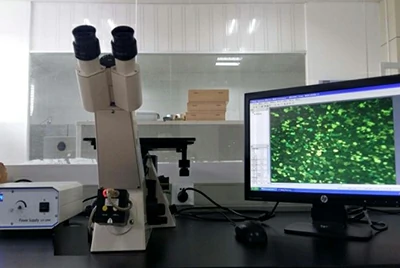
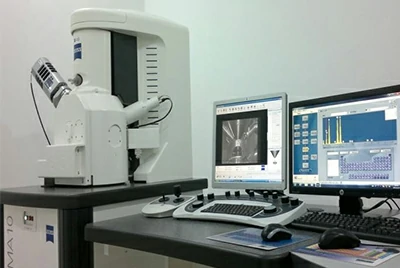
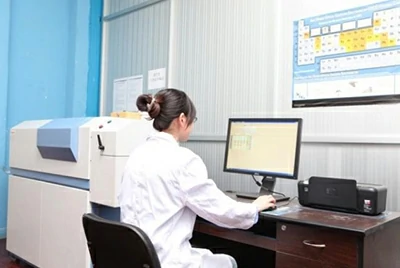
Chalco can provide relevant inspection documents for high-formability aluminum materials used in 3C internal components upon request, helping customers verify material grade, temper, properties, and batch information.
- Material certificate: Confirms aluminum grade, temper, dimensions, batch number, and supply details.
- Chemical composition Report: Verifies that material composition meets order or standard requirements.
- Mechanical properties Report: Confirms key performance metrics such as tensile strength, yield strength, and elongation.
- Dimensional inspection report: Confirms compliance with requirements for thickness, width, length, flatness, and tolerances.
- Surface quality inspection: Checks for visible scratches, dents, oil stains, oxidation spots, or other surface defects.
- Packing list: Enables customers to verify quantities and specifications of aluminum sheet, aluminum strip, and aluminum coil.
- Packing photos: Provided before export shipment to confirm packaging condition and reduce risks during transit and receipt.
- Batch traceability Records: Facilitate future quality tracking, production management, and verification of repeat bulk orders.
For smartphone mid-frames, backlight plates, keyboard plates, LED back plates, and precision stamped structural components, it is recommended to confirm required inspection items before placing an order to ensure material properties, dimensions, and surface condition meet downstream processing requirements.
Information required for quotation
To expedite confirmation of a high-formability aluminum solution, please provide the following when requesting a quote:
- Part name: e.g., LED back plate, keyboard plate, smartphone mid-frame, backlight plate, internal bracket, etc.
- Alloy grade: e.g., 1050, 3104, 5050, 5052, 5754, 5B59, 6063, 6101, 7075.
- Temper and thickness: e.g., O, H32, H34, H38, H39, T6, along with specific thickness, width, and length.
- Processing method: e.g., stamping, bending, drawing, deep drawing, perforating, trimming, or CNC machining.
- Performance requirements: e.g., strength, elongation, flatness, residual stress, or dimensional tolerance specifications.
- Surface requirements: e.g., scratch control, dent control, protective film, interleaving paper, or surface treatment specifications.
- Drawings or samples: Part drawings, sample photos, or technical specifications may be provided.
- Order quantity and packaging Requirements: Including samples, trial orders, bulk orders, and export packaging needs.
Chalco can determine the appropriate alloy, temper, dimensions, and supply solution based on the above information.
FAQs
Which aluminum alloys are suitable for 3C electronic internal components?
Commonly used alloys include 1050, 3104, 5050, 5052, 5754, 5B59, 6063, 6101, and 7075. Different grades suit different structural components; selection should consider formability, strength requirements, thickness, flatness, and processing method.
Is high-formability aluminum sheet suitable for stamping?
Yes. High-formability aluminum sheet is suitable for stamping, bending, drawing, deep drawing, perforating, and trimming, and is ideal for parts such as back plates, keyboard plates, smartphone mid-frames, backlight plates, and internal brackets.
What aluminum alloys can be used for smartphone mid-frames?
Smartphone mid-frames typically require good strength, thin-gauge stability, and flatness. Material choice also depends on the manufacturing route and is discussed in the mobile phone middle-frame material comparison. Materials such as 5B59 or 7075 can be selected based on drawing requirements, with confirmation of temper, thickness, and mechanical properties.
What aluminum alloys are suitable for LED back plates?
LED back plates typically prioritize formability, flatness, and thermal conductivity. Alloys such as 3104, 5050, or 5052 can be selected based on structural design and thickness requirements.
How can post-stamping deformation and warping be minimized?
This can be addressed by optimizing alloy grade, temper, thickness tolerance, flatness, residual stress, and stamping process parameters. It is recommended to provide drawings, forming method, and dimensional tolerance requirements before placing an order.
Can specifications be customized based on drawings?
Yes. Chalco can confirm the alloy, temper, thickness, width, cut-to-size dimensions, surface quality, and packaging for aluminum sheet, aluminum strip, and aluminum coil based on customer drawings or samples.