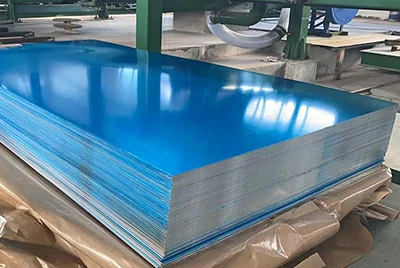
When standard electrical aluminum busbars cannot meet the required width, thickness, length, or cross-section for high-current service, Chalco can manufacture custom large plate-cut aluminum busbars from thick aluminum plate according to customer drawings. We also support further processing such as hole and slot machining, bending, end machining, aluminum foil or thin-sheet welded flexible sections, inspection, and export packing based on project requirements.
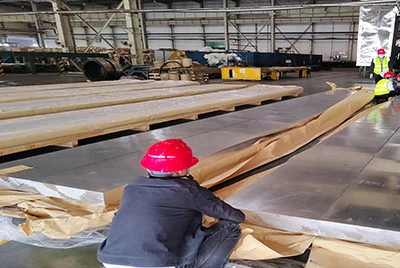
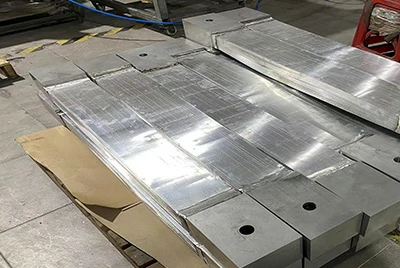
This solution is designed for large rectifier systems, electrolysis equipment, transformers, generators, and heavy industrial high-current connections. From drawing review and manufacturing route selection to inspection and shipment, Chalco helps customers turn oversized aluminum busbar requirements into project-ready conductive components.
- Large-Size Customization: Supports extra-wide, extra-thick, extra-long, and large cross-section aluminum busbar projects based on customer drawings.
- Plate-Cut Manufacturing Route: Uses thick aluminum plate cutting when extrusion or standard flat bars are not suitable for the required dimensions.
- Further Processing Support: Includes hole and slot machining, bending, end machining, and aluminum foil or thin-sheet welded flexible sections.
- Project-Based Delivery: Supports dimensional inspection, documentation traceability, surface treatment, export packing, and shipping plans for extra-long parts.
Chalco supports oversized aluminum busbar projects where standard extrusion, flat bars, or off-the-shelf busbar sizes are not suitable.
Why Use Plate Cutting for Large Aluminum Busbars?
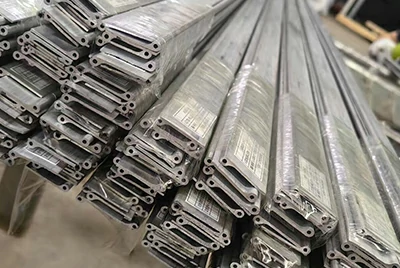
Standard extruded aluminum busbars, including 6061 aluminum flat bars for applications requiring suitable mechanical properties, are options for mature, standardized sizes. Typical extruded busbars are about 2–40 mm thick, 10–200 mm wide, and commonly supplied in 3 m or 6 m lengths. They can be cut to length and further processed with drilling, surface treatment, or insulation.
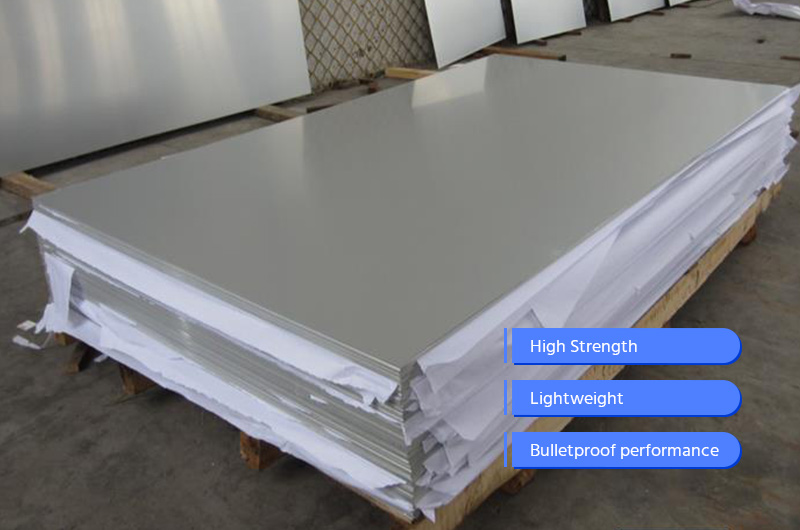
When project drawings require 500–600 mm width, 60–120 mm thickness, or 8–10 m class length, the key question is no longer which standard busbar to choose. The project must confirm whether thick aluminum plate can be cut to shape while meeting requirements for flatness, waviness, cut angle, edge quality, post-cutting processing, and protection against deformation during shipping.
The value of plate cutting is not only achieving larger dimensions. It turns thick aluminum plate into high-current aluminum busbars that are ready for installation, inspection, traceability, and project delivery. For installations considering a different conductor section, electrical aluminum bus pipes provide another structure to evaluate.
| Comparison Criteria | Standard Extruded Aluminum Busbar | Thick Plate-Cut Large-Scale Aluminum Busbar |
| Typical Dimensions | Thickness: ~2–40 mm; Width: ~10–200 mm; Standard lengths: 3 m / 6 m | Capable of producing conductive bars up to 120 mm thick, 600 mm wide, and ~10 m long |
| Manufacturing Method | Standard profile extrusion with mature dimensional systems | Precision sawing or cutting of thick aluminum plates, customized per drawing |
| Secondary Processing | Cut-to-length, drilling, surface treatment, insulation | Hole/slot machining, end machining, bending, and flexible connections via aluminum foil or thin-sheet welding |
| Key Acceptance Criteria | Cross-section, length, hole positions, surface condition | Flatness, waviness/camber, cut angle, burrs, and resistance to deformation during transport |
| Typical Applications | Switchgear cabinets, standard busway systems, conventional electrical connections | Rectifiers, electrolysis cells, transformers, generators, and heavy industrial high-current connections |
Dimensional Tolerances and Shape Control for Large Plate-Cut Aluminum Busbars
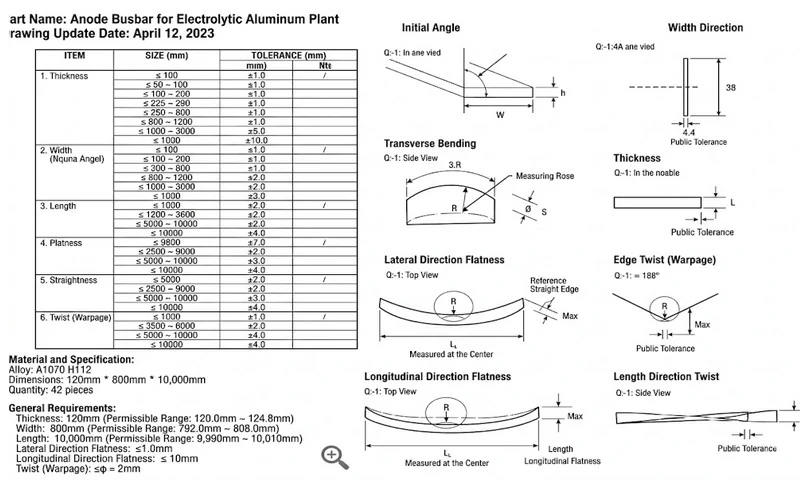
For thick plate-cut large-size aluminum busbars, customers care not only about maximum achievable size but also whether post-cut parts meet drawing tolerances, plate shape control, edge quality, and field installation requirements. Chalco customizes thick plate-cut aluminum busbars per customer drawings and confirms technical agreements on thickness, width, length, flatness, waviness, cut angle, surface condition, and packaging.
Dimensional Specifications
| Control Parameter | Specification Range | Tolerance |
| Thickness | 20–180 mm | ±1.0–±3.0 mm |
| Width | ≤600 mm | ±2.5–±3.0 mm |
| Length | ≤15000 mm | -0 / +3.0 mm to -0 / +20.0 mm |
Plate Shape and Cut Quality Control
Acceptance of large-size aluminum busbars should consider more than just length, width, and thickness. For wide, thick, and long bars, flatness, waviness, camber, and cut angle directly affect field installation, bolted joint integrity, and electrical contact stability.
| Control Parameter | Tolerance |
| Cut angle (thickness direction) | -0 / +1.0 mm to -0 / +3.0 mm |
| Flatness (width direction) | ±1.0–±2.0 mm |
| Flatness (length direction) | -0 / +3.0 mm to -0 / +15.0 mm |
| Waviness / camber | As specified in drawing |
| End Warpage | As specified in drawing |
Edge and Surface Requirements
After thick plate cutting, visible burrs must be removed and aluminum chips cleaned. Severe scratches, dents, blisters, inclusions, corrosion, oxidation, and prominent oil stains-surface defects that impair functionality-must be controlled. If tin plating, nickel plating, insulation, or localized contact surface machining is required, treatment areas and contact surface specifications should be confirmed in advance.
The key acceptance criteria for large-size aluminum busbars ensure compliance with dimensional accuracy, tolerances, plate shape, edge condition, surface quality, and installation requirements. Drawings should clearly define flatness, waviness, hole locations, end machining, and surface condition.
Material Selection for Large Conductive Aluminum Busbars
Material selection for large conductive aluminum busbars should not be based on electrical conductivity alone. For thick plate-cut projects, cross-section, strength, end connections, bending requirements, surface treatment, and project standards must also be considered. When choosing between copper busbars and aluminum conductors, compare required section, mass, electrical performance, and installed cost.
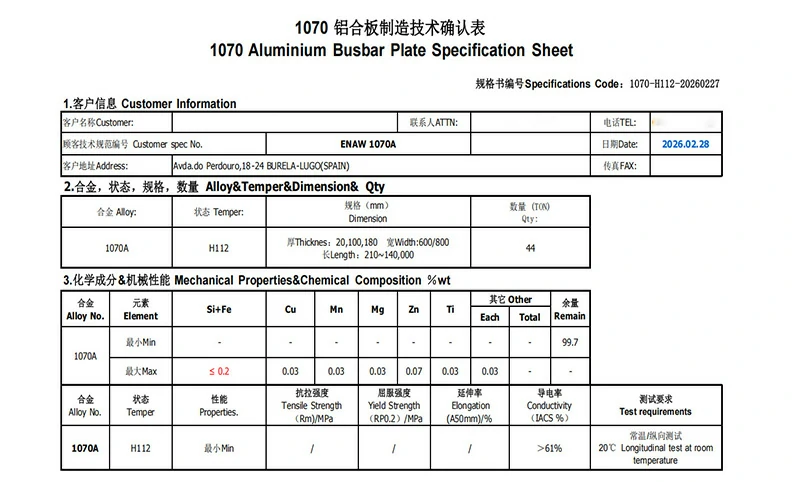
For high-conductivity, large cross-section plate-cut busbars, 1070 / 1070A is commonly prioritized. If cost, strength, bolted connection performance, or local structural support is more important, 1060, 1350, or 6101 can also be evaluated according to the drawing. Availability of suitable 6101 aluminum sheet and plate should be checked for the required thickness and cutting route.
| Alloy | Electrical Conductivity (Reference) | Strength Level | Typical Application | Selection Focus |
| 1070 / 1070A | >61% IACS | Low–Medium | Primary conductive busbars from thick plate cutting; rectifier/electrolysis connections | Prioritizes conductivity; common in large cross-section projects. Strength must be evaluated per drawing. |
| 1060 | 61–62% IACS | Low–Medium | General-purpose conductive busbars, cut parts, simple bent components | Balances conductivity, cost, and availability |
| 1350 | 61.0–61.8% IACS | Low | Electrical conductors, straight conductive segments | Conductivity-focused; load-bearing, bending, and machining require separate evaluation |
| 6101 | 55–59.5% IACS | Medium–High | Electrical busbars, bolted connection zones, structural conductive components | Balances conductivity and strength; aligns with electrical busbar alloy logic |
Note: Conductivity values above are typical references. Actual values vary with temper, heat treatment, product form, and batch. Final specifications must follow customer standards, Mill Test Certificates (MTC), and mutually agreed technical protocols.
Post-Cutting Processing and Connection Options
After plate cutting, large aluminum busbars can be further processed according to drawings to match equipment interfaces, routing paths, and field connection requirements. Chalco can support bending, hole and slot machining, end machining, and flexible joint integration for project-specific busbar assemblies. Relevant CNC aluminum machining methods can be considered when evaluating custom holes, slots, and contact interfaces.
Bent and Transition Aluminum Busbars
Post-cut aluminum bars can be bent, angled, or formed into transition shapes per drawing, ideal for applications where equipment ports are not coplanar, routing requires directional changes, or installation space is constrained.
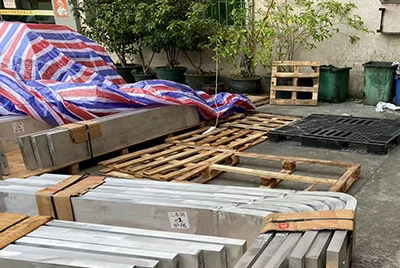
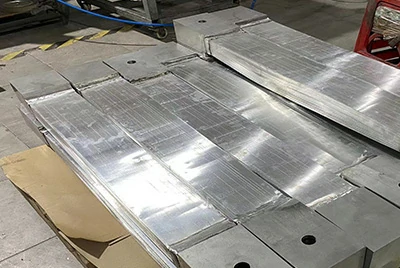
Holes, Slots, End Machining, and Connection Interfaces
For oversized busbars, Chalco supports drilling, slotting, chamfering, stepped ends, and contact-face machining, with controls on hole position, end quality, and flatness for reliable high-current connections. Mating busbar connector assemblies should be verified during drawing review.
Aluminum Foil / Thin-Sheet Welded Flexible Joints
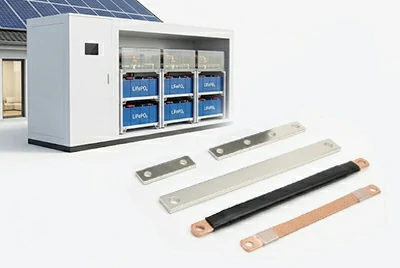
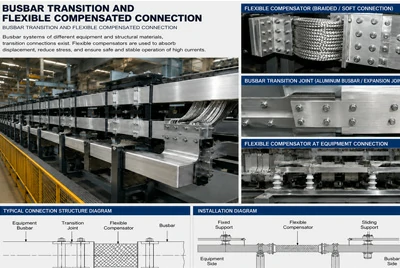
Welded aluminum foil or thin-sheet sections can absorb thermal expansion, vibration, and assembly misalignment between rigid busbars. Alternative flexible busbar designs may be evaluated for different movement and connection requirements.
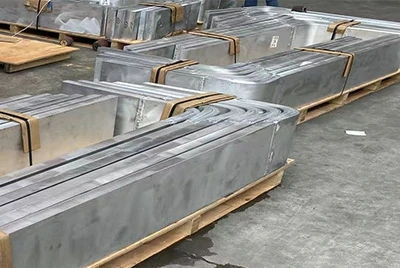
These further processing represent Chalco's customization capabilities for thick plate-cut large-size aluminum busbars. Based on equipment interfaces, routing paths, and compensation needs, we provide bending, hole/slot machining, end finishing, or flexible connections to ensure field installation readiness and successful project delivery.
Surface Treatment and Contact Reliability
For large conductive aluminum busbars, surface treatment is mainly related to contact stability, oxidation resistance, protection, and installation reliability. Chalco can evaluate conductive contact areas, non-contact areas, and end connection zones separately according to customer drawings.
- Surface Cleaning / Deburring: Removes visible burrs and aluminum chips to minimize assembly interference and contact surface damage.
- Tin Plating: Applied to conductive contact surfaces to enhance contact stability and oxidation resistance; the tin plating process requires selection against the actual contact and service conditions.
- Nickel Plating: Improves corrosion resistance, wear resistance, and surface stability in connection zones.
- Silver Plating: Can be evaluated for low contact resistance and high-reliability high-current contact areas.
- Insulation Coating / Spraying: Applied to non-contact areas for electrical insulation, safety identification, or phase isolation. The treatment area must be confirmed per drawing.
- Localized Masking: Used to differentiate contact and non-contact surfaces, preventing coating from interfering with electrical contact.
- Contact Surface-Specific Treatment: For end connections, bolted joints, or equipment interfaces, confirm requirements for localized cleaning, grinding, plating, or secondary machining.
The surface treatment method must be determined based on the contact area, installation environment, and drawing requirements. Chalco can provide full-surface, localized, or contact surface-specific treatment solutions according to project needs.
Related Products
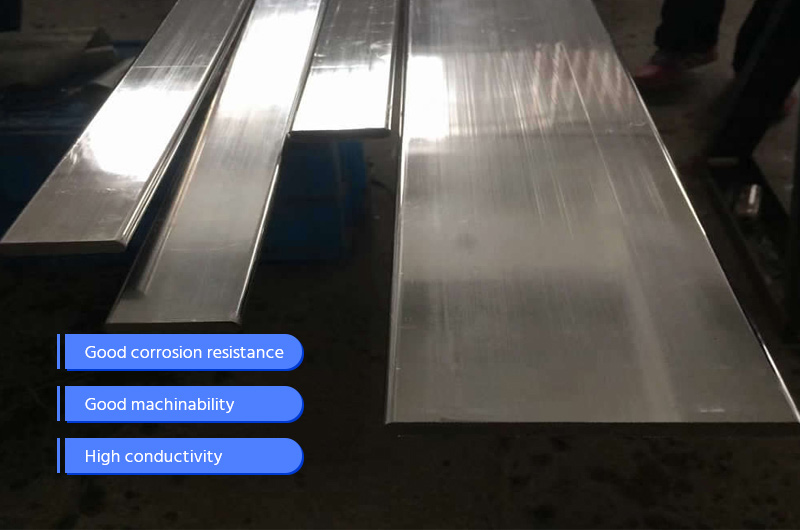
1060 Electrical Aluminum Busbar
1350 1370 Electrical Aluminum Busbar
6101 T6 T61 T64 Electrical Aluminum Busbar
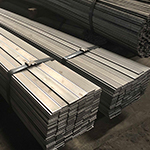
6061 T4 T6 Electrical Aluminum Flat Bar/Busbar
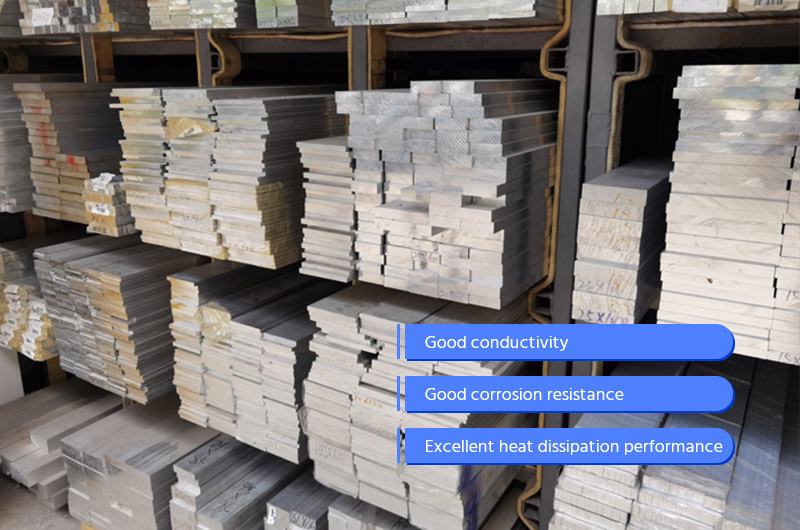
6063 T4 T6 Electrical Aluminum Flat Bar/Busbar
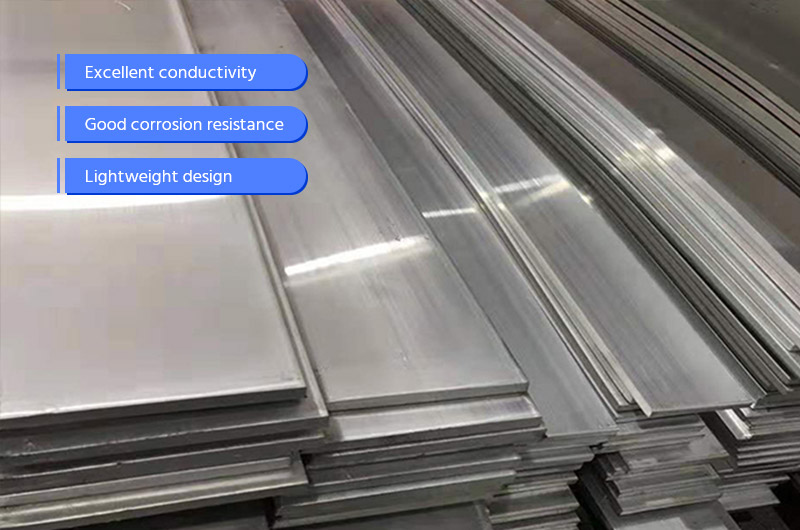
6082 T4 T5 T6 Electrical Aluminum Busbar
Inspection, Documentation, and Traceable Delivery
Delivering large-size aluminum busbars involves more than cutting and machining-it must also meet drawing-based acceptance criteria, material documentation, and batch traceability requirements. Chalco verifies critical dimensions, plate flatness, surface quality, material documents, and packaging labels per customer drawings, technical agreements, and purchase orders.
Dimensional and Flatness Inspection: Checks thickness, width, length, flatness, waviness, camber (banana shape), and cut angle to ensure compliance with drawing tolerances.
Surface and Edge Inspection: Examines surface defects such as scratches, dents, oxidation, oil stains, and inclusions that could affect performance, and confirms removal of visible burrs and aluminum chips.
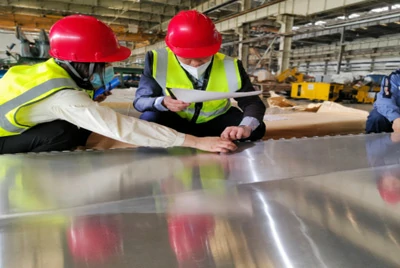
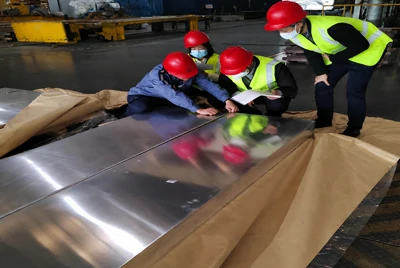
Machined Feature Inspection: For products with drilling, slotting, chamfering, or end machining, hole positions, slot dimensions, end faces, and contact area quality are verified per drawing.
Material Documentation and Performance Verification: Material test certificates (e.g., MTC / EN10204 3.1) can be provided per order requirements. If electrical conductivity is specified, it is confirmed per technical agreement or material documentation.
Packaging Labels and Batch Traceability: Labels include alloy, temper, dimensions, weight, melt number, and batch number to support customer identification, acceptance, and traceability upon receipt.
Inspection and documentation for large-size aluminum busbars serve not only to certify product compliance but also to enable quick verification of dimensions, material, and batch information during receipt, installation, and project acceptance-reducing on-site rework and delivery risks.
Packaging and Export Shipping for Extra-Long aluminum busbars
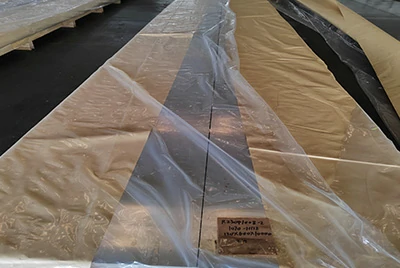
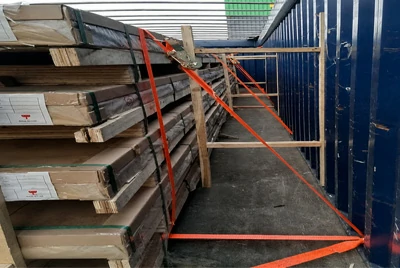
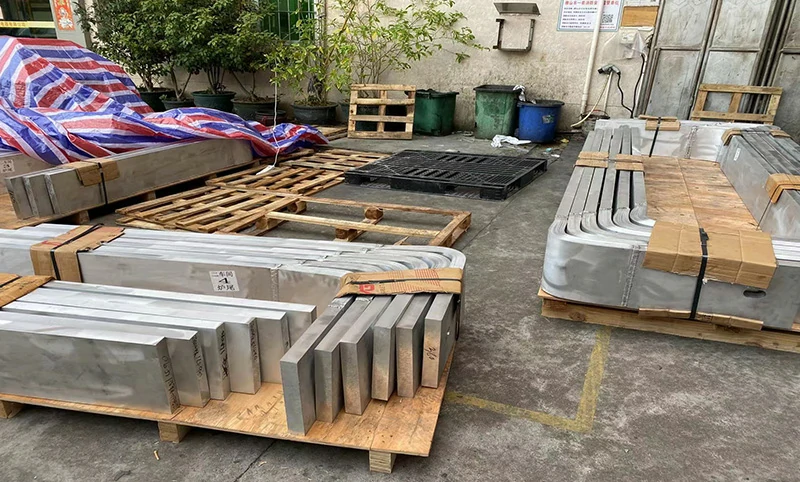
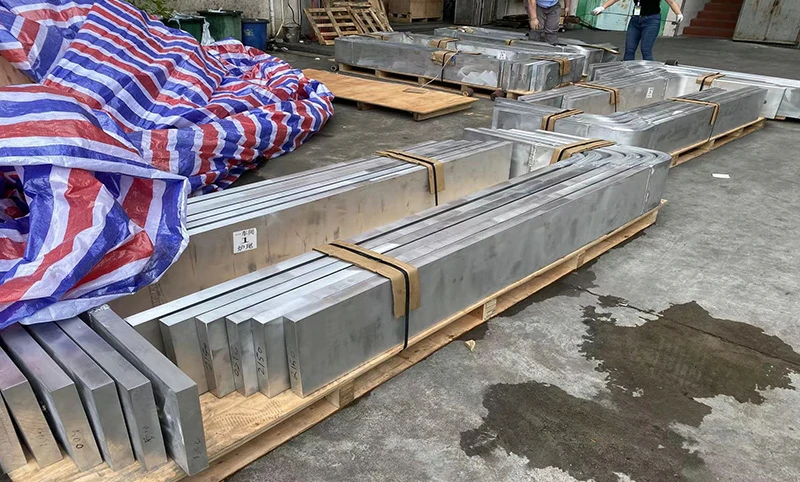
During transport, large-size aluminum busbars require protection against surface scratches, edge impacts, and long-length deformation. Chalco can provide protective film, separated packing, export-grade fumigation-free wooden pallets or supports, and suitable ocean freight loading plans based on product length, weight, packing size, and destination port requirements.
For 8–10 m class or other extra-long busbars, standard container loading, open-top containers, or special loading methods can be evaluated according to the actual product size and packing conditions. Packaging labels can support product identification, acceptance inspection, and batch traceability upon arrival.
Suitable Large High-Current Applications
Plate-cut large-size aluminum busbars are primarily used in industrial power applications requiring high current, large cross-sections, long lengths, or non-standard routing; broader power busbar solutions cover additional conductor types and installation configurations. Compared to standard aluminum busbars, these applications place greater emphasis on cross-sectional area, contact stability, thermal expansion compensation, and field installation compatibility.
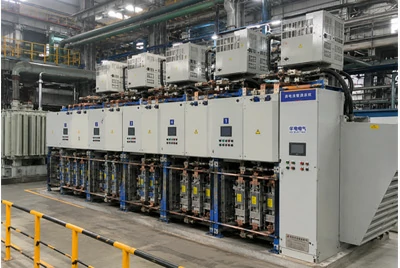
Large Rectifier Systems
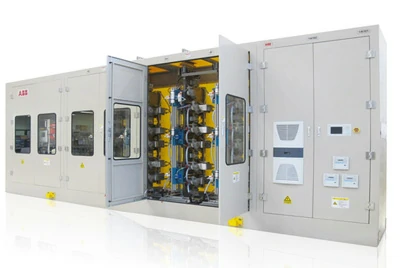
Large rectifier systems need stable high-current connections. Chalco customizes plate-cut aluminum busbars with matched cross-sections, hole patterns, end machining, and surface treatments.
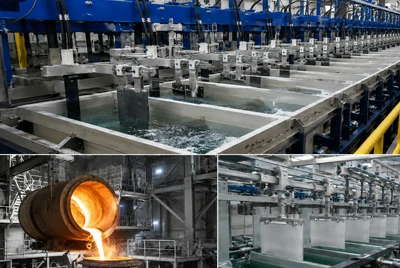
Electrolysis, Electrochemical, and Smelting Equipment
For electrolysis, electrochemical, and smelting equipment, plate-cut aluminum busbars provide low-loss, large-section high-current connections and can work with flexible segments to reduce thermal and assembly stress.
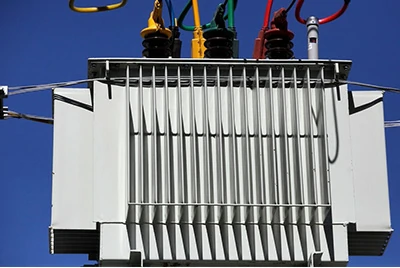
Large Transformers and Generator Connections
For large transformers, generators, and high-power equipment, Chalco provides bent, slotted, drilled, and end-machined aluminum busbars to match oversized terminals and complex installation routes. Matching aluminum, copper, and bimetal cable lugs and connectors may require separate interface review.
Heavy Industrial High-Current Equipment
For metallurgy, mining, chemical processing, arc furnaces, and heavy manufacturing, large aluminum busbars are customized per drawings for high-current, large-size, and complex installation needs.
Busbar Transitions and Flexible Compensation Joints
In large busbar systems, plate-cut rigid ends can be combined with welded flexible segments to absorb thermal expansion, vibration, and assembly tolerances.
Project Reference: A1070 H112 10 m Class Large Aluminum Busbar
Chalco supplied A1070 H112 thick plate-cut aluminum busbars for a major high-current interconnection project. Each piece measured 120 mm × 600 mm × 10,000 mm, with a total quantity of 62 pieces. The project required control of thickness, width, length, width-direction flatness, length-direction flatness, and waviness/camber, making it a typical custom large cross-section, extra-long aluminum busbar project.
This case shows that large aluminum busbar supply is not only about size capability. It also requires compliance with drawing tolerances, shape control, edge quality, surface protection, export packing, shipping, and documentation traceability. For similar projects, Chalco can evaluate plate cutting, post-cutting processing, dimensional inspection, export packing, and material documentation based on customer drawings.
If your project involves aluminum busbars with widths of 500–600 mm, thicknesses around 100 mm, or lengths in the 8–10 m range, send your drawings to Chalco for evaluation of plate-cutting, tolerance control, and packaging/transport solutions.


FAQ
1. Can aluminum busbars with 600 mm width or over 100 mm thickness still be produced by extrusion?
Direct evaluation using standard extruded aluminum busbar is generally not recommended. Conventional extrusion suits standard profiles and high-volume production. When busbar width reaches 500–600 mm, thickness approaches 100 mm, and length extends to 8–10 m, plate-cutting becomes the preferred route. The final manufacturing method must be confirmed based on alloy, dimensional requirements, tolerances, and project technical specifications.
2. What types of large-size plate-cut aluminum busbars can Chalco customize?
Chalco customizes extra-wide, extra-thick, extra-long, and large-cross-section conductive aluminum busbars per customer drawings. We have delivered 120 mm × 600 mm × 10,000 mm A1070 H112 plate-cut aluminum busbars. Final dimensions depend on alloy temper, available plate stock, tolerances, unit weight, packaging, and shipping constraints.
3. What tolerances need to be controlled for 120 mm thick, 600 mm wide, 10 m class aluminum busbars?
Beyond thickness, width, and length tolerances, critical controls include flatness in both width and length directions, waviness/camber, cut angle, end warpage, edge burrs, and surface condition. These directly impact field installation, end connections, contact interface fit, and project acceptance. For large-size busbars, relevant tolerances and inspection criteria should be clearly defined at the drawing stage.
4. Which aluminum alloys are typically selected for large-size conductive aluminum busbars?
For priority on electrical conductivity, consider high-conductivity alloys like 1070 / 1070A, 1060, or 1350. For balanced conductivity and mechanical strength, 6101 may be evaluated. In plate-cut large-cross-section main conductors, 1070 / 1070A are commonly prioritized. Final selection must align with conductivity requirements, temper, MTC, applicable standards, and mutually agreed technical specifications.
5. Can plate-cut large-size aluminum busbars still undergo bending, drilling, or end machining?
Yes, based on drawing evaluation. Post-cut aluminum busbars can be drilled, slotted, chamfered, stepped, machined at contact faces, or bent. For extra-large busbars, such operations are typically focused on end interfaces, mounting features, and conductive contact zones-with emphasis on hole accuracy, end face quality, and contact surface flatness.
6. Can flexible segments made of aluminum foil / thin sheet be welded to large-size rigid aluminum busbars?
Yes, upon project-specific evaluation. Where thermal expansion, vibration, or assembly misalignment exist, flexible segments (welded from aluminum foil or thin sheets) can be added between rigid busbar sections to relieve stress and improve installation fit. This configuration serves as a flexible joint solution for rigid busbars-not as a standalone flexible busbar product.
7. What surface treatments are available for large-size aluminum busbars?
Chalco evaluates surface cleaning, deburring, tin plating, nickel plating, silver plating, insulation coating/spraying, localized masking, and contact surface-specific treatments per drawings. The method depends on conductive contact requirements, non-contact zones, installation environment, part size, and downstream assembly needs.
8. How are 10 m-class or extra-long aluminum busbars packaged and shipped for export?
Chalco tailors packaging and marine shipping solutions based on product length, weight, and destination port. Standard approaches include protective film, segregated packaging, and fumigation-free export wooden cradles. For 8–10 m or container-exceeding lengths, open-top containers or special loading methods are assessed. Labels include alloy, temper, dimensions, weight, melt number, and batch number for easy receipt verification and traceability.
9. What information is needed to request a quote for large-size plate-cut aluminum busbars?
Please provide the alloy/temper, thickness, width, length, quantity, drawings or sketches, tolerance requirements, flatness/waviness specifications, hole/slot or end machining requirements, bending or flexible joint needs, surface treatment, material certification, packaging method, and destination port. The more complete the information, the easier it is for Chalco to evaluate thick plate cutting feasibility, inspection requirements, packaging solutions, and quotation.
Request a custom quote for large-size aluminum busbars
Please send your drawings, dimensions, tolerances, alloy, processing requirements, and packaging/shipping details. Chalco can assess thick plate cutting, further processing, surface treatment, inspection documentation, and export delivery options based on your project requirements, and provide a corresponding quotation.
We recommend providing the following information:
- Alloy/Temper: e.g., 1070/1070A H112, 1060, 1350, 6101, etc.
- Dimensions and Quantity: Thickness × Width × Length, quantity or total weight
- Drawings or Sketches: To confirm shape, hole locations, bending, end configurations, and connection methods
- Tolerance Requirements: For thickness, width, length, flatness, waviness, cut angle, etc.
- Further processing: Drilling, slotting, chamfering, end machining, bending, or flexible joints
- Surface Treatment: Cleaning, deburring, tin plating, nickel plating, silver plating, insulation coating, or localized treatment
- Documentation Requirements: MTC, EN10204 3.1, test reports, heat/batch traceability
- Packaging and Shipping: Individual piece length, destination port, and whether special loading or open-top container solutions are needed
Chalco can provide you the most comprehensive inventory of aluminum products and can also supply you customized products. Precise quotation will be provided within 24 hours.
Get a quote