5154 aluminum wire is a non-heat-treatable Al-Mg alloy wire with Mg as the primary alloying element. It combines good strength, ductility, corrosion performance and fine-wire drawing capability, making it particularly suitable for cable braiding, shielding and wire mesh applications that require stable wire diameter and consistent continuous processing.
Chalco can supply 5154 fine aluminum wire with a minimum diameter of 0.08 mm. Products can meet ASTM B211/B211M and other applicable material standards. For aluminum braiding wire, products can also be supplied to relevant MIL-DTL-24640 requirements. Projects requiring a finished braided structure can also use braided aluminum wire.
Chalco 5154 aluminum wire supply specifications
Chalco can supply 5154 aluminum wire for cable braiding, shielding, wire mesh and other applications, with wire solutions available for different application requirements.
| Alloy | 5154 |
| Alloy type | Al-Mg alloy |
| Product form | Round wire / fine wire / braiding wire |
| Wire diameter | 0.08–3.0 mm |
| Common braiding wire diameters | 0.127 mm, 0.143 mm, 0.160 mm, 0.180 mm, 0.202 mm, 0.227 mm, 0.255 mm |
| Temper | O, H32, H34, H36, H38 |
| Standard | ASTM B211/B211M |
| Braiding application standard | MIL-DTL-24640 |
| Surface condition / treatment | Bare wire, degreasing, polishing, anodizing preparation |
| Supply form | Coil / spool |
| Packaging | Protective film + label; pallet or wooden case export packaging supported |
Why is 5154 aluminum wire suitable for braiding and shielding?
5154 aluminum wire is commonly used for cable braiding and shielding because fine wire can provide a balance of strength, ductility, low weight and electrical performance.
Balance of strength and ductility
5154 fine wire can maintain good strength and ductility within common fine-diameter ranges. Commercial 0.12-0.22 mm 5154 braiding wire typically reaches tensile strength above 220 MPa while retaining a certain level of elongation. This helps the wire withstand tension and repeated bending during continuous braiding and can reduce the risk of wire breakage.
Suitable for fine-wire drawing
5154 is commonly used in fine braiding wire diameters such as 0.127, 0.160, 0.180 and 0.202 mm, with 0.160 mm being a typical size for coaxial cable applications. Chalco can also supply finer 5154 wire for precision braiding and high-density shielding structures.
Shielding performance with lower weight
The electrical conductivity of 5154 is typically about 30% IACS or higher, which can meet the requirements of various cable braid shielding applications. Its density is only about 2.66 g/cm³, substantially lower than copper, making it particularly suitable for weight-sensitive cable shielding and shipboard cable braid applications.
5154 aluminum wire properties
In fine-wire form, 5154 aluminum wire combines relatively high mechanical strength, a certain level of ductility and stable electrical performance. Annealed wire places greater emphasis on ductility and braiding performance, while harder tempers provide higher tensile strength. The temper can be selected according to cable braiding, shielding and other processing requirements.
Typical mechanical and electrical properties
| Electrical resistivity at 20°C | ≤49 Ω·mm²/km |
| Electrical conductivity at 20°C | ≥35% IACS |
| Density at 20°C | 2.78 g/cm³ |
| Annealed tensile strength | ≥210 MPa |
| Annealed elongation | ≥8-12%, depending on wire diameter |
| Hard tensile strength | ≥330 MPa |
| Hard elongation | ≥1% |
Annealed 5154 wire can maintain tensile strength of ≥210 MPa while providing 8-12% elongation depending on wire diameter, making it more suitable for applications involving continuous bending and braiding. Hard-temper wire can reach tensile strength of ≥330 MPa for structures requiring higher wire strength.
Resistance and elongation by wire diameter
| AWG | Diameter / mm | Diameter tolerance / mm | Resistance at 20°C / Ω·km⁻¹ | Annealed elongation |
| 36 | 0.127 | ±0.003 | 3947 | ≥8% |
| 35 | 0.143 | ±0.003 | 3113 | ≥8% |
| 34 | 0.16 | ±0.003 | 2486 | ≥8% |
| 33 | 0.18 | ±0.003 | 1964 | ≥8% |
| 32 | 0.202 | ±0.004 | 1560 | ≥10% |
| 31 | 0.227 | ±0.004 | 1235 | ≥10% |
| 30 | 0.255 | ±0.004 | 979 | ≥10% |
| 29 | 0.286 | ±0.004 | 778 | ≥10% |
| 28 | 0.321 | ±0.004 | 617 | ≥12% |
| 27 | 0.361 | ±0.004 | 488 | ≥12% |
| 26 | 0.405 | ±0.005 | 388 | ≥12% |
| 25 | 0.455 | ±0.005 | 307 | ≥12% |
| 24 | 0.511 | ±0.005 | 243 | ≥12% |
| 23 | 0.573 | ±0.005 | 193.8 | ≥12% |
| 22 | 0.643 | ±0.006 | 153.9 | ≥12% |
| 21 | 0.723 | ±0.007 | 121.7 | ≥12% |
| 20 | 0.812 | ±0.008 | 96.5 | ≥12% |
| 19 | 0.912 | ±0.009 | 76.5 | ≥12% |
| 18 | 1.024 | ±0.010 | 60.7 | ≥12% |
| 17 | 1.15 | ±0.011 | 48.1 | ≥12% |
| 16 | 1.291 | ±0.012 | 38.1 | ≥12% |
| 15 | 1.45 | ±0.014 | 30.2 | ≥12% |
| 14 | 1.628 | ±0.016 | 24 | ≥12% |
| 13 | 1.828 | ±0.018 | 19 | ≥12% |
| 12 | 2.053 | ±0.020 | 15.1 | ≥12% |
| 11 | 2.305 | ±0.023 | 12 | ≥12% |
| 10 | 2.588 | ±0.025 | 9.5 | ≥12% |
As wire diameter increases, resistance per unit length decreases significantly, while annealed elongation increases from ≥8% for fine wire to ≥12%. In actual selection, the 5154 wire size and temper should therefore be determined by considering wire diameter, tensile strength, elongation and resistance requirements together.
If your project has defined requirements for wire diameter, tensile strength, elongation or electrical performance, send the technical parameters or application requirements to Chalco. We can provide a 5154 aluminum wire supply solution for your braiding, shielding or fine-wire project.
5154 aluminum wire tempers and selection
5154 is a non-heat-treatable aluminum alloy. Wire properties are mainly adjusted through cold working and annealing. Tensile strength, ductility and flexibility vary by temper, so the final temper should be selected according to wire diameter, braiding tension and subsequent processing requirements.
Annealed temper (O)
O temper is annealed for better ductility and flexibility, making it more suitable for fine wire, braiding wire and applications involving repeated bending and continuous braiding. For fine-diameter wire, higher ductility can help reduce wire breakage during pay-off and braiding.
Work-hardened tempers (H32, H34, H36, H38)
H32, H34, H36 and H38 represent different degrees of strain hardening and stabilization. As the degree of work hardening increases, tensile strength generally increases while ductility decreases, making these tempers more suitable for applications with higher requirements for braiding tension, structural strength and dimensional stability.
Selection guidance
If your project prioritizes flexibility, complex braiding performance and a lower risk of wire breakage, O temper can be considered first. If a balance between braiding performance and strength is required, H32 / H34 can be considered. If higher tension capacity and structural stability are the primary requirements, H36 / H38 may be suitable. For ultra-fine wire or high-speed braiding projects, the final temper should also be determined based on wire diameter, target tensile strength, elongation and machine tension.
5154 aluminum wire chemical composition and alloy characteristics
5154 is a wrought Al-Mg aluminum alloy with Mg as the primary alloying element at a standard range of 3.1-3.9%. It also contains 0.15-0.35% Cr. This composition gives 5154 good corrosion performance together with relatively high work-hardening capability and good wire-drawing performance.
| Element | Content |
| Mg | 3.1–3.9% |
| Cr | 0.15–0.35% |
| Si | ≤0.25% |
| Fe | ≤0.40% |
| Cu | ≤0.10% |
| Mn | ≤0.10% |
| Zn | ≤0.20% |
| Ti | ≤0.20% |
| Other, each | ≤0.05% |
| Other, total | ≤0.15% |
| Al | Balance |
Role of Mg in 5154 wire
The relatively high Mg content is the main source of strength and work-hardening capability in 5154 and also helps retain the good corrosion performance of Al-Mg alloys. It provides an important basis for achieving different hard-temper properties through cold drawing.
Role of Cr in 5154 wire
5154 contains 0.15-0.35% Cr. Cr is mainly used for microstructure and property control and helps maintain stable material properties after processing. For fine wire requiring multiple drawing passes, consistent alloy composition and microstructural control are important for obtaining uniform wire properties.
5154 vs. 5052 aluminum wire: How to choose
5052 and 5154 are both non-heat-treatable Al-Mg aluminum alloys and can both be used for wire, braiding and wire mesh. Their main difference is Mg content and the resulting emphasis on strength, formability and application. 5052 contains about 2.2-2.8% Mg, while 5154 contains 3.1-3.9% Mg, and 5154 typically provides higher mechanical strength.
| Comparison item | 5052 aluminum wire | 5154 aluminum wire |
| Mg content | 2.2–2.8% | 3.1–3.9% |
| Strength | Moderate; balances strength and formability | Higher; suitable for wire requiring greater tension and structural stability |
| Weaving / forming | Easier to form and braid | Higher strength; braiding requires more appropriate tension control |
| Marine environment | Greater emphasis on long-term corrosion performance | Combines corrosion performance with higher mechanical strength |
| Typical selection focus | Flexibility, formability, corrosion performance | Strength, structural stability, braiding / reinforcement |
Typical material data for the same H38 temper show a tensile strength of about 300 MPa for 5052-H38 and about 340 MPa for 5154-H38, further illustrating the advantage of 5154 where higher strength is required.
Selection guidance: If your project places greater emphasis on flexibility, easier braiding and forming, and corrosion performance in long-term high-salinity environments, 5052 can be considered first. If the project requires higher tensile strength, greater braiding-tension capacity and better structural stability after forming while maintaining corrosion performance, 5154 is generally the stronger candidate. For cable braiding, reinforcement or fine wire requiring higher mechanical strength, 5154 typically offers greater advantages.
5154 aluminum wire applications
5154 aluminum wire is mainly used in products that require fine-wire drawing, continuous braiding, relatively high strength and corrosion performance. Cable braiding and shielding are the most typical application areas.
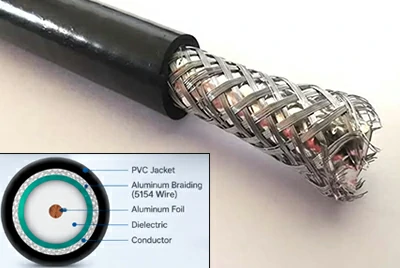
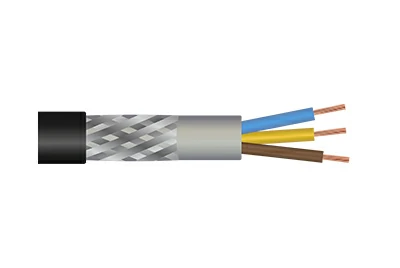
Cable braiding and shielding
Used for the braided shielding layer of coaxial cable, communication cable and electrical cable, combining lower weight, strength and continuous braiding performance.
Shipboard cable braid and armor
Can be used for braided armor structures in lightweight shipboard cable and is suitable for marine cable applications with higher requirements for weight control and corrosion performance.
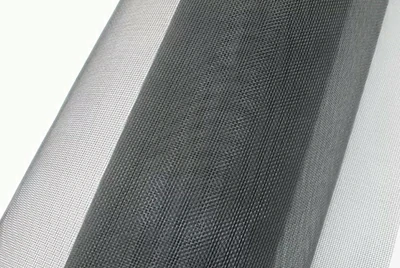
Wire mesh and insect screen
Suitable for aluminum wire mesh, insect screen and similar woven products, providing good mesh strength and structural stability.
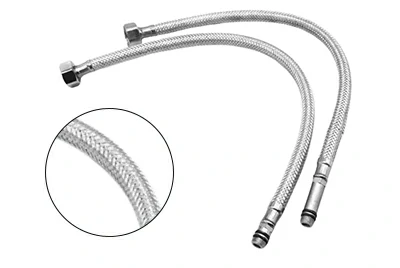
Hose reinforcement braid
Can be used as the metallic reinforcement braid for flexible hose, combining strength and flexibility under repeated bending.
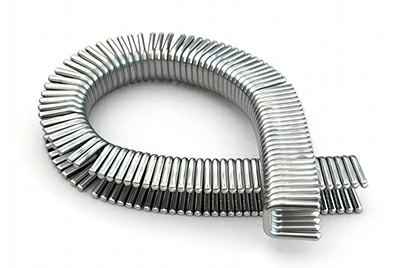
Cold heading and formed wire products
Can also be used for cold-headed or formed products such as fasteners, clips and staples, where ductility, surface quality and processing stability are important.
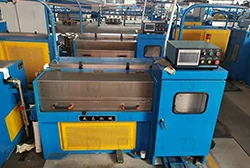
5154 aluminum wire production and quality control
The final properties of 5154 fine wire are closely related to drawing, heat treatment, surface condition and winding. For braiding wire in particular, consistency in wire diameter, mechanical properties and pay-off condition is important.
Wire-drawing process control
During multi-pass drawing of 5154 wire, lubrication, die alignment, slip and cooling conditions need to be controlled. The drawing process and final wire diameter both affect tensile and yield properties, so fine-diameter products require consistent process control.
Heat treatment and temper control
Annealing and work hardening are used to control O, H32, H34, H36 and H38 tempers so the wire obtains the corresponding tensile strength and elongation required for different braiding and processing applications.
Surface and winding control
Fine wire should have a clean surface with minimized scratches and residual lubricant. Stable traverse winding can reduce the risk of wire jumping, tangling or jamming during pay-off.
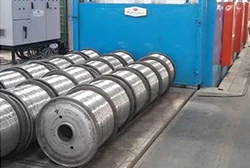
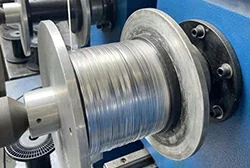
5154 aluminum wire spools and packaging
5154 fine wire and braiding wire are typically supplied on spools / bobbins to maintain orderly winding and continuous pay-off. Common commercial spool sizes are listed below:
| Spool size | Material | Rim diameter | Core diameter | Net wire weight |
| 4 inch | PP / ABS | 105 mm | 18 mm | 1.0 ± 0.055 kg |
| 5 inch | PP / ABS | 130 mm | 24 mm | 1.5 ± 0.055 kg |
| 6 inch | PP / ABS | 160 mm | 35 mm | 3.0 ± 0.055 kg |
| 7 inch | PP / ABS | 185 mm | 35 mm | 4.0 ± 0.055 kg |
| 8 inch | PP / ABS | 200 mm | 76 mm | 5.0 ± 0.055 kg |
For cable braiding projects, the spool size can be selected according to the braiding machine's spool diameter, core diameter, wire loading weight and traverse-winding requirements. Reel or drum supply can also be used when a larger wire load is required.
Key purchasing parameters for 5154 braiding wire
When purchasing 5154 braiding wire, key parameters include wire diameter, diameter tolerance, temper, tensile strength, elongation, electrical performance and spool / winding requirements. These parameters directly affect braiding stability, the risk of wire breakage and final shielding performance.
If your project has special requirements for fine-wire dimensions, mechanical properties or spool type, send the drawing, specification or application requirements to Chalco. We can help match a suitable 5154 aluminum wire solution based on the actual service conditions.
5154 aluminum wire FAQ
How fine can 5154 aluminum wire be drawn?
Chalco can supply fine 5154 aluminum wire with a minimum drawn diameter of 0.08 mm for cable braiding, shielding and precision braiding applications.
Is 5154 aluminum wire suitable for cable braiding?
Yes. 5154 combines good strength, ductility and corrosion performance and can be drawn to fine diameters such as 0.127, 0.160 and 0.180 mm. It is a commonly used Al-Mg alloy wire for coaxial cable and other shielding braid applications.
What are the common tempers for 5154 aluminum wire?
Common tempers include O, H32, H34, H36 and H38. If the project prioritizes flexibility and complex braiding, O temper can be considered first. If higher strength and greater tension capacity are required, an H-series temper can be selected according to the project requirements.
What is the difference between 5154 and 5052 aluminum wire?
Both are Al-Mg alloys, but 5154 has a higher Mg content and typically provides higher mechanical strength. 5052 places greater emphasis on flexibility and formability, while 5154 is more suitable for applications that require braiding performance, strength and structural stability together.
Are 5154 and 5154A the same alloy?
Not exactly. Their Mg content ranges are similar, but the control requirements for Si, Fe, Mn, Cr and other elements differ. Purchasing specifications should clearly state 5154 or 5154A together with the applicable material standard.
What standards can 5154 aluminum wire meet?
Standard 5154 aluminum wire can be supplied to ASTM B211/B211M. For specific cable braiding applications, wire diameter, mechanical properties and braiding requirements can be confirmed according to relevant ANSI/SCTE or MIL-DTL-24640 requirements.