Henan Chalco supplies Aluminum Foam Sandwich Panels for lightweight and multifunctional structural designs. Aluminum foam cores can be combined with aluminum sheet, stainless steel sheet, fire-resistant panels and decorative facings to meet requirements for structural stiffness, sound absorption and insulation, fire performance and surface appearance.
Henan Chalco can customize total thickness, aluminum foam core thickness, face and back sheet materials, pore structure and surface finishes according to project requirements, with different composite configurations available for wall panels, ceilings, partitions and other functional panel applications.
If your project has combined requirements for lightweighting, structural performance, acoustics or fire performance, contact Henan Chalco. We can match the aluminum foam core and composite structure to the actual service conditions.
What is an aluminum foam sandwich panel?
An Aluminum Foam Sandwich Panel is a lightweight composite panel with a porous aluminum foam core bonded to a dense face sheet on one or both sides. A typical structure is face sheet + aluminum foam core + back sheet. The aluminum foam not only reduces weight, but also provides support, energy absorption and acoustic functions for the overall composite structure.
The key difference from common PU, XPS and EPS foam sandwich panels is that the core itself is a porous structure made from metallic aluminum. Compared with a solid aluminum foam panel (/knowledge/porous-foam-sheet-plate/), the addition of a face sheet or back sheet can further improve surface strength, structural stability and compatibility with decorative finishes.
What structural types are available for aluminum foam sandwich panels?
The aluminum foam core can be combined with a facing on one side or both sides according to project requirements. The two structures differ in the number of face sheets, surface protection and overall structural performance.
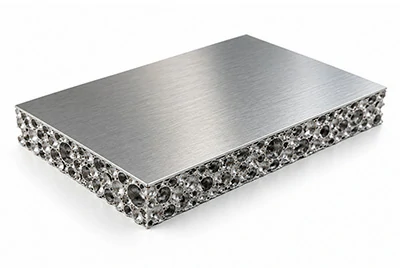
Single-sided composite structure
Single face sheet + aluminum foam core
A face sheet is added to only one side of the aluminum foam while the other side retains the exposed aluminum foam surface. This structure is suitable for projects requiring protection, decoration or an installation surface on one side.
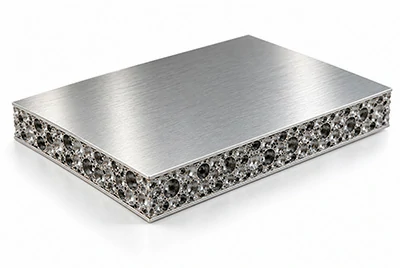
Double-sided sandwich structure
Face sheet + aluminum foam core + back sheet
Face sheets cover both sides of the aluminum foam core to form a complete sandwich structure. It maintains the lightweight advantage while providing better overall stiffness, stability and surface protection. The two face sheets can use the same or different materials.
Aluminum foam sandwich panel facing materials
Henan Chalco can combine aluminum foam cores with aluminum sheet, stainless steel sheet, steel sheet, fire-resistant panels and other facing materials. The choice of facing is not simply an appearance change; it also affects panel weight, durability and the intended service environment.
| Facing material | Main advantages | More suitable projects |
| Aluminum sheet | Lightweight, corrosion resistant and high strength-to-weight ratio. Combined with an aluminum foam core, it retains the lightweight advantage of an all-aluminum structure. | Wall panels, ceilings, partitions, transportation structures and modular structures where weight reduction is a priority |
| Stainless steel sheet | Excellent corrosion resistance and surface durability, with brushed, mirror and other metallic decorative finishes available for long-term exposure or appearance-critical surfaces. | Architectural decorative surfaces, public spaces, humid or corrosive environments, and projects requiring a highly durable surface |
| Steel sheet | Higher stiffness and resistance to mechanical damage. Where lightweight aluminum skins are not required on both sides, steel can strengthen local surface protection and structural support. | Projects that prioritize stiffness, impact resistance or surface protection over minimum weight |
| Fire-resistant panel | The aluminum foam core can be combined with a dedicated fire-resistant facing to integrate the lightweight sandwich structure with building fire-protection requirements. | Fire-resistant partitions, interior walls, ceilings and other indoor building projects with defined facing combustibility requirements |
If lightweighting is the priority, aluminum sheet is usually more suitable. Stainless steel can be selected where higher corrosion resistance and surface durability are required. Steel sheet is suitable where stiffness and mechanical protection are more important, while fire-resistant panels can be incorporated when the project has defined building fire-performance requirements.
The two sides of a double-sided sandwich structure can also use different materials and thicknesses to balance weight, structural performance and surface functions.
Core advantages of aluminum foam sandwich panels
- Lower structural weight: Common aluminum foam density is about 0.15-0.2 g/cm³, approximately 1/20 that of aluminum and 1/5 that of water. A composite structure can achieve about 50% weight reduction, making it particularly suitable for panels and modular structures where overall weight is critical.
- Strong sound absorption and noise reduction: The average noise reduction coefficient is about 0.75 and can reach up to 0.9, helping improve indoor acoustics by reducing reflected noise and reverberation.
- Stable sound insulation: Average sound insulation is about 30 dB, improving sound blocking while maintaining a lightweight structure.
- High energy absorption and cushioning: Aluminum foam can reach more than 70% of the ideal energy-absorption curve. The porous core continuously absorbs energy under impact and compression, providing cushioning and impact protection for the structure.
- Higher lightweight structural efficiency: At the same weight, the relevant performance can reach 5 times that of steel and 2 times that of aluminum, helping maintain strong structural support while reducing weight.
- Strong electromagnetic shielding: The continuous conductive structure of metallic aluminum foam provides excellent electromagnetic shielding, with shielding capability increased by up to 1,000 times for projects requiring greater control of the electromagnetic environment.
- Fire performance and thermal insulation: The material has an A+ flame-retardant rating together with good thermal insulation, supporting higher fire-safety requirements in buildings and functional spaces.
- Low moisture absorption for long-term use: Mass moisture absorption W1 <0.1% and volumetric moisture absorption W2 <0.1%, reducing the risk that absorbed moisture will affect long-term stability.
- Good corrosion and weather resistance: Aluminum foam itself provides good corrosion and weather resistance for long-term projects requiring environmental stability.
If your project requires a combination of weight reduction, sound absorption and insulation, fire performance, energy absorption or electromagnetic shielding, the aluminum foam core parameters, facing materials and sandwich structure can be matched to the actual service conditions. Contact Henan Chalco for an Aluminum Foam Sandwich Panel solution for your project.
Aluminum foam sandwich panel bonding methods
Henan Chalco can use adhesive bonding or brazing according to the facing material and service environment. The joining method not only determines how securely the facing is bonded to the aluminum foam core, but also affects panel temperature resistance, fire performance, durability and interface stability.
Adhesive bonding
A high-strength adhesive forms a continuous bonding layer between the aluminum foam core and the facing. The process temperature is low and it offers strong compatibility with different facing materials, making it suitable for metal sheets, functional panels and decorative facings.
The key factors are adhesive-layer continuity and interfacial bond strength. For long-term high-temperature, fire-sensitive or thermal-cycling environments, the heat resistance, aging resistance and flame-retardant properties of the adhesive also require particular attention. Studies indicate that interface aging and debonding are among the typical long-term risks of adhesively bonded AFS.
Brazed bonding
Brazing creates a metallic joint between the facing and the aluminum foam core through a filler metal, avoiding an organic adhesive layer. It is more suitable for all-metal sandwich structures and projects with higher requirements for temperature resistance, fire performance and interface stability.
Brazing quality is mainly affected by oxide-layer treatment, filler metal, heating temperature and holding time. Improper temperature or time control may result in insufficient filler-metal melting or overheating of the aluminum foam core and facing, so interface-process control is critical to joint quality.
How to choose the bonding method?
- Different facing materials, decorative composites or processing flexibility prioritized: Adhesive bonding is generally more suitable.
- All-metal structure with higher temperature and fire-performance requirements: Brazed bonding is generally more suitable.
- Higher structural load or long-term reliability requirements: In addition to the bonding method, peel strength, interface integrity and long-term delamination risk should be verified.
Typical aluminum foam sandwich panel thicknesses and configurations
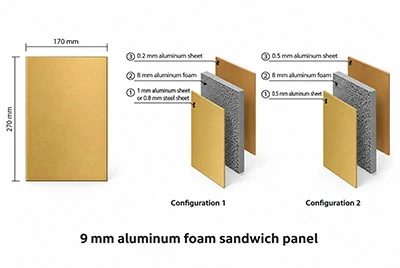
9 mm aluminum foam sandwich panel
Primarily a lightweight metal sandwich structure, for example 0.5 mm aluminum sheet + 8 mm aluminum foam + 0.5 mm aluminum sheet. A thicker aluminum or steel face sheet can also be combined with a thin aluminum back sheet to balance lightweighting and surface support.
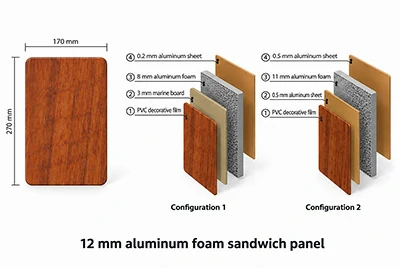
12 mm aluminum foam sandwich panel
A typical configuration can use an 11 mm aluminum foam core + 0.5 mm aluminum sheet on both sides. Marine-grade board and a PVC finish can also be added to combine sandwich structure and decorative requirements.
18 mm aluminum foam sandwich panel
Uses a thicker aluminum foam core that can be combined with aluminum sheet or marine-grade board, with finishes such as natural wood veneer added where a thicker structure and decorative appearance are required.
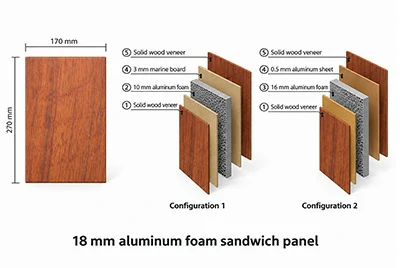
Aluminum foam sandwich panel surface and decorative options
An aluminum foam sandwich panel can use a metal facing as the final exposed surface, or a decorative layer can be added over the facing or substrate so the lightweight sandwich structure also meets interior design and appearance requirements.
Metal surfaces
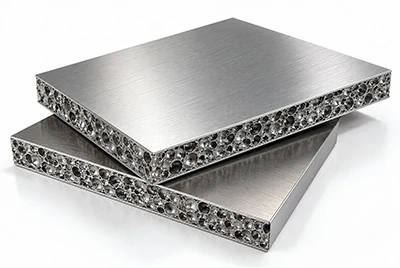
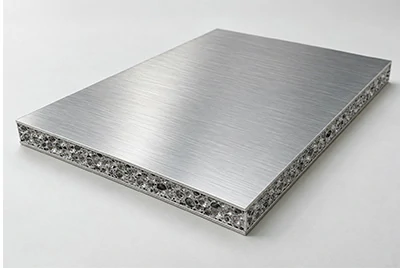
Aluminum and stainless steel facings can be used directly as exposed surfaces, retaining a clean metallic appearance suitable for architectural wall panels, ceilings and other modern-style projects.
PVC film finish
PVC finishes can be combined with substrates such as aluminum sheet or marine-grade board to provide wood-grain, solid-color and other decorative effects while retaining the internal aluminum foam core structure. A 12 mm composite panel, for example, can use a structure such as PVC film + 3 mm marine-grade board + 8 mm aluminum foam + 0.2 mm aluminum sheet.
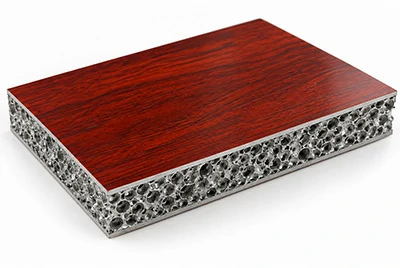
Natural wood veneer
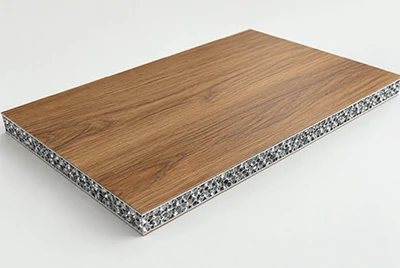
Natural wood veneer can be used where a more natural wood appearance is required. An 18 mm structure can combine wood veneer with marine-grade board or aluminum sheet and an aluminum foam core, providing both lower weight and a wood decorative finish.
Henan Chalco can match the decorative layer and substrate combination to the required surface appearance, service environment and panel structure, ensuring that decorative requirements remain compatible with the structural needs of the sandwich panel.
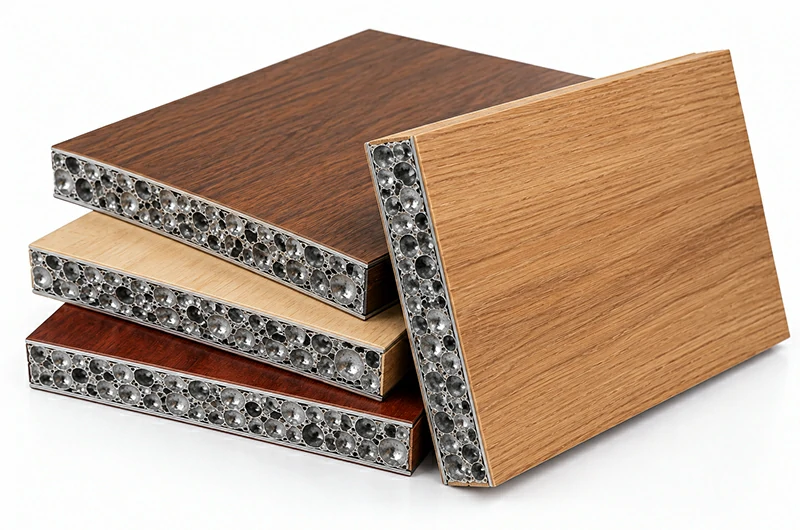
Aluminum foam sandwich panel applications
Aluminum foam sandwich panels can be used for exterior walls, interior walls, partitions, ceilings and prefabricated building-envelope systems, reducing structural weight while also addressing stiffness, fire performance, sound insulation and weather resistance.
-
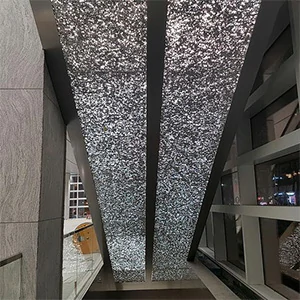 Acoustic walls and ceilings
The porous aluminum foam core can be combined with a perforated face sheet for sound-absorbing wall and ceiling systems in theaters, gymnasiums, conference spaces and similar venues, addressing sound absorption, sound insulation and reverberation control.
-
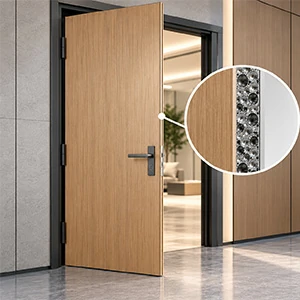 Door panels and functional doors
The aluminum foam sandwich structure can be used as a lightweight door panel or door core for door systems requiring a combination of weight reduction, sound insulation, fire performance and decorative surfaces.
-
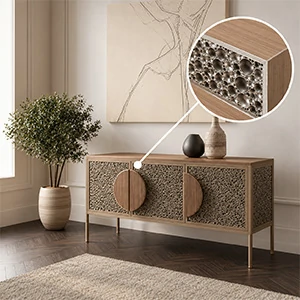 Furniture and cabinetry
The aluminum foam core can be combined with aluminum sheet, marine-grade board, PVC or wood finishes for cabinets, furniture panels and interior decorative panels, reducing panel weight while providing multiple surface effects.
-
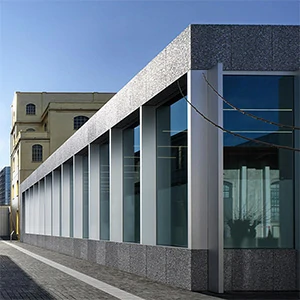 Building envelope systems
Suitable for exterior walls, interior walls, partitions, ceilings and prefabricated building-envelope systems. The aluminum foam sandwich structure can integrate lightweighting, structural support, fire performance, sound insulation and weather resistance while adapting to dry-hanging, framing and modular assembly methods.
Solid aluminum foam panel vs. aluminum foam sandwich panel
| Comparison item | Solid aluminum foam panel | Aluminum foam sandwich panel |
| Panel thickness | Common open-cell aluminum foam thicknesses: 9.5, 12.7, 25.4 and 43.2 mm; closed-cell aluminum foam: 6-300 mm | Common total thicknesses: 9, 12 and 18 mm; custom structures available |
| Finished size | Common sizes: 500 x 500, 500 x 1000 and 600 x 1200 mm; larger sizes available | Sizes such as 2000 x 500 mm are available, with customization to project dimensions |
| Pore structure | Open-cell aluminum foam pore size about 5-10 mm; closed-cell aluminum foam pore size about 3-10 mm | Aluminum foam core pore structure can be adjusted and combined with perforated facings for functional design |
| Sound absorption | Open-cell aluminum foam NRC >0.75; some structures have a sound absorption coefficient of about 0.70-0.75 | Average NRC about 0.75, up to 0.9 |
| Sound insulation | A 20 mm closed-cell aluminum foam structure can provide about 20-40 dB sound insulation | Average sound insulation about 30 dB |
| Density | Open-cell aluminum foam about 0.2-0.5 g/cm³; closed-cell aluminum foam about 0.3-0.75 g/cm³ | Common aluminum foam core density about 0.15-0.2 g/cm³ |
| Structure | Single aluminum foam panel relying mainly on the aluminum foam itself for performance | Single-sided composite or double-sided sandwich structure, with the facing and aluminum foam core working together |
| Overall stiffness and surface protection | The porous surface is directly exposed; overall stiffness and resistance to surface damage depend mainly on the aluminum foam itself | Dense face sheets can increase overall panel stiffness and protect the aluminum foam core, making the product more suitable for panel-type structures |
| Surface and decorative options | Primarily displays the porous metallic appearance of aluminum foam | Can use aluminum, stainless steel, steel or fire-resistant facings, plus PVC, wood veneer and other composite surface finishes |
| More suitable requirements | More suitable where sound absorption, electromagnetic shielding, porous-metal appearance and the inherent functions of aluminum foam are emphasized | More suitable for projects requiring lightweighting, structural support, surface protection, decoration and multifunctional integration |
How to choose the right aluminum foam sandwich panel?
When selecting an Aluminum Foam Sandwich Panel, first define the project's primary requirements and then match the panel structure, rather than comparing total thickness alone.
- Lightweighting first: Prioritize aluminum facings with a low-density aluminum foam core, focusing on core density, facing thickness and total panel weight.
- Overall stiffness first: Use a double-sided sandwich structure, increasing face-sheet support and selecting a suitable core thickness to improve overall panel stability.
- Sound absorption and noise reduction first: Focus on aluminum foam pore structure, core thickness and facing type. For higher acoustic requirements, a perforated facing can be used.
- Fire performance first: Prioritize metal or fire-resistant facings and select an appropriate adhesive or brazed bonding method according to service temperature and required fire rating.
- Corrosion resistance and surface durability first: Aluminum or stainless steel can be used as the outer facing, with the surface treatment selected according to the actual environment.
- Decorative appearance first: PVC, natural wood veneer and other finishes can be added over the sandwich structure to combine lightweighting with interior decorative effects.
- Panel thickness: 9 mm is more suitable for thin, lightweight structures; 12 mm can balance structural and decorative composite requirements; 18 mm can use a thicker aluminum foam core and multilayer finishes where greater overall thickness and surface effect are required.
For projects with multiple requirements such as lightweighting, structural performance, acoustics, fire performance or decorative appearance, Henan Chalco can match the aluminum foam core parameters, facing materials and composite structure to the actual service conditions.
Aluminum foam sandwich panel FAQ
Is an aluminum foam sandwich panel the same as a conventional foam-core sandwich panel?
No. The core of an Aluminum Foam Sandwich Panel is metallic aluminum foam, while conventional foam-core sandwich panels typically use polymer cores such as PU, XPS or EPS. In addition to reducing weight, the aluminum foam core provides the characteristics of a porous metal material, including energy absorption, acoustic performance, fire performance and electromagnetic shielding.
What is the difference between an aluminum foam sandwich panel and a solid aluminum foam panel?
A solid aluminum foam panel consists only of aluminum foam and directly exposes the porous metallic surface. An Aluminum Foam Sandwich Panel adds a facing on one or both sides of the aluminum foam core, which can further improve overall stiffness, surface protection and compatibility with decorative finishes.
Can the facing material be customized?
Yes. Aluminum sheet, stainless steel sheet, steel sheet, fire-resistant panels and other facing materials can be selected according to the project. PVC, wood veneer and other surface layers can also be added for decorative requirements. The final combination should be determined according to weight, environment and functional requirements.
What thicknesses are commonly available?
Common structures include 9 mm, 12 mm and 18 mm panels. Each thickness can use different aluminum foam core, facing and decorative-layer combinations, and the structure can also be adjusted to project requirements.
Can both adhesive bonding and brazing be used?
Yes. The bonding method can be selected according to the structure and service environment. Adhesive bonding is more suitable for combining different facing materials, while brazing is more suitable for all-metal structures and projects with higher requirements for temperature resistance, fire performance and interface stability.
Can aluminum foam sandwich panels be cut and further processed?
Yes. Cutting, hole making, edge treatment and other processing can be performed according to the final structure. The specific processing method should account for the facing material, aluminum foam core and bonding method to avoid damaging the sandwich structure or bonded interface.
How do I determine which structure my project needs?
First define the project's most important objective, such as weight reduction, stiffness, sound absorption and insulation, fire performance, corrosion resistance or decorative appearance. Then determine the aluminum foam core parameters, facing material, total thickness and bonding method instead of selecting only by price or panel thickness.
Aluminum foam sandwich panel quote information
For a quotation, please provide the application, panel dimensions, total thickness, facing material, aluminum foam core requirements, surface finish, target performance, purchase quantity and delivery schedule. If the full structure has not yet been determined, you can first provide the main application and key performance requirements. Henan Chalco can then match a suitable core, facing and composite solution and provide a project-specific quotation.
Chalco can provide you the most comprehensive inventory of aluminum products and can also supply you customized products. Precise quotation will be provided within 24 hours.
Get a quote