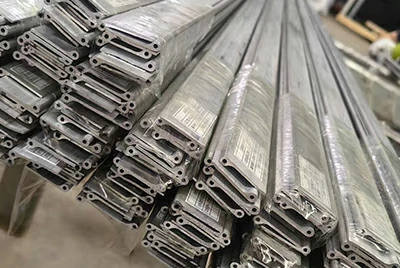
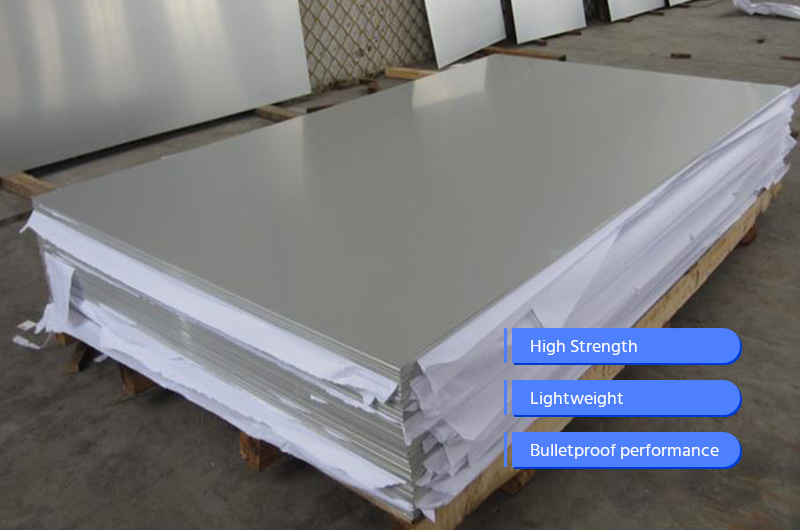
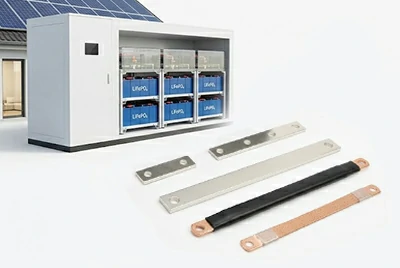
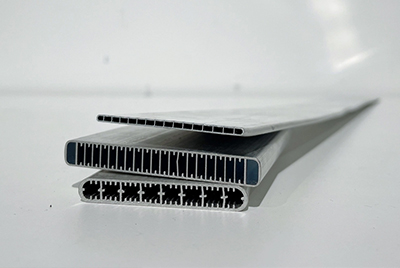
Copper clad aluminum busbar can be used as the main conductor in busway / busbar trunking systems. While meeting busway current-carrying and connection requirements, it can help reduce conductor weight and copper usage, making it suitable for compact, plug-in and high-current busway systems.
Chalco can provide straight, wide-format and specially formed copper clad aluminum conductors for straight sections, elbows, tees, offsets, joints and other busway configurations.
Cut-to-length processing, punching, bending and special forming are available based on customer drawings. Suitable specifications can be determined by considering rated current, allowable temperature rise and conductor arrangement.
Common CCA busbar configurations for busway systems
Copper clad aluminum busbars in busway systems can be fabricated into different configurations for straight power transmission, changes in direction, branches and connection points to suit the internal conductor layout and available installation space.
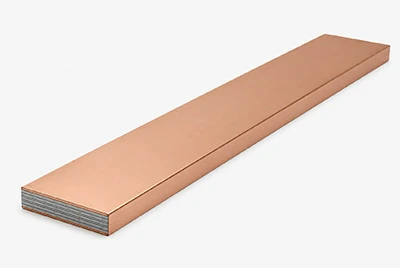
Straight busbar
Used in straight busway sections as a continuous current-carrying conductor. Width, thickness and length can be customized according to rated current, conductor arrangement and available internal busway space.
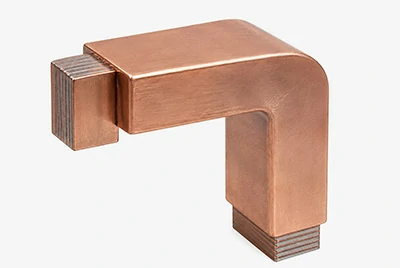
Bent and formed busbar
Used at elbows, offsets and other changes in direction. It can be formed into L-shaped, Z-shaped or multi-bend configurations according to the busway route, reducing splices at complex locations.
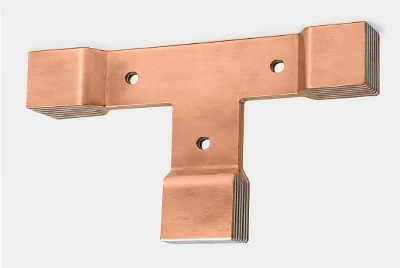
Tee / branch busbar
Used at busway branch positions to connect the main conductor to branch circuits. T-shaped or other branch configurations can be customized according to branch direction, phase spacing and available installation space.
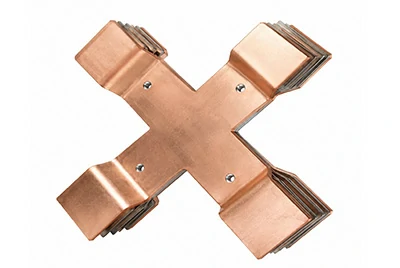
Cross / four-way branch busbar
Used at multidirectional busway branch positions to connect the main conductor in four directions. The overall profile, bent ends and connection holes can be customized according to the busway layout, reducing splices at complex branch points.
Stepped / formed busbar
Used at busway connections or specific installation positions. A stepped profile and bent ends can accommodate different connection heights and structural clearances. Hole positions, end shapes and overall dimensions can be machined to drawings.
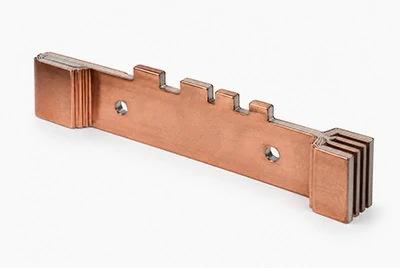
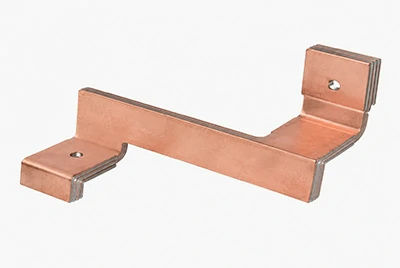
Offset / bent busbar
Used where busway connections have height differences or positional offsets. A bent configuration provides conductor transition and is suitable for space-constrained installations or busway layouts with changing installation paths.
Chalco can provide cut-to-length, punching, bending and forming for straight and specially shaped CCA conductors based on the busway layout, conductor dimensions and customer drawings.
CCA busbar specifications and selection for busway systems
Copper clad aluminum busbar for busway systems should be selected according to rated current, conductor cross-section, copper ratio and allowable temperature rise. The following dimensions can be used as references for different current ratings.
Rated current and conductor cross-section
As rated current increases, CCA busbar generally requires a larger effective cross-section. In addition to increasing width and thickness, multiple parallel conductors can also be used where the internal busway space allows.
Copper ratio
Common copper volume ratios for CCA busbar include 20%, 25% and 30%. Different copper ratios correspond to different electrical properties and should be selected together with the target current-carrying capacity and temperature-rise requirements.
Do not replace a copper busbar with the same-size CCA busbar
CCA busbar has lower electrical conductivity than pure copper. Therefore, when replacing an existing copper busbar with a CCA conductor, the conductor cross-section and arrangement generally need to be recalculated rather than keeping the same width × thickness.
Temperature rise
At the same rated current, conductor width-to-thickness ratio, arrangement, joint contact condition and busway heat dissipation all affect temperature rise. Final dimensions should be confirmed against the temperature-rise requirements of the complete busway assembly.
Main advantages of CCA busbar in busway systems
Copper clad aluminum busbar combines the lower weight of an aluminum conductor with the electrical and connection characteristics of a copper surface. It can be used in compact busways and high-current busway systems, with advantages in weight reduction, conductor-section design and special-shape forming.
Lower conductor weight
CCA busbar has a specific gravity of about 3.94, significantly lower than pure copper. This can reduce the weight of the conductors and the complete busway section, lowering transportation, lifting and installation loads.
Lower voltage drop and conductor loss
Compared with a conventional aluminum conductor, copper clad aluminum conductor provides higher electrical conductivity and can reduce voltage drop and conductor loss during busway operation. It is more suitable for compact busways with higher current-carrying requirements.
Integrated forming for special-shaped conductors
Right-angle bends, T-shaped branches, four-way branches and other complex conductors can be cut and formed as integrated parts according to customer drawings. This can reduce welding and multi-piece assembly at complex locations and improve manufacturing efficiency for special-shaped busbars.
Support for 800 mm+ wide conductors
The cast-rolling process can provide strip widths above 800 mm, exceeding the approximately 250 mm width limitation of conventional extruded profiles. By optimizing the conductor section through a thinner and wider design, the number of parallel conductors can be reduced. The referenced design can support a 3150 A busway with a single-row conductor.
Reduced copper usage and material cost
At the same weight, the conductor volume of a CCA conductor can be about 226% of that of a copper conductor. For large-section and high-volume busway projects, copper usage can be substantially reduced while meeting conductor design requirements, helping lower overall material cost.
Typical applications of copper clad aluminum busway
Copper clad aluminum busway is suitable for low-voltage distribution systems requiring high-current transmission, long-distance power distribution and lower installation weight. It can be used for main power distribution in buildings, industrial facilities and data infrastructure.
-
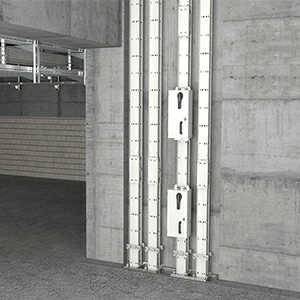 High-rise vertical distribution
Suitable for vertical riser busway in high-rise residential buildings, office buildings and hotels. The lower conductor weight can reduce the load associated with lifting and support between floors.
-
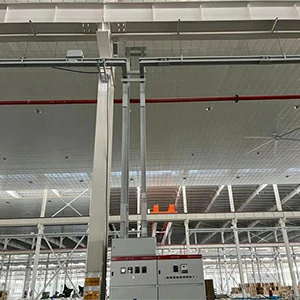 Industrial plants
Used for main power distribution in production workshops, automated factories and large equipment installations. Straight, elbow and branch busway sections can connect different production areas and electrical loads.
-
 Data centers
Suitable for plug-in busway in server rooms and data centers. Main distribution lines can be routed along cabinet rows, with tap-off units supplying individual cabinets or distribution units.
-
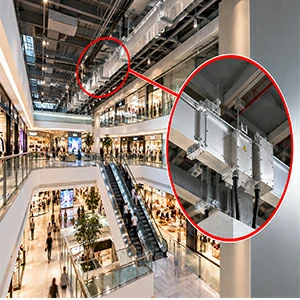 Commercial buildings
Can be used for floor and area distribution in shopping malls, office buildings, hospitals and large public buildings, particularly where there are many load points and long distribution distances.
-
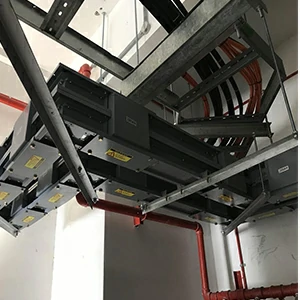 High-current distribution systems
Suitable for high-capacity power transmission between substation outgoing circuits, distribution rooms and large low-voltage equipment. CCA busbar cross-sections and busway structures can be designed for current ratings such as 1600 A, 2000 A and 3150 A.
Why do high-current busways use wide CCA busbars?
When the busway rated current increases to 1600 A, 2000 A or higher, the conductor requires a larger effective cross-section. Compared with increasing thickness alone, increasing busbar width provides both a larger conductor cross-section and more heat-dissipation surface area.
Wide-format capability
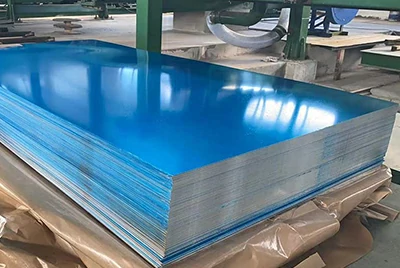
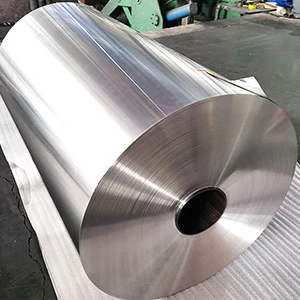
Copper clad aluminum material can be produced in widths above 800 mm. Compared with the approximately 250 mm width limitation of conventional extruded profiles, this provides a wider single-conductor option for high-current busway systems.
More flexible conductor arrangement
Where the internal busway space allows, wide CCA busbar can reduce reliance on multiple parallel conductors, simplifying conductor arrangement and connection structures.
Custom dimensions for the busway
Wide busbars can be cut to length, profiled and drilled according to rated current, busway internal width, conductor spacing and joint locations. They are suitable for high-current compact busways and custom busway systems.
What is the difference between copper busway and copper clad aluminum busway?
The difference between a pure copper busway and a copper clad aluminum busway is not limited to conductor material. It also affects busbar cross-section, system weight, connection design and overall cost.
| Comparison item | Copper busway | Copper clad aluminum busway |
| Conductor structure | Solid copper busbar | Aluminum core + continuous copper layer |
| Conductivity | Approx. 100% IACS | Typically approx. 67.6%-70% IACS |
| Conductor cross-section | Usually smaller at the same current | Usually requires a larger effective cross-section |
| Conductor weight | Higher | Significantly lower |
| Copper usage | High | Substantially reduced |
| High-current design | Can use a more compact cross-section | Can meet current requirements by increasing width, cross-section or using parallel conductors |
| Joint contact | Copper-to-copper contact | Outer copper layer can be used as the contact surface |
| Special-shape fabrication | Cutting, punching and bending available | Cutting, punching, bending and integrated special forming available |
| Material cost | More sensitive to copper prices | Lower copper content provides more flexibility in cost control |
Why can't CCA busbar directly replace a copper busbar of the same size?
Different conductivity requires a different conductor cross-section
The volumetric conductivity of pure copper is about 100% IACS, with a resistivity of about 0.01724 Ω·mm²/m at 20°C. CCA busbar with a common copper volume ratio of 20%-30% has conductivity of about 67.6%-70% IACS and resistivity of about 0.02455-0.02550 Ω·mm²/m at 20°C.
Therefore, a CCA busbar of the same cross-section has higher resistance than a copper busbar. Replacing copper with CCA generally requires increasing the conductor cross-section rather than retaining the original dimensions.
Copper ratio affects conductor design
With reference to ASTM B1005, Chalco classifies electrical CCA busbar by copper volume ratio as 20%, 25% and 30%, with annealed and hard-worked conditions available for each category.
As copper volume increases, conductivity also increases. For example, the typical conductivity of a 20% Cu product is about 67.6% IACS, while a 30% Cu product can reach about 70% IACS. Therefore, the CCA copper ratio should be defined before determining the busway conductor cross-section.
Higher rated current requires a larger conductor cross-section
Busway conductor dimensions increase with rated current. Reference busway designs include:
| Busway rated current | CCA busbar size (T × W) |
| 500 A | 3 × 60 mm |
| 630 A | 3 × 75 mm |
| 800 A | 3 × 95 mm |
| 1000 A | 3 × 125 mm |
| 1250 A | 3 × 160 mm |
| 1600 A | 3 × 200 mm |
| 2000 A | 3.3 × 250 mm |
Temperature rise and short-circuit capability must be considered together
The final CCA busbar specification should also be determined by considering allowable temperature rise, short-circuit withstand current and busbar support spacing.
For high-current or high-short-circuit-current busways, conductor cross-section, arrangement and support structure should be confirmed together rather than selecting busbar dimensions only from rated current.
Custom special-shaped CCA busbars for busway systems
Elbow, branch, offset and connector positions in busway systems often require specially shaped conductors. Copper clad aluminum busbars can be fabricated according to the busway layout and customer drawings.
- Cutting and profiling: L-shaped, Z-shaped, T-shaped, stepped and multidirectional branch structures can be produced, with section lengths, bend angles and overall profiles controlled to drawing requirements.
- Punching and drilling: Joint holes, bolt holes and mounting holes are available. Hole positions, spacing and edge distances can be customized for the connection structure.
- Bending: Wide-edge bending and complex forming are available. For 90° wide-edge bends, the bend diameter is typically not less than 2 × busbar thickness.
- Integrated forming: Complex elbow, offset and branch conductors can be formed as integrated parts according to drawings, reducing welding and multi-piece assembly.
CCA busbar connection considerations for busway systems
Contact surface
Keep the contact surface flat and provide sufficient effective contact area to avoid increased contact resistance and temperature rise caused by localized poor contact.
Hole positions and end machining
Bolt holes, hole spacing and end dimensions should match the connector structure to prevent assembly deviations from affecting clamping force and effective contact area.
Copper-clad contact area
Connection points should use the intact copper layer as the contact surface wherever possible, avoiding machining that damages the primary conductive contact area.
Joint temperature rise
In existing connector tests, under low-to-medium current conditions, the temperature rise of copper clad aluminum conductor joints was about 1-2 K lower than that of copper busbar joints. High-current applications require particular attention to contact area and connection design.
Dissimilar-metal connections
Where a copper-aluminum transition component is involved, the contact interface should be handled according to the actual connection method rather than directly applying a conventional aluminum-busbar connection method to the CCA conductor.
Information required for a CCA busbar inquiry
For an inquiry, provide the busway rated current, busbar size, copper ratio, conductor structure, fabrication requirements, drawings and quantity. For specially shaped CCA busbars such as bent, branch, offset or connector parts, mark hole positions, bend locations, angles and end dimensions on the drawing to facilitate specification and fabrication review.
FAQ
Can a CCA busbar directly replace a copper busbar of the same size?
Direct replacement with the same dimensions is not recommended. The specification should be recalculated based on rated current, copper ratio, conductor cross-section and allowable temperature rise.
Can CCA busbar be bent and formed?
Yes. L-shaped, Z-shaped, offset and other formed configurations can be produced according to the busway design. The bend radius should be controlled and the integrity of the copper-aluminum interface should be checked during forming.
Can CCA busbar be used in high-current busways?
Yes. Higher current requirements can be met by increasing conductor width, adjusting the cross-section or using parallel conductors. Wide-format material can be supplied in widths above 800 mm.
Can CCA busbar be used for connector and joint components?
Yes. Contact surfaces, hole positions, end shapes and copper-aluminum transition parts can be machined according to connector drawings for connections between busway sections.
Can CCA busbar be customized to customer drawings?
Yes. Chalco supports cut-to-length processing, cutting, punching, drilling, bending and special forming, and can supply finished conductor parts according to busway drawings.