Chalco supplies aluminum angle bar in equal leg and unequal leg profiles for structural frames, brackets, corner reinforcement, architectural trim, equipment supports, and fabrication projects. Common options include 6061, 6063, 5052, 5083, and 7075 aluminum angle, with standard inch and metric sizes available.
Custom aluminum angle bar can be supplied according to drawings, including cut-to-length, drilling, slotting, CNC machining, bending, anodizing, and powder coating. Share your leg size, thickness, alloy, finish, length, and quantity to get a suitable quotation for project supply.
Aluminum Angle Bar Overview
Types: Equal / Unequal Leg
Sizes: Inch / Metric / Custom
Alloys: 6061 / 6063 / 5052 / 5083 / 7075
Processing: Cut / Drill / Slot / Bend
Finish: Mill / Anodized / Powder Coated
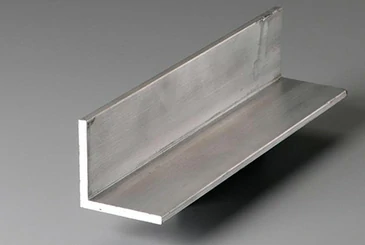
Aluminum Angle Bar Sizes Chart (Inch and Metric)
Chalco supplies aluminum angle bar in common inch and metric sizes for structural frames, brackets, fabrication parts, architectural trim, and project installation. Equal leg, unequal leg, standard size, and custom cut-to-length options can be discussed according to drawings or order requirements.
- Common inch sizes: 1×1, 1-1/2×1-1/2, 2×2, 3×3, 4×4, 6×6 aluminum angle
- Metric sizes: 20×20 mm, 25×25 mm, 30×30 mm, 40×40 mm, 50×50 mm, 60×60 mm
- Thickness options: light-duty profiles, general fabrication sizes, and heavier structural sections
- Leg configurations: equal and unequal aluminum angle sizes available. See how to choose the right configuration in the selection guide.
- Custom supply: cut-to-size, drilling, slotting, surface finish, and drawing-based production can be arranged for project orders
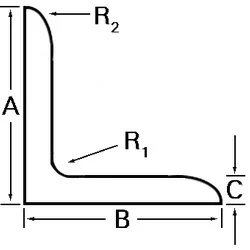
| Reference size for Structural Angle |
 |
|||
| Leg (A) | Leg (B) | Thickness (C) | Radius (R1) | Radius (R2) |
| 1 | 1 | 1/8 | .125 | .094 |
| 1 | 1 | 3/16 | .125 | .094 |
| 1 | 1 | 1/4 | .125 | .094 |
| 1 1/4 | 1 1/4 | 1/8 | .188 | .125 |
| 1 1/4 | 1 1/4 | 3/16 | .188 | .125 |
| 1 1/4 | 1 1/4 | 1/4 | .188 | .125 |
| 1 1/2 | 1 1/2 | 1/8 | .188 | .125 |
| 1 1/2 | 1 1/2 | 3/16 | .188 | .125 |
| 1 1/2 | 1 1/2 | 1/4 | .188 | .125 |
| 2 | 1 1/2 | 3/16 | .188 | .125 |
| 2 | 1 1/2 | 1/4 | .188 | .125 |
| 2 | 2 | 1/8 | .250 | .125 |
| 2 | 2 | 3/16 | .250 | .125 |
| 2 | 2 | 1/4 | .250 | .250 |
| 2 | 2 | 3/8 | .250 | .125 |
| 2 1/2 | 2 | 1/4 | .250 | .125 |
| 2 1/2 | 2 1/2 | 3/16 | .250 | .125 |
| 2 1/2 | 2 1/2 | 1/4 | .250 | .125 |
| 2 1/2 | 2 1/2 | 3/8 | .250 | .125 |
| 3 | 1 1/2 | 3/16 | .250 | .188 |
| 3 | 2 | 3/16 | .250 | .188 |
| 3 | 2 | 1/4 | .312 | .188 |
| 3 | 2 | 5/16 | .312 | .313 |
| 3 | 2 | 3/8 | .312 | .250 |
| 3 | 3 | 3/16 | .312 | .250 |
| 3 | 3 | 1/4 | .312 | .250 |
| 3 | 3 | 3/8 | .312 | .250 |
| 3 | 3 | 1/2 | .312 | .250 |
| 3 1/2 | 3 1/2 | 1/4 | .375 | .250 |
| 3 1/2 | 3 1/2 | 3/8 | .375 | .250 |
| 4 | 2 | 1/4 | .375 | .250 |
| 4 | 3 | 1/4 | .375 | .250 |
| 4 | 2 1/2 | 1/4 | .375 | .250 |
| 4 | 3 | 3/8 | .375 | .250 |
| 4 | 4 | 1/4 | .375 | .250 |
| 4 | 4 | 3/8 | .375 | .250 |
| 4 | 4 | 1/2 | .375 | .250 |
| 5 | 3 | 1/4 | .250 | .250 |
| 5 | 3 | 3/8 | .375 | .312 |
| 5 | 5 | 3/8 | .500 | .375 |
| 5 | 3 | 1/2 | .375 | .312 |
| 6 | 4 | 3/8 | .500 | .375 |
| 6 | 4 | 1/2 | .500 | .375 |
| 6 | 6 | 3/8 | .500 | .375 |
| 6 | 6 | 1/2 | .500 | .375 |
| 6 | 6 | 3/4 | .750 | .375 |
| 8 | 8 | 1/2 | .500 | .375 |
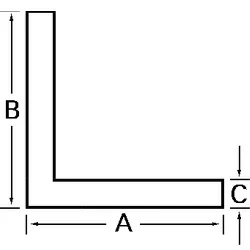
| Reference size for Sharp Corner Architectural Angle |
 |
|
| Leg (A) | Leg (B) | Thickness (C) |
| 1/2 | 1/2 | 1/8 |
| 1/2 | 1/2 | 1/8 |
| 3/4 | 3/4 | 1/8 |
| 1 | 3/4 | 1/8 |
| 1 | 1 | 1/8 |
| 1 1/4 | 1 1/4 | 1/8 |
| 1 1/2 | 1 | 1/8 |
| 1 1/2 | 1 1/2 | 1/16 |
| 1 1/2 | 1 1/2 | 1/8 |
| 1 1/2 | 1 1/2 | 3/16 |
| 2 | 1 | 1/8 |
| 2 | 1 1/2 | 1/8 |
| 2 | 2 | 1/8 |
| 2 | 2 | 3/16 |
| 2 | 2 | 1/4 |
| 3 | 1 | 1/8 |
| 3 | 3 | 1/4 |
Aluminum angle sizes are formed through extrusion, ensuring consistent dimensions and supporting custom configurations for different project requirements. Contact Chalco for size availability and project-based supply.
Equal Leg and Unequal Leg Aluminum Angle
Chalco supplies both equal leg aluminum angle and unequal leg aluminum angle for structural frames, brackets, equipment supports, architectural trim, and custom fabrication projects. The right choice depends on load direction, installation space, profile size, and drawing requirements.
-
Equal Leg Aluminum Angle
-
Unequal Leg Aluminum Angle
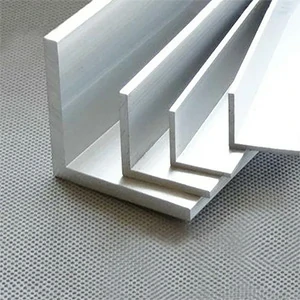
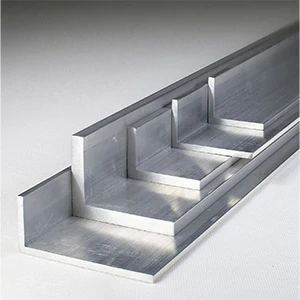
How to Select Equal or Unequal Aluminum Angle Bar
- Balanced support: choose equal leg aluminum angle for standard frames, brackets, and general structural use
- Directional support: choose unequal leg aluminum angle for offset mounting, asymmetric structures, or one-sided reinforcement
- Custom fabrication: select the profile according to leg size, thickness, alloy, cut length, holes, slots, and surface finish
Not sure which aluminum angle bar fits your project? Send your drawing, leg dimensions, thickness, alloy, finish, and application requirements. Chalco can help match suitable equal or unequal aluminum angle options for quotation.
Aluminum Angle Bar Alloy Options
Chalco supplies aluminum angle bar in multiple alloy options for structural frames, brackets, architectural trim, marine parts, outdoor installations, and custom fabrication projects. Alloy selection depends on required strength, corrosion resistance, surface finish, machining needs, and project environment.
Reference standards: ASTM B308; AMS-QQ-A-200/8
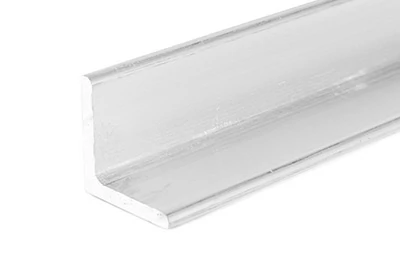
6061 aluminum angle is commonly selected for higher-strength frames, brackets, supports, machinery parts, and load-bearing fabrication. It offers good machinability, corrosion resistance, and structural performance for project use.
Reference standards: ASTM B221; AMS-QQ-A-200/9
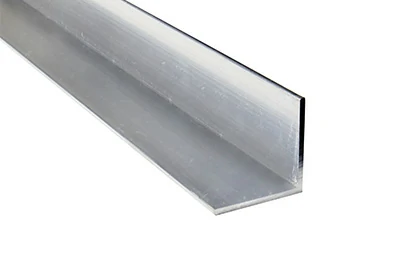
6063 aluminum angle is preferred for architectural trim, decorative profiles, display frames, edge protection, and projects requiring good surface quality. It is suitable for anodizing, powder coating, and visible installation areas.
Other aluminum angle alloys can be supplied according to strength, corrosion resistance, and application requirements:
- 2024 aluminum angle: high-strength option for aerospace, transport, and high-load structural applications
- 7075 aluminum angle: ultra-high-strength option for demanding structural and precision parts
- 5052 / 5083 aluminum angle: corrosion-resistant options for marine, outdoor, vehicle, and humid environments
Need to choose between 6061, 6063, 5052, 5083, 2024, 7075 or 7050 aluminum angle bar? Share your application, load requirement, finish, processing needs, and working environment. Chalco can help recommend a suitable alloy and supply form for quotation.
Custom Processed Aluminum Angle: Cut, Drilled, Slotted and Bent
Chalco supplies processed aluminum angle bar for projects that require ready-to-use parts instead of standard lengths only. Cutting, drilling, slotting, bending, perforation, and surface finishing can be arranged according to drawings, hole positions, installation layout, and assembly requirements.
-
Slotted Aluminum Angle
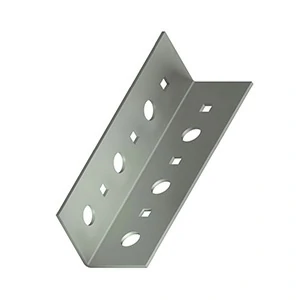
Slot size, spacing, and layout can be customized for adjustable frames, mounting systems, racks, brackets, and modular assemblies.
-
Bent Aluminum Angle
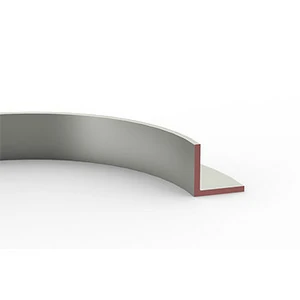
Bending and curved forming can be arranged for architectural structures, custom frames, edge profiles, and project-specific installation designs.
-
Pre-Drilled Aluminum Angle
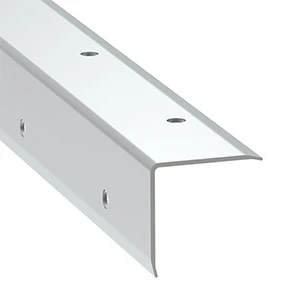
Hole diameter, hole position, and spacing can be processed before delivery to reduce on-site drilling and support faster installation.
-
Perforated Aluminum Angle
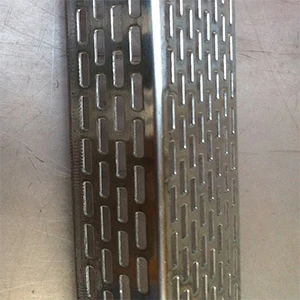
Custom hole patterns can support ventilation, drainage, weight reduction, decorative effects, and special assembly requirements.
Need aluminum angle cut to size or processed before delivery? Send your drawing, size, alloy, hole layout, slot details, bend requirement, finish, and quantity. Chalco can help review suitable processing options for your project.
Aluminum Angle Bar Applications by Project Use
Chalco supplies aluminum angle bar for structural, architectural, industrial, and outdoor project applications. Different alloys, leg configurations, processing methods, and surface finishes can be selected according to load requirements, installation position, appearance needs, and working environment.
For load-bearing or equipment support applications, 6061 aluminum angle is often selected for higher strength and machinability. For architectural trim and visible installation areas, 6063 aluminum angle is commonly used because of its good surface quality and finishing performance.
Construction & Framing Applications
Common Alloys: 6061 / 6063
Typical Forms: Equal / Unequal Leg
Processing: Cut / Drilled / Slotted
Uses: frames, brackets, edge protection, light structural supports
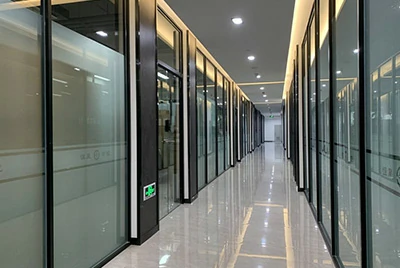
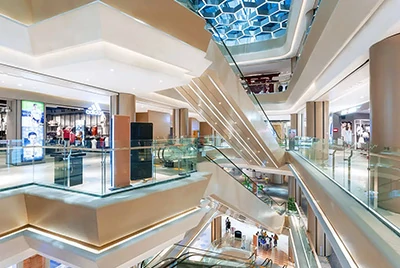
Architectural Trim & Edge Protection
Common Alloy: 6063
Surface Options: Anodized / Brushed / Powder Coated
Typical Forms: Small / Thin / Custom Cut
Uses: wall corners, stair edges, tile trims, interior detailing
Industrial Equipment & Support Structures
Common Alloys: 6061 / 7075
Processing: Cut-to-Length / Pre-Drilled / CNC Machined
Typical Forms: Structural / Heavy-Duty Sections
Uses: machine frames, racks, brackets, support parts
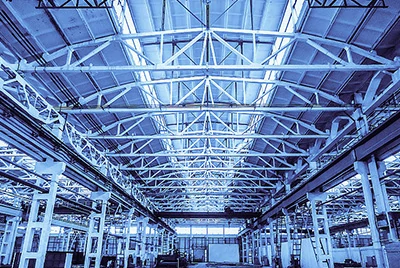

Outdoor & Energy Support Projects
Common Alloys: 6061 / 6063 / 5052 / 5083
Key Needs: Lightweight / Corrosion Resistance / Stable Dimensions
Surface Options: Mill / Anodized / Powder Coated
Uses: solar mounting, outdoor frames, support brackets, equipment bases
Aluminum Angle Application Gallery
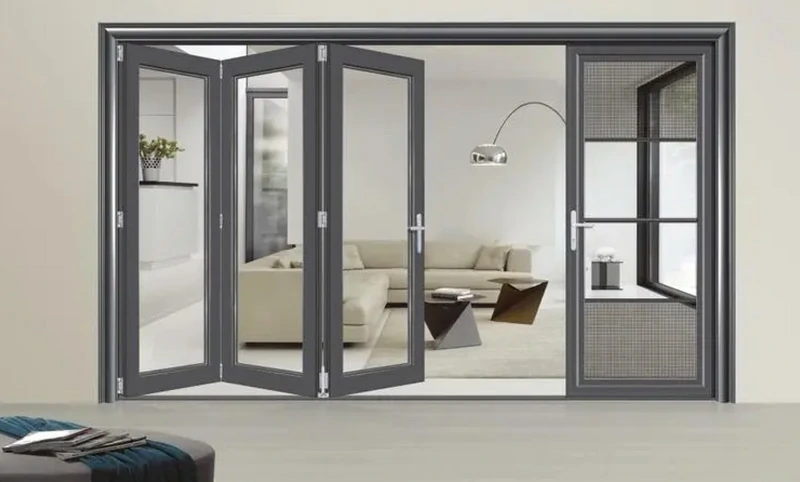
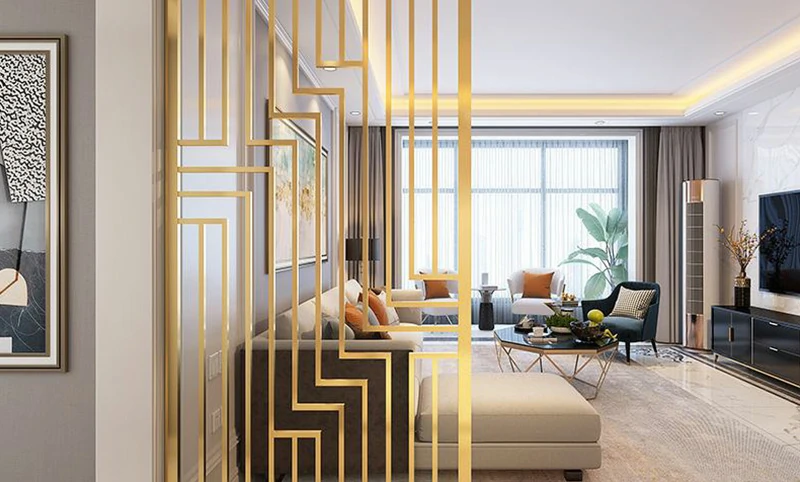
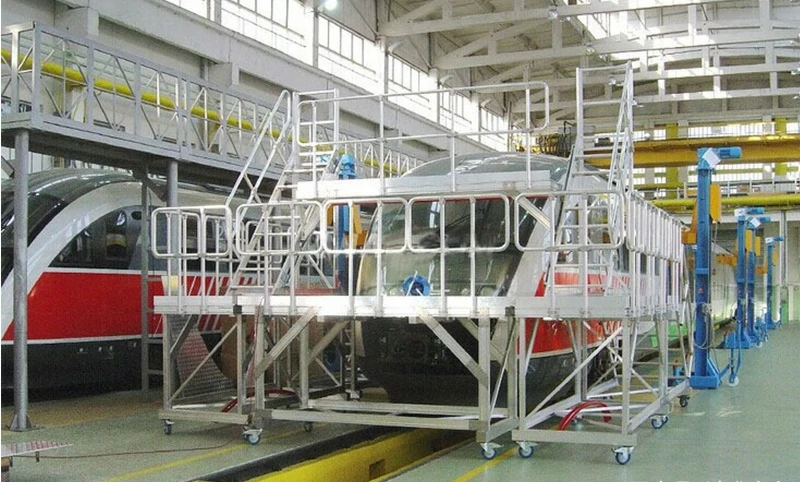



Have a structural, architectural, equipment, or outdoor support application? Share your application scene, load requirement, alloy preference, size, finish, processing needs, and quantity. Chalco can help match suitable aluminum angle bar options for your project.
Aluminum Angle Surface Finishes & Ready-to-Use Options
Chalco supplies aluminum angle bar with different surface finish options for structural, architectural, decorative, outdoor, and ready-to-install project requirements. Finish selection can be matched according to corrosion resistance, appearance, color consistency, installation environment, and fabrication needs.
Common options include mill finish, clear anodized, black anodized, brushed, polished, and powder coated aluminum angle. Powder coated aluminum angle can be supplied in white, black, and custom colors for projects requiring specific visual or design effects.
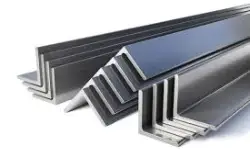
Mill Finish Aluminum Angle
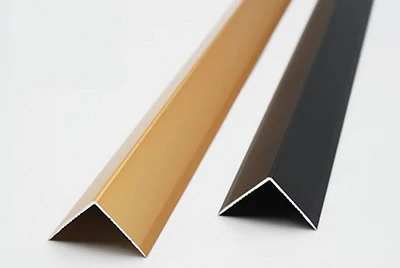
Clear Anodized Aluminum Angle
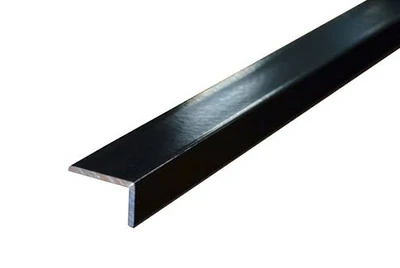
Black Anodized Aluminum Angle
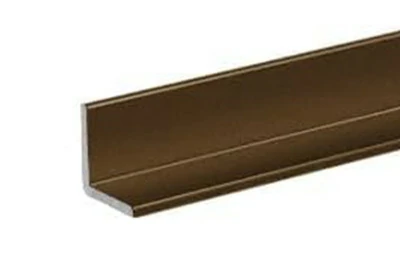
Powder Coated Aluminum Angle
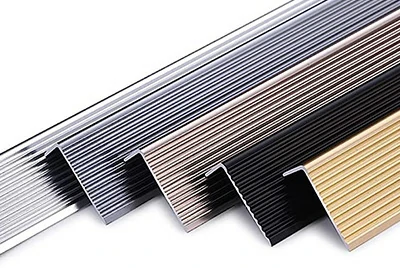
Brushed Aluminum Angle
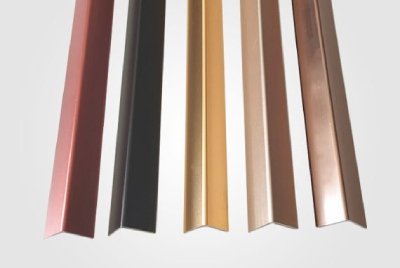
Polished Aluminum Angle
Need aluminum angle with a specific finish or color? Share your alloy, size, application environment, color requirement, processing details, and quantity. Chalco can help match suitable surface finish options for your project.
Aluminum Angle Manufacturing & Supplier Capabilities
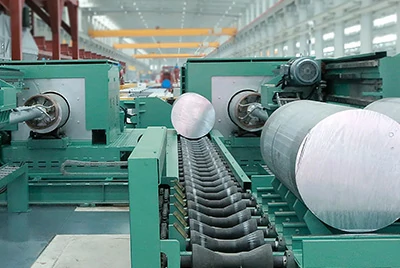
Chalco supports aluminum angle bar supply from extrusion and size matching to secondary processing, surface finishing, inspection, packaging, and project delivery. Equal leg, unequal leg, standard sizes, and drawing-based aluminum angle profiles can be arranged according to fabrication, structural, and installation requirements.
- Extrusion supply: equal leg aluminum angle, unequal leg aluminum angle, standard profiles, and custom extrusion options
- Size matching: inch sizes, metric sizes, thickness options, cut lengths, and project-specific dimensions
- Fabrication support: cutting, drilling, slotting, bending, CNC machining, and ready-to-install processing
- Surface finishing: mill finish, anodized, brushed, polished, and powder coated aluminum angle options
- Quality control: dimensional checking, surface inspection, processing review, and packaging confirmation before delivery
- Project supply: batch orders, drawing-based production, mixed specifications, export packaging, and delivery support
Need stable aluminum angle bar supply for a structural, architectural, industrial, or custom fabrication project? Send your drawings, size list, alloy, finish, processing details, packaging requirements, and order quantity. Chalco can help review suitable production and supply options.
Frequently Asked Questions About Aluminum Angle Bar
1. Is there an aluminum angle bar?
Yes. Aluminum angle bar is a 90-degree L-shaped aluminum profile available in equal leg and unequal leg configurations. It is commonly used for frames, brackets, corner reinforcement, edge protection, architectural trim, equipment supports, and custom fabrication projects.
2. What is the strength of aluminum angle bar?
The strength of aluminum angle bar depends on the alloy, temper, leg size, thickness, span, load direction, and installation method. 6061 aluminum angle is often selected for structural and load-bearing applications, while 6063 aluminum angle is commonly used for architectural and decorative projects where surface quality is important.
3. How strong is a 1×1 aluminum angle?
A 1×1 aluminum angle can be used for light frames, trim, brackets, edge protection, and general fabrication, but its actual load capacity depends on wall thickness, alloy, temper, unsupported span, and fastening method. For load-bearing use, it is better to confirm the size and application before ordering.
4. How strong is a 2×2 aluminum angle?
A 2×2 aluminum angle generally provides higher rigidity than smaller angle sizes and is often used for frames, supports, racks, brackets, and structural fabrication. The final strength still depends on thickness, alloy, temper, span, load direction, and installation design.
5. What aluminum angle bar sizes are available?
Aluminum angle bar is available in common inch sizes such as 1×1, 1-1/2×1-1/2, 2×2, 3×3, 4×4, and 6×6, as well as metric sizes such as 20×20 mm, 25×25 mm, 30×30 mm, 40×40 mm, 50×50 mm, and 60×60 mm. Custom sizes and cut-to-length supply can also be discussed according to project requirements.
6. What is the difference between equal and unequal aluminum angle?
Equal leg aluminum angle has two legs of the same length and is commonly used for balanced frames, brackets, and general structural support. Unequal leg aluminum angle has different leg lengths and is suitable for offset mounting, directional support, edge reinforcement, and custom assemblies.
7. Can aluminum angle bar be cut to size?
Yes. Aluminum angle bar can be supplied in standard lengths or cut to size before delivery. Drilling, slotting, bending, CNC machining, perforation, anodizing, and powder coating can also be arranged for ready-to-use project components.
8. Which alloy is better for aluminum angle, 6061 or 6063?
6061 aluminum angle is usually preferred for higher-strength frames, brackets, machinery parts, and load-bearing fabrication. 6063 aluminum angle is better suited for architectural trim, decorative profiles, edge protection, and applications requiring good surface quality or anodized finishes.
9. How much does aluminum angle bar cost?
Aluminum angle bar price depends on alloy, size, thickness, length, surface finish, processing requirements, order quantity, and packaging method. For accurate pricing, send the required leg size, thickness, alloy, finish, cut length, quantity, and drawing if processing is needed.
10. Can Chalco supply aluminum angle bar for bulk or project orders?
Yes. Chalco supplies aluminum angle bar for structural, architectural, industrial, outdoor, and custom fabrication projects. Standard sizes, equal and unequal profiles, multiple alloy options, surface finishes, cut-to-size processing, and export packaging can be arranged based on project requirements.
Aluminum Angle Supply and Ordering
Chalco supplies aluminum angle bar for standard size orders, custom cut-to-length requirements, drawing-based fabrication, and project-based procurement. Equal leg, unequal leg, inch sizes, metric sizes, multiple alloy options, surface finishes, and secondary processing can be arranged according to order requirements.
- Confirm profile type: equal leg aluminum angle, unequal leg aluminum angle, or custom extruded profile
- Confirm specifications: leg size, thickness, alloy, temper, length, surface finish, and quantity
- Confirm processing needs: cut-to-size, drilling, slotting, bending, CNC machining, perforation, or finishing
- Confirm project requirements: application, load condition, installation environment, packaging method, and delivery plan
Send your aluminum angle bar size list, alloy requirement, finish, processing details, drawings, and order quantity. Chalco can help review suitable supply options and provide a tailored quotation for your project.
Chalco can provide you the most comprehensive inventory of aluminum products and can also supply you customized products. Precise quotation will be provided within 24 hours.
Get a quote