Aluminum bus bars are essential conductive components used in power distribution systems, switchgear assemblies, renewable energy installations, and battery applications. With advantages in lightweight design, cost efficiency, and reliable electrical performance, aluminum busbars are widely adopted in medium- and high-current applications where conductivity, thermal stability, and structural reliability are critical.
As a professional aluminum bus bar manufacturer and global supplier, Chalco provides a comprehensive portfolio of EC-grade and structural alloys including 6101 (T61), 1350, 1060, 6061, 6063, and 6082. Backed by integrated casting, extrusion, machining, and surface treatment capabilities, we support customized production, stable bulk supply, and export-ready project delivery. Our long-term cooperation with leading transformer, switchgear, and energy equipment manufacturers reflects our proven quality control and reliable supply performance in global power projects.

Aluminum Busbar Grades & Alloy Options
-
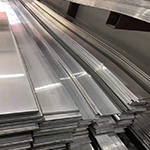 6101 EC Aluminum Bus Bar (T61) T6, T61, T63, T64, T65
6101 aluminum bus bar is a high-conductivity EC grade alloy widely used in switchgear and power distribution systems. Compared with 1350, it offers improved mechanical strength and better anti-creep performance.
High conductivity Anti-creep performance -
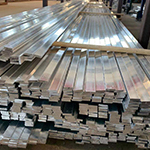 1350 EC Aluminum Bus Bar H14, H16, H19
1350 aluminum busbar contains a minimum of 99.5% aluminum and is widely recognized as an EC-grade conductor alloy, providing excellent electrical conductivity. It is commonly used in battery busbars and high-current applications.
Maximum conductivity Battery applications -
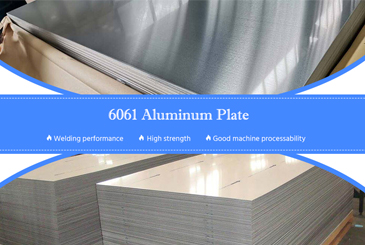
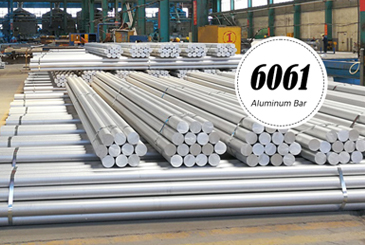
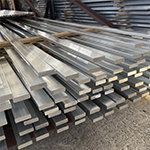 6061 Aluminum Bus Bar T4, T6
6061 aluminum bus bar offers a balance of conductivity and structural strength, making it suitable for applications requiring both electrical performance and mechanical stability.
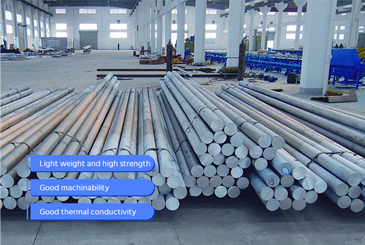
Structural strength Good machinability -
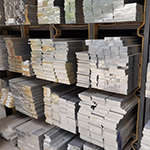 6063 Aluminum Bus Bar T5, T6, T66
6063 aluminum busbar is known for its excellent surface finish and extrusion performance. It is commonly used where aesthetic appearance and heat dissipation are important.
Surface finish Heat dissipation -
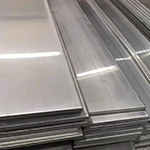 6082 Aluminum Bus Bar T4, T6
6082 aluminum bus bar provides higher mechanical strength while maintaining reliable electrical conductivity, suitable for heavy-duty industrial installations.
High strength Industrial grade -
1070 EC Aluminum Bus Bar
1070 aluminum bus bar offers very high electrical conductivity with excellent forming properties. It is commonly used in medium- and high-current electrical systems where conductivity is the primary requirement.
High conductivity Good formability -
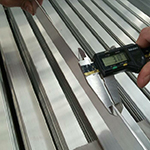 6060 Aluminum Bus Bar
6060 aluminum busbar provides a balance between electrical conductivity and extrusion performance. It is suitable for applications requiring smooth surface finish and lightweight structural design.
Lightweight Excellent extrusion -
Custom Aluminum Bus Bar
Custom aluminum bus bars are available in various sizes, thicknesses, and surface treatments including tin plated aluminum bus bar options to meet specific project requirements.
Custom sizes Tin plated option
Aluminum Tubular Busbar (Bus Pipe)
Aluminum busbars are typically supplied in flat bar form. For high-current and substation applications, aluminum tubular busbars (aluminum bus pipes) provide an alternative structural solution.
Compared with flat bars, tubular busbars offer greater rigidity, improved heat dissipation, and reduced corona effects, making them suitable for long-span and outdoor high-voltage systems.
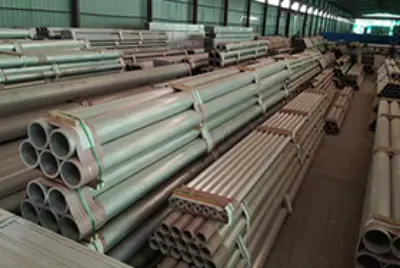
Chalco provides aluminum bus pipe solutions in multiple alloys to meet different electrical and structural requirements:
- 6101 Aluminum Bus Pipe – High conductivity with enhanced mechanical strength, widely used in high-current power transmission systems.
- 1350 Aluminum Bus Pipe – Maximum electrical conductivity, suitable for ultra-high current and substation bus systems.
- 6061 Aluminum Bus Pipe – Combines structural strength and conductivity for mechanically demanding installations.
- 6063 Aluminum Bus Pipe – Excellent extrusion performance and surface finish, ideal for precision applications.
- 1060 Aluminum Bus Pipe – High purity aluminum offering reliable conductivity and good formability for medium-current systems.
- 3003 Aluminum Bus Pipe – Improved corrosion resistance with moderate strength, suitable for industrial and outdoor environments.
For detailed specifications, dimensional data, and ampacity performance of tubular busbars, please refer to our dedicated Aluminum Electrical Bus Pipe page. For project-specific requirements or technical consultation, please contact our engineering team for support.
Aluminum Busbar Ampacity & Current Carrying Capacity
The current carrying capacity (ampacity) of an aluminum busbar depends on alloy type, cross-sectional area, installation method, and ambient temperature. Proper sizing ensures safe operation, reduced temperature rise, and long-term reliability.
Below is a simplified reference for flat aluminum bus bars under standard installation conditions:
| Size (mm) | Cross Section (mm²) | Approx. Ampacity (A) |
|---|---|---|
| 30×5 | 150 | ~300 A |
| 40×5 | 200 | ~400 A |
| 50×5 | 250 | ~500 A |
| 60×10 | 600 | ~1000 A |
For detailed aluminum busbar ampacity data under different temperature rise limits and installation conditions, please refer to the full ampacity chart below.
Note: Ampacity values are approximate and may vary depending on installation conditions, airflow, and allowable temperature rise.
Aluminum Busbar Size & Dimensions
Aluminum busbar size selection depends on current carrying requirements, installation space, and temperature rise limits. Standard flat aluminum bus bars are available in various thicknesses, widths, and lengths to meet common electrical system specifications.
- Thickness: typically 2 mm – 40 mm
- Width: typically 10 mm – 200 mm
- Length: up to 12 meters (custom cutting available)
For high-capacity power distribution and substation projects, large cross-section aluminum busbars can be customized to support higher ampacity and improved thermal performance. Wider and thicker busbars reduce resistance and temperature rise under heavy load conditions.
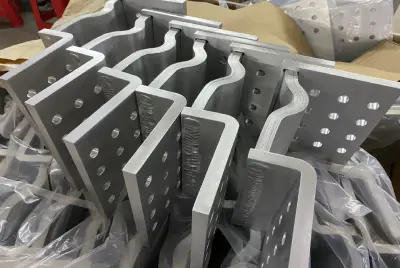
Custom aluminum busbar sizes, drilled holes, bending configurations, and surface treatments can be manufactured according to project drawings and technical specifications.
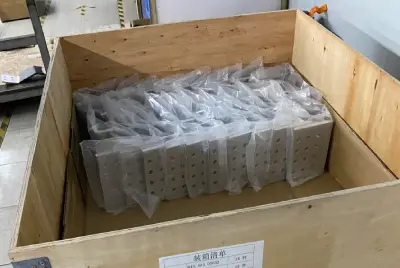
Chalco Aluminum Busbar Manufacturing & Surface Treatment Capabilities
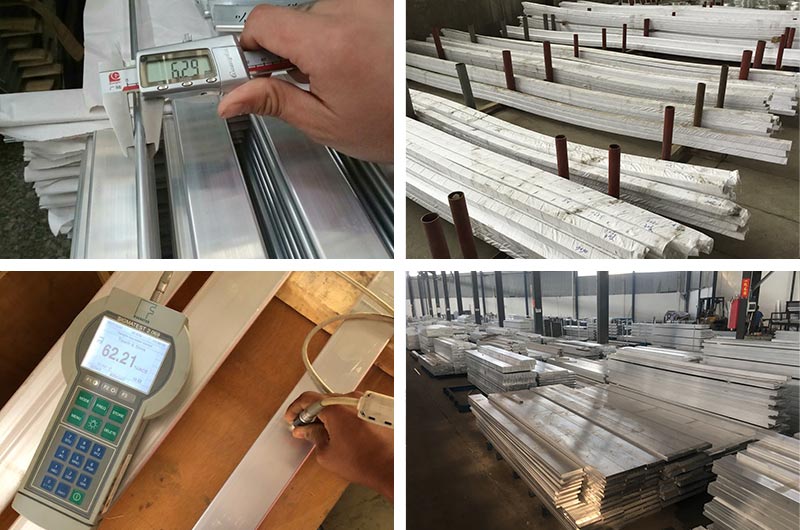
Chalco manufactures aluminum busbars using precision extrusion, rolling, and CNC machining processes. Our production capabilities support stable electrical performance, dimensional accuracy, and project-based customization for industrial and power distribution systems.
Production Capability
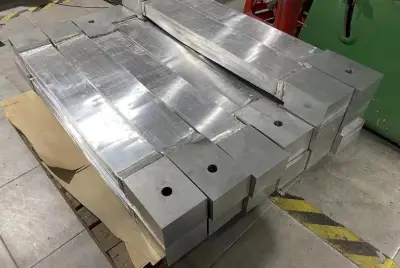
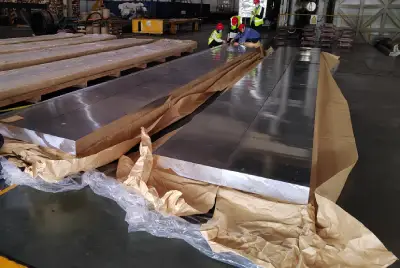
Chalco manufactures aluminum busbars through both extrusion and large-size plate processing, supporting standard conductive bars as well as heavy-section industrial power applications.
- Extruded busbars with stable cross-section control, available in lengths up to 12 meters for high-current systems
- Heavy-section busbars processed from thick plates, supporting sizes up to 120 mm thickness and 600 mm width
- Controlled flatness and dimensional tolerance for large-format industrial busbars
Surface Treatment Options
To enhance corrosion resistance and connection reliability, we provide multiple surface treatments for aluminum bus bars:
- Tin Plated Aluminum Bus Bar – Reduces contact resistance and improves oxidation resistance in humid or outdoor environments.
- Nickel or Silver Plating – Enhances conductivity and wear resistance for critical electrical connections.
- Anodizing – Provides additional surface protection in specific industrial applications.
Copper Cladding & Insulation Solutions
For applications requiring bimetallic transition or electrical insulation, we offer:
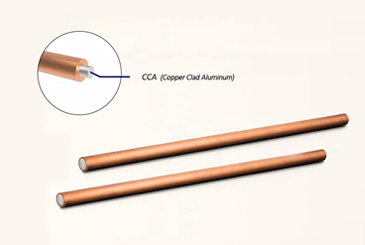
- Copper-clad aluminum processing (explosive welding, rolling cladding)
- Powder coating and epoxy insulation
- Insulation sleeves (PVC, heat shrink, silicone)
Precision Machining & Custom Fabrication
Custom aluminum busbar sizes and configurations can be manufactured according to technical drawings and installation requirements:
- Custom cutting (up to 6 meters)
- Drilling & punching for connection holes
- CNC milling and slotting
- Bending and forming for assembly integration
- Thickness range: 2 mm – 40 mm
- Width range: 10 mm – 200 mm
Applications of Aluminum Busbars
Aluminum busbars are widely used in medium- and high-current electrical systems where weight reduction, cost efficiency, and reliable conductivity are required. Proper alloy selection and structural design allow aluminum busbars to perform effectively across various industrial and power applications.
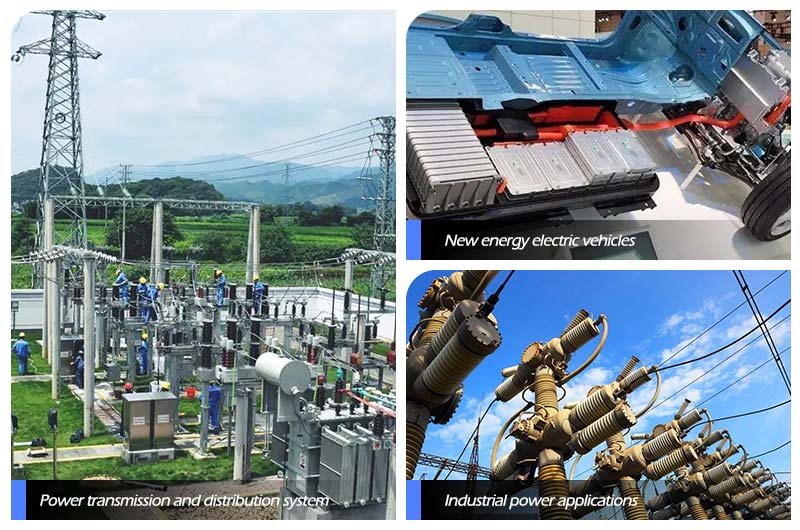
- Power Transmission & Distribution: Used in substations, distribution transformers, switchgear assemblies, and panel boards. In high-current systems, aluminum busbars serve as primary electrical bus bar solutions for stable current transfer and structural integration.
- Battery & Energy Storage Systems: In EV battery packs, energy storage cabinets, and charging infrastructure, lightweight aluminum conductors reduce overall system weight while maintaining reliable conductivity. See our dedicated battery bus bar applications for detailed configurations.
- Power Electronics & Compact Equipment: In inverter systems, converters, and UPS equipment, space-saving conductor layouts are critical. In these cases, laminated busbars are often adopted to reduce inductance and improve thermal performance.
- Industrial Equipment & Mechanical Installations: Manufacturing plants, mining facilities, and heavy-duty electrical installations use aluminum busbars for cost-effective current distribution, especially where large cross-sections are required.
- Grounding & Safety Systems: Aluminum busbars are also used in grounding and bonding systems to ensure electrical safety and equipotential connection. Learn more about ground busbar applications.
Aluminum vs Copper Busbar Comparison & Transition Solutions
Aluminum and copper are both widely used materials in electrical busbar systems. Material selection depends on conductivity requirements, installation space, mechanical performance, and overall project cost. When properly engineered and installed, both aluminum and copper busbars can achieve reliable long-term performance in power distribution systems.
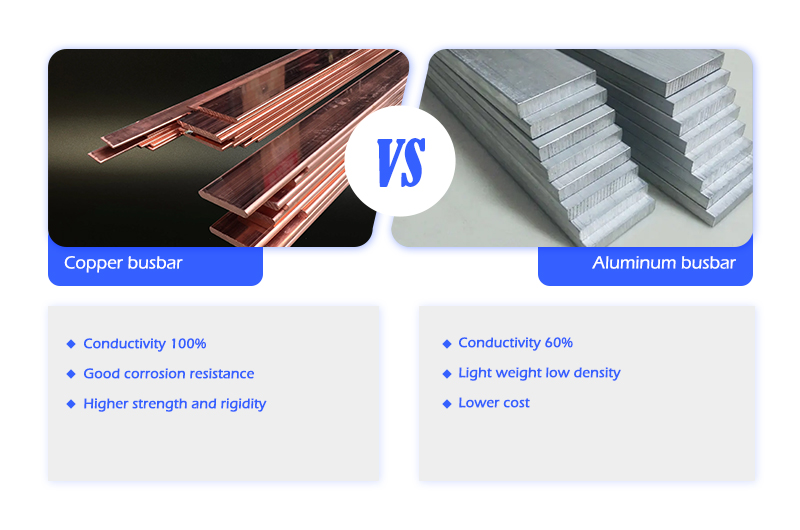
- Electrical Conductivity: Copper has lower resistivity, but aluminum achieves comparable performance when properly sized.
- Weight: Aluminum is approximately 50% lighter than copper, reducing structural load and installation effort.
- Thermal Expansion: Aluminum has a higher expansion coefficient and requires proper fastening design.
- Cost Consideration: Aluminum bus bars generally offer better cost efficiency in high-current and large-volume projects.
Copper and aluminum busbars are both widely used in power systems, and when properly sized and connected with suitable transition solutions, they can achieve reliable electrical performance while balancing conductivity, weight, and cost considerations.
-
Bimetallic Transition Plates
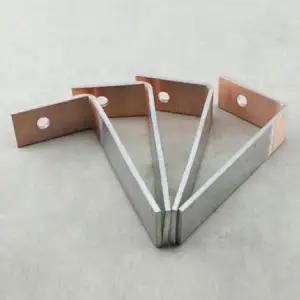
Copper-aluminum bonded plates designed to prevent galvanic corrosion and maintain low contact resistance in transition assemblies.
-
Copper-Clad Aluminum Busbars
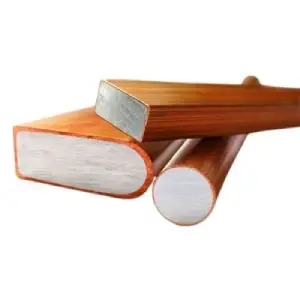
Integrated bimetallic solution combining aluminum conductivity with a copper interface for stable copper-to-aluminum transitions.
-
Busbar Connectors
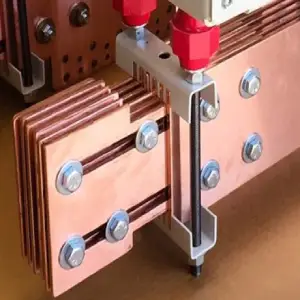
Used for multi-busbar connections and controlled transition assemblies.
-
Busbar Terminal Connectors
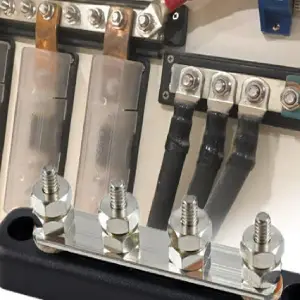
Support cable-to-busbar and copper-to-aluminum interface transitions in switchgear systems.
Chalco – Reliable Aluminum Busbar Manufacturer & Global Supplier
Chalco is a professional aluminum busbar manufacturer supplying EC-grade conductive busbars for power distribution, renewable energy, industrial equipment, and EV systems worldwide. We support large-scale production, stable quality control, and export-ready project delivery.
- Complete Product Range: Aluminum, copper, and copper-clad aluminum busbars with EC-grade alloys including 6101, 1050, 1060, 1070, 1100, 1350, 6061, 6063, and 6082
- International Standards Compliance: ASTM B317, ASTM B236, IEC 60105, EN 573-3, DIN EN 755-2, ISO 209
- Certified Quality System: Mill Test Certificate (MTC) available, third-party inspection support
- Stable Supply Capacity: Bulk production capability with consistent raw material sourcing
- Global Export Experience: Supplying customers in Europe, North America, Southeast Asia, and the Middle East
- OEM & Project Support: Drawing-based production, technical coordination, and flexible order quantities
- Industry Partnerships: Long-term cooperation with transformer, switchgear, capacitor, and electrical equipment manufacturers
With integrated supply chain management and global project experience, Chalco ensures reliable delivery, competitive pricing, and long-term performance for aluminum busbar applications.
Ampacity Chart of Copper and Aluminum Busbar
| Converting Copper to Aluminum using an Ampacity Chart | ||||||||||||
| Ampacity Conversion Chart | Copper C110 | 30° C Rise | 50° C Rise | 65° C Rise | Aluminum 6101 | 30° C Rise | 50° C Rise | 65° C Rise | ||||
| Flat Bar Size in Inches | Sq. In | Circ Mils Thousands | Weight Per Ft in Lb. | DC Resistance at 20° C, Microhms/Ft | 60 Hz Ampacity Amp* | Weight Per Ft in Lb. | DC Resistance at 20° C, Microhms/Ft | 60 Hz Ampacity Amp** | ||||
| 1/2*1 | 0.5 | 637 | 1.93 | 16.5 | 620 | 820 | 940 | 0.585 | 31 | 347 | 459 | 526 |
| 1/2*1 1/2 | 0.75 | 955 | 2.9 | 11 | 830 | 1100 | 1250 | 0.878 | 21 | 465 | 616 | 700 |
| 1/2*2 | 1 | 1270 | 3.86 | 8.23 | 1000 | 1350 | 1550 | 1.17 | 15 | 560 | 756 | 868 |
| 1/2*2 1/2 | 1.25 | 1590 | 4.83 | 6.58 | 1200 | 1600 | 1850 | 1.463 | 12 | 672 | 896 | 1036 |
| 1/2*3 | 1.5 | 1910 | 5.8 | 5.49 | 1400 | 1850 | 2150 | 1.755 | 10 | 784 | 1036 | 1204 |
| 1/2*3 1/2 | 1.75 | 2230 | 6.76 | 4.7 | 1550 | 2100 | 2400 | 2.048 | 9 | 868 | 1176 | 1344 |
| 1/2*4 | 2 | 2550 | 7.73 | 4.11 | 1700 | 2300 | 2650 | 2.34 | 8 | 952 | 1288 | 1484 |
| 1/2*5 | 2.5 | 3180 | 9.66 | 3.29 | 2050 | 2750 | 3150 | 2.925 | 6 | 1148 | 1540 | 1764 |
| 1/2*6 | 3 | 3820 | 11.6 | 2.74 | 2400 | 3150 | 3650 | 3.51 | 5 | 1344 | 1764 | 2044 |
| 1/2*8 | 4 | 5090 | 15.5 | 2.06 | 3000 | 4000 | 4600 | 4.68 | 4 | 1680 | 2240 | 2576 |
| 1/4*1/2 | 0.125 | 159 | 0.483 | 65.8 | 240 | 315 | 360 | 0.146 | 123 | 134 | 176 | 202 |
| 1/4*3/4 | 0.188 | 239 | 0.726 | 43.8 | 320 | 425 | 490 | 0.220 | 82 | 179 | 238 | 274 |
| 1/4*1 | 0.25 | 318 | 0.966 | 32.9 | 400 | 530 | 620 | 0.293 | 62 | 224 | 297 | 347 |
| 1/4*1 1/2 | 0.375 | 477 | 1.450 | 21.9 | 560 | 740 | 880 | 0.439 | 41 | 314 | 414 | 482 |
| 1/4*2 | 0.5 | 637 | 1.930 | 16.5 | 710 | 940 | 1100 | 0.585 | 31 | 398 | 526 | 616 |
| 1/4*2 1/2 | 0.625 | 796 | 2.410 | 13.2 | 850 | 1150 | 1300 | 0.731 | 25 | 476 | 644 | 728 |
| 1/4*3 | 0.75 | 955 | 2.900 | 11 | 990 | 1300 | 1550 | 0.878 | 21 | 554 | 728 | 868 |
| 1/4*3 1/2 | 0.875 | 1110 | 3.380 | 9.4 | 1150 | 1500 | 1750 | 1.024 | 18 | 644 | 840 | 980 |
| 1/4*4 | 1 | 1270 | 3.860 | 8.23 | 1250 | 1700 | 1950 | 1.170 | 15 | 700 | 952 | 1092 |
| 1/4*5 | 1.25 | 1590 | 4.830 | 6.58 | 1500 | 2000 | 2350 | 1.463 | 12 | 840 | 1120 | 1316 |
| 1/4*6 | 1.5 | 1910 | 5.800 | 5.49 | 1750 | 2350 | 2700 | 1.755 | 10 | 980 | 1316 | 1512 |
| 1/8*1/2 | 0.0625 | 79.6 | 0.241 | 132 | 153 | 205 | 235 | 0.073 | 247 | 86 | 115 | 132 |
| 1/8*3/4 | 0.0938 | 119 | 0.362 | 87.7 | 215 | 285 | 325 | 0.110 | 164 | 120 | 160 | 182 |
| 1/8*1 | 0.125 | 159 | 0.483 | 65.8 | 270 | 360 | 415 | 0.146 | 123 | 151 | 202 | 232 |
| 1/8*1 1/2 | 0.188 | 239 | 0.726 | 43.8 | 385 | 510 | 590 | 0.220 | 82 | 216 | 286 | 330 |
| 1/8*2 | 0.25 | 318 | 0.966 | 32.9 | 495 | 660 | 760 | 0.293 | 62 | 277 | 370 | 426 |
| 1/8*2 1/2 | 0.312 | 397 | 1.210 | 26.4 | 600 | 800 | 920 | 0.365 | 49 | 336 | 448 | 515 |
| 1/8*3 | 0.375 | 477 | 1.450 | 21.9 | 710 | 940 | 1100 | 0.439 | 41 | 398 | 526 | 616 |
| 1/8*3 1/2 | 0.438 | 558 | 1.690 | 18.8 | 810 | 1100 | 1250 | 0.512 | 35 | 454 | 616 | 700 |
| 1/8*4 | 0.5 | 636 | 1.930 | 16.5 | 900 | 1200 | 1400 | 0.585 | 31 | 504 | 672 | 784 |
| 1/16*1/2 | 0.0312 | 39.7 | 0.121 | 264 | 103 | 136 | 157 | 0.037 | 494 | 58 | 76 | 88 |
| 1/16*3/4 | 0.0469 | 59.7 | 0.181 | 175 | 145 | 193 | 225 | 0.055 | 327 | 81 | 108 | 126 |
| 1/16*1 | 0.0625 | 79.6 | 0.242 | 132 | 187 | 250 | 285 | 0.073 | 247 | 105 | 140 | 160 |
| 1/16*1 1/2 | 0.0938 | 119 | 0.362 | 87.7 | 270 | 355 | 410 | 0.110 | 164 | 151 | 199 | 230 |
| 1/16*2 | 0.125 | 159 | 0.483 | 65.8 | 345 | 460 | 530 | 0.146 | 123 | 193 | 258 | 297 |
| Source: Copper Development Organization; Aluminum Association | ||||||||||||
| Note: Ratings depend upon configuration, air flow, ambient temp, etc. The values depicted are an approximation. Controlled testing is always required to validate. | ||||||||||||
| Other considerations Forming the busbar (aluminum has a tendency to crack with very tight radius) Electroplating the busbar (white rust on aluminum, oxidation is an issue with aluminum) Configuration of the busbar (vertical or horizontal configuration) | ||||||||||||
Standard Conductive Aluminum Busbar Size Reference Table
| Square angle aluminum bar | ||||||||||
| 2mm | 2*30 | 2*40 | 2*67 | 2*70 | 2.5* 25 | |||||
| 3mm | 3*10 | 3*15 | 3*20 | 3*25 | 3*30 | 3*40 | 3*50 | 3*60 | 3*67 | 3*75 |
| 3*110 | ||||||||||
| 4mm | 4*10 | 4*15 | 4*20 | 4*25 | 4*30 | 4*40 | 4*45 | 4*50 | 4*60 | 4.6*60 |
| 4.8*9.8 | ||||||||||
| 5mm | 5*15 | 5*20 | 5*25 | 5*30 | 5*35 | 5*40 | 5*50 | 5*60 | 5*80 | 5*100 |
| 6mm | 6*20 | 6*25 | 6*30 | 6*40 | 6*50 | 6*54 | 6*55 | 6*60 | 6*65 | 6*70 |
| 6*75 | 6*80 | 6*100 | 6*120 | 6*150 | 6*160 | |||||
| 6.3mm | 6.3*50 | 6.3*63 | 6.3*63.5 | 6.3*80 | 6.35*50.8 | 6.35*76.2 | ||||
| 7mm | 7.6*80 | 7*150 | 7*4*20*4 | |||||||
| 8mm | 8*11 | 8*30 | 8*40 | 8*50 | 8*51 | 8*60 | 8*63 | 8*63.5 | 8*65 | 8*70 |
| 8*80 | 8*90 | 8*100 | 8*120 | 8*125 | 8.8*28.6 | |||||
| 9mm | 9*170 | 9*125 | 9. 2*64 | |||||||
| 10mm | 10*20 | 10*25 | 10*30 | 10*40 | 10*45 | 10*50 | 10*60 | 10*63 | 10*65 | 10*70 |
| 10*80 | 10*90 | 10*100 | 10*110 | 10*114 | 10*120 | 10*125 | 10*140 | 10*150 | 10*160 | |
| 12mm | 12*30 | 12*40 | 12*45 | 12*50 | 12*60 | 12*70 | 12*76 | 12*80 | 12*100 | 12*120 |
| 12*125 | 12*130 | 12*140 | 12*150 | 12*160 | ||||||
| 12.5mm | 12.5*90 | 12.5*100 | 12.5*125 | 12.5*127 | 12.7*101.6 | 12.7*160 | ||||
| 13mm | 13*125 | 13*130 | 13*160 | |||||||
| 14mm | 14*100 | 14*120 | 14.5*80 | |||||||
| 15mm | 15*30 | 15*35 | 15*50 | 15*60 | 15*80 | 15*100 | 15*120 | 15*125 | 15*150 | |
| 16mm | 16*30 | 16*90 | 16*100 | 16*110 | 16*125 | 16*130 | 16*140 | 16*150 | 16*160 | |
| 20mm | 20*76 | 20*100 | 20*120 | 20*130 | ||||||
| Square bar | 19*19 | 30*45 | 15*15 | |||||||
| Round bar | Φ6 | Φ8 | Φ10 | Φ11 | Φ12 | Φ14 | Φ15 | Φ15.6 | Φ16 | Φ18 |
| Φ20 | Φ21 | Φ22 | Φ23 | Φ25 | Φ27 | Φ28 | Φ30 | Φ32 | Φ35 | |
| Φ38 | Φ40 | Φ45 | Φ50 | Φ55 | Φ60 | |||||
| Round angle aluminum bar | |||||||||
| 2mm | R2*20 | R2.5* 50 | |||||||
| 3mm | R3*30 | R3*40 | R3*50 | R3*60 | R3*80 | R3*100 | R3*120 | R3*160 | |
| 4mm | R4*25 | R4*30 | R4*35 | R4*40 | R4*50 | R4*60 | R4.1*44.1 | R4.7*151 | |
| 5mm | R5*30 | R5*35 | R5*40 | R5*45 | R5*50 | R5*60 | R5*70 | R5*75 | R5*80 |
| R5*90 | R5*100 | R5*120 | |||||||
| 6mm | R6*40 | R6*50 | R6*60 | R6*70 | R6*80 | R6*100 | R6*120 | R6*140 | R6*160 |
| R6.3*63 | R6.35*76.5 | ||||||||
| 7mm | R7*70 | ||||||||
| 8mm | R8*40 | R8*50 | R8*60 | R8*80 | R8*100 | RS*120 | |||
| 10mm | R10*20 | R10*40 | R10*50 | R10*60 | R10*75 | R10*80 | R10*100 | R10*120 | R10*125 |
| R10*150 | R10*160 | R10*170 | R10.4*25 | ||||||
| 12mm | R12*80 | R12*100 | R12*110 | R12*120 | R12*125 | R12*150 | R12*160 | ||
| 12.5mm | R12.5*80 | R12.5*125 | R12.7*90 | R12.7*127 | |||||
| 13mm | R13*120 | R13*125 | |||||||
| 14mm | R14*100 | R14*120 | R14*150 | ||||||
| 15mm | R15*100 | R15*120 | R15*130 | R15*150 | |||||
| 16mm | R16*150 | R16*160 | |||||||
| 19mm | R19.05*101.6 | R19.05*127 | |||||||
| 20mm | R20*80 | R20*120 | R20*130 | ||||||
| Custom-shaped aluminum profiles | *4*50 | *5*50 | *5*60 | *6*40 | *6*50 | *6*60 | *6*80 | *8*60 | *8*80 |
| *8*100 | *8*120 | *10*40 | *10*80 | *10*100 | *10*120 | *12*80 | *12*100 | *12*120 | |
| *15*120 | *20*130 | *28*60 | |||||||
Aluminum Busbar Ordering & Pricing Information
The price of aluminum busbars depends on alloy type, cross-sectional size, surface treatment, and fabrication complexity. As a professional aluminum busbar manufacturer, Chalco provides competitive pricing based on stable raw material sourcing and large-scale production capacity.
- Alloy Selection: EC-grade alloys such as 6101 and 1350 typically differ in conductivity and mechanical strength, affecting overall cost.
- Cross-Section & Dimensions: Thickness, width, and length directly influence material consumption and current carrying capacity.
- Surface Treatment: Tin plating, nickel plating, silver plating, or copper cladding will impact final pricing.
- Machining & Customization: Drilling, bending, CNC processing, and special tolerances may affect production cost.
- Order Volume: Bulk orders benefit from more competitive unit pricing.
For accurate aluminum busbar price quotation, please provide the following information:
- Required alloy grade (e.g., 6101-T61, 1350-H19)
- Dimensions (thickness × width × length)
- Surface treatment requirements
- Estimated order quantity
- Application or installation environment (if applicable)
Our engineering team will evaluate technical requirements and provide a fast quotation along with material certification and delivery schedule details.
Chalco can provide you the most comprehensive inventory of aluminum products and can also supply you customized products. Precise quotation will be provided within 24 hours.
Get a quote