Aramid honeycomb core is a lightweight non-metallic core material widely used in bonded sandwich structures for aerospace, rail transit, and marine applications.
Made from aramid fiber paper impregnated and cured with phenolic resin, it offers a high strength-to-weight ratio, stable dielectric properties, and excellent dimensional stability, making it a reliable core material for lightweight sandwich panels.
Chalco supplies aramid honeycomb core in densities from 29–144 kg/m³, with cell diameters starting from 1/8 in (3.2 mm), standard block dimensions of 2440 × 1220 × 914 mm, and support for precision cutting and contour machining.
What is aramid honeycomb core?
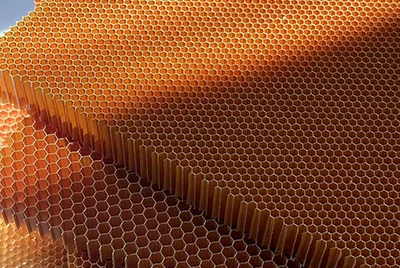
Aramid honeycomb core is a biomimetic hexagonal cellular material made from aromatic polyamide fiber paper, bonded and then impregnated with phenolic resin for curing. As a non-metallic material, it inherently offers three key structural advantages: no galvanic corrosion, no electromagnetic interference, and extremely low thermal conductivity.
The node adhesive and resin system are mildew-resistant and non-corrosive to metals, ensuring reliable bonding and material compatibility.
Para-Aramid Honeycomb Core
Higher strength and stiffness for weight-critical structural sandwich panels, including aerospace, defense composites, and high-performance marine applications.
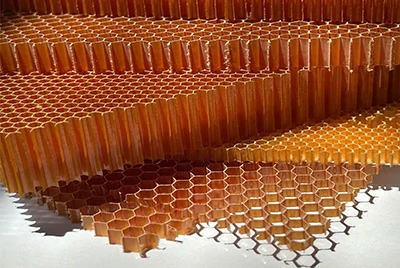
Meta-Aramid Honeycomb Core
Better flame resistance, insulation, and cost efficiency for aviation interiors, rail transit panels, and fire-sensitive sandwich structures.
Available specifications and standard sizes
Chalco supplies standard block-form aramid honeycomb core and can also provide custom dimensions based on lightweight sandwich panel production requirements.
Customers can select different cell sizes, densities, thicknesses, and cell geometries based on panel structure, bonding method, and application environment.
| Parameter | Range / Standard Value |
| Standard Block Dimensions | 2440 mm (L-direction) × 1220 mm (W-direction) × 914 mm (T-direction) |
| Minimum Available Thickness | 1.20 mm |
| Cell Wall Length | 1.83 / 2.50 / 2.75 / 3.67 / 4.50 / 5.50 mm |
| Corresponding cell diameter | 3.2 / 4.3 / 4.8 / 6.4 / 7.8 / 9.6 mm |
| Over-expanded option | 2.75OX, 4.8 mm cell diameter |
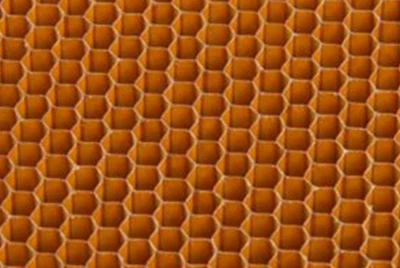
| Cell shape | Regular hexagonal / Over-expanded / Pentagon / Quadrilateral |
| Density Range | 29–144 kg/m³ |
| Honeycomb Core Grade | Aerospace grade / Radar-absorbing honeycomb |
| Special Forms | Partially cured honeycomb core / Prepreg honeycomb core |
| Adhesive Compatibility | Compatible with most structural adhesives used in sandwich composites |
Chalco provides precision thickness cutting, dimension cutting, and contour machining for aramid honeycomb core per customer drawings. For complex shapes or projects requiring high surface quality, ultrasonic cutting is available to minimize burrs, fiber pull-out, and cell wall damage.
In addition to supplying aramid honeycomb core, Chalco can also support further fabrication into finished aramid honeycomb sandwich panels according to project requirements.
Physical and environmental performance of aramid honeycomb core
Chalco's aramid honeycomb core is suitable for lightweight sandwich structures requiring low weight, high strength, electrical insulation, and environmental stability.
Customers can select different densities, cell sizes, and thicknesses based on project needs-for applications such as aircraft interiors, rail transit, marine vessels, yachts, and composite structural components.
| Performance Parameter | Value / Requirement | Reference Standard |
| Density Range | 29–144 kg/m³ | Company standard Q/CSG 001-2024 |
| Operating Temperature Range | −55°C to 180°C | Company standard Q/CSG 001-2024 |
| Flame Resistance | Self-extinguishing; can meet EN45545 per project requirements | Company standard Q/CSG 001-2024 |
| Dielectric Constant | < 1.50, tested per GB/T 5597 | Company standard Q/CSG 001-2024 |
| Water Migration | ≤ 6 consecutive cells | Company standard Q/CSG 001-2024 |
| Density Tolerance | ≤ ±10% | Company standard Q/CSG 001-2024 |
| Dimensional Tolerance | Within 5% of nominal dimensions | Company standard Q/CSG 001-2024 |
| Standard Block Dimensions | 2440 × 1220 × 914 mm | Company standard Q/CSG 001-2024 |
| Minimum Available Thickness | 1.20 mm | Company standard Q/CSG 001-2024 |
| Shelf Life | 2 years from production date; may be re-inspected after expiration and used if compliant | Company standard Q/CSG 001-2024 |
Aramid honeycomb core maintains stable performance across a wide temperature range, making it suitable for projects exposed to high temperatures, low temperatures, or humid environments.
Relevant testing shows that the 1.83-96 grade aramid honeycomb retains approximately 67.3% of its compressive strength at 177°C, providing valuable reference data for material selection in high-temperature applications.
Mechanical performance data of aramid honeycomb core
Aramid honeycomb core is an anisotropic material, with mechanical properties varying by direction.
When designing sandwich panels, engineers must identify the L-direction (ribbon direction) and W-direction (transverse direction) of the honeycomb core based on the primary shear load orientation.
The table below lists typical and minimum values for commonly used Chalco aramid honeycomb core specifications, suitable for preliminary selection and technical discussions.
| Model | Cell Wall Length | Density | Flatwise Compressive Strength Typ / Min | L-Direction Shear Strength Typ / Min | L-Direction Shear Modulus Typ | W-Direction Shear Strength Typ / Min | W-Direction Shear Modulus Typ |
| AHK-1.83-48 | 1.83 mm | 48 kg/m³ | 2.00 / 1.58 MPa | 1.28 / 0.97 MPa | 42 MPa | 0.69 / 0.52 MPa | 24 MPa |
| AHK-1.83-64 | 1.83 mm | 64 kg/m³ | 3.40 / 2.40 MPa | 1.75 / 1.49 MPa | 55 MPa | 0.95 / 0.75 MPa | 31 MPa |
| AHK-1.83-80 | 1.83 mm | 80 kg/m³ | 4.75 / 3.75 MPa | 2.24 / 1.84 MPa | 73 MPa | 1.20 / 0.98 MPa | 36 MPa |
| AHK-1.83-96 | 1.83 mm | 96 kg/m³ | 6.40 / 4.82 MPa | 2.48 / 2.20 MPa | 89 MPa | 1.59 / 1.17 MPa | 45 MPa |
| AHC-2.75-32 | 2.75 mm | 32 kg/m³ | 0.83 / 0.66 MPa | 0.60 / 0.50 MPa | 30 MPa | 0.44 / 0.28 MPa | 16 MPa |
| AHC-2.75-48 | 2.75 mm | 48 kg/m³ | 2.00 / 1.59 MPa | 1.20 / 0.98 MPa | 41 MPa | 0.70 / 0.47 MPa | 23 MPa |
| AHC-2.75-64 | 2.75 mm | 64 kg/m³ | 3.46 / 2.43 MPa | 1.60 / 1.48 MPa | 52 MPa | 1.08 / 0.76 MPa | 32 MPa |
Typ denotes typical value; Min denotes minimum value. Flatwise compressive strength can be tested per GB/T 1453, and shear strength per GB/T 1455, based on project requirements.
The above data are reference performance values. Final performance must be confirmed based on project specifications, honeycomb core thickness, resin system, and MTC material test reports.
If you require other cell sizes such as 2.50 / 3.67 / 4.50 / 5.50 mm or higher-density aramid honeycomb core data, please contact Chalco's technical team to confirm specifications and test documentation.
How to select the right cell size, density, and cell geometry?
Selecting aramid honeycomb core should not be based on density alone.
The optimal specification must consider panel weight, compressive loading, shear direction, surface quality, bonding area, bending/forming requirements, and local reinforcement needs.
Select density based on load and weight targets
Generally, higher density improves flatwise compressive strength and shear performance-but also increases panel weight. Low-density cores are better suited for weight-critical structures.
For example, within the 1.83 mm cell wall length series, the 48 kg/m³ grade offers a flatwise compressive strength of 2.00 MPa, while the 96 kg/m³ grade reaches 6.40 MPa.
| Density Range | Typical Application Focus |
| 29–48 kg/m³ | Weight-priority interior panels, ceiling panels, and lightly loaded sandwich structures |
| 48–64 kg/m³ | Rail transit, marine, and general-purpose composite sandwich panels |
| 80–96 kg/m³ | Flooring, secondary load-bearing structures, and areas with higher localized loads |
| Above 96 kg/m³ | High-compression zones, hard-point reinforcements, and aerospace structures with stringent requirements |
Select cell size based on panel surface and bonding requirements
| Cell Size | Recommended Applications |
| Small cell, 1.83 mm / 1/8 in | Denser cells yield smoother panel surfaces and larger bonding areas-ideal for high-precision sandwich panels |
| Medium cell, 2.50–2.75 mm | Balances weight, cost, and mechanical performance-ideal for rail transit, marine, and general-purpose composite panels. |
| Large cell size: 3.67–5.50 mm | Suitable for large-format industrial panels or structural components where surface precision is not critical. |
Small-cell aramid honeycomb is typically better suited for aerospace interiors, radomes, and panels requiring high surface quality. Medium and large cell sizes are more appropriate for projects that need to balance performance, panel size, and cost.
Select cell geometry based on forming requirements
| Cell Geometry | Selection Guidelines |
| Regular hexagonal | Most common; offers structural stability and suits most flat sandwich panel applications. |
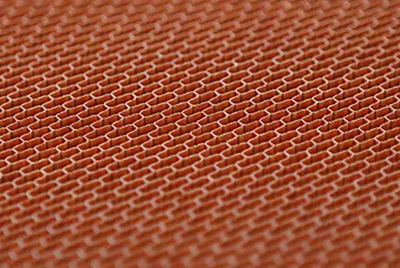
| Over-expanded | Better suited for singly curved panels; improves bendability in the W-direction. |
| Pentagon | Used for specialized structures or forming needs; specific applications should be confirmed with engineering drawings. |
| Quadrilateral | Applicable to custom projects with specific cell geometry requirements. |
Regular hexagonal honeycomb is preferred for most flat sandwich panels. For curved or singly curved surfaces, over-expanded honeycomb enables easier forming and helps reduce the risk of cell wall buckling.
Resin potting can be used to reinforce localized load-bearing areas.
For areas with fasteners, cutouts, mounting points, or other concentrated local loads, resin potting can create hard-point reinforcements. This enhances local load capacity without altering the entire panel structure.
Flame-retardant polyurethane and epoxy systems both significantly improve the compressive performance of aramid paper honeycomb. Among them, single-component flame-retardant polyurethane delivers notable compression strength gains while maintaining relatively low density.
If you're unsure about the optimal density, cell size, or geometry, share your panel drawings, load locations, thickness requirements, and operating environment with Chalco. Our engineering team can help determine the right aramid honeycomb core specification and localized reinforcement strategy.
Industry applications of aramid honeycomb core
Aramid honeycomb core is ideal for sandwich structures requiring lightweight design, rigidity, electrical insulation, vibration damping, and environmental stability.
Rail Transit
Aramid honeycomb core can be used for side wall panels, ceiling panels, partitions, luggage rack panels and floor base structures, helping reduce vehicle weight while improving vibration and acoustic performance.


Aerospace and Aviation Interiors
Aramid honeycomb core is suitable for aircraft honeycomb structures such as overhead bins, galley structures, cabin partitions, floor panels and door liners where lightweight structure and stable strength are required.
Marine and Yacht
Aramid honeycomb core can be used for marine bulkhead panels, yacht decks, hull liners, interior furniture and lightweight composite panels, with proper bonding and edge sealing for humid environments.


Motorsport and Sports Equipment
Aramid honeycomb core is suitable for racing body panels, sports equipment, ski cores, surfboards and cycling composite parts, offering a balance of low weight, stiffness and energy absorption.
Radome and Antenna Structures
Aramid honeycomb core offers low density, non-metallic structure and stable dielectric performance, making it suitable for radomes, antenna covers and communication panels.

Aerospace project specification alignment support
Chalco provides material selection support for aramid honeycomb core in aerospace, helicopter, defense, and high-performance composite projects.
If customer drawings or procurement documents reference specifications such as Boeing BMS 8-124, Airbus AIMS 11-01-004, Bell 299-947-386, Northrop Grumman ACS-MRS-5301, Lockheed Martin 5PTMDL17-D, FAR 25.853, or FAR 25.855, Chalco can assist in evaluating required cell size, density, thickness, resin system, and test requirements.
| Customer Specification Reference | Chalco-Supported Confirmation Items |
| Boeing BMS 8-124 | Cell size, density, grade, flatwise compression, shear, flammability, and project documentation evaluation |
| Airbus AIMS 11-01-004 | Alignment of aramid honeycomb core specifications, density, mechanical properties, and flammability requirements |
| Bell 299-947-386 | Evaluation of honeycomb core specifications for helicopter composite sandwich structures |
| Northrop Grumman ACS-MRS-5301 | Assessment of 1/8 in cell size, specified density, and mechanical performance requirements |
| Lockheed Martin 5PTMDL17-D | Evaluation of project specifications for high-performance composite honeycomb cores |
| FAR 25.853 / FAR 25.855 | Testing support for flammability requirements related to aircraft interiors and cargo compartments |
The above specifications are provided solely to illustrate that Chalco can perform specification evaluation and performance alignment based on customer project documentation.
Final compliance must be verified against customer drawings, project-specific test requirements, and Material Test Certificates (MTC).
How aramid honeycomb core is manufactured
Production begins with aramid fiber paper. Thermoset adhesive lines are printed in a staggered pattern onto the paper sheets to form adhesive node bonds. Multiple sheets are stacked and hot-pressed into a solid block-known as a HOBE block-then mechanically expanded from both sides to open the hexagonal cell structure.
The expanded honeycomb is impregnated with phenolic resin, followed by multiple impregnation and curing cycles to lock in the cell geometry and target density. Final shaping is achieved through precision sawing or contour machining.
Resin content and cure conditions during impregnation directly determine the core's final density and mechanical performance, making this a critical step for ensuring batch consistency.
Chalco also offers pre-cured core and pre-impregnated core as specialized variants.
Custom processing and engineering support for aramid honeycomb core
Chalco supplies standard aramid honeycomb blocks and also provides custom services-including cut-to-size, precision thickness cutting, contour machining, curved forming assessment, and localized reinforcement-based on customer drawings, panel designs, and project requirements.
For aerospace interiors, rail transit, marine, radome, and composite sandwich panel projects, appropriate processing and honeycomb core joining methods help minimize assembly errors and enhance bonding reliability.
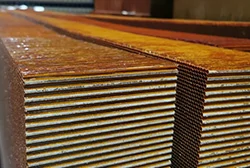
Cut-to-Size
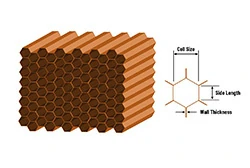
Contour Machining
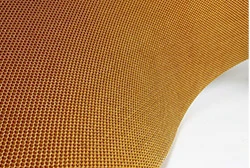
Curved Forming
For fastener zones, cutout edges, mounting points, and other areas subject to concentrated local loads, resin potting can be applied per design requirements to create hard-point reinforcements and improve local load-bearing capacity.
For complex geometries or applications demanding high machining quality, ultrasonic cutting can be evaluated to minimize burrs, fiber pull-out, and cell wall damage.
Customers can provide CAD drawings, core specifications, thickness, density, cell geometry, quantity, and application environment. The Chalco team will assist in verifying machinability, confirming specifications, and preparing a project quotation.
Test standards and quality documentation support
Chalco aramid honeycomb core can be tested and documented per project requirements to verify key properties including flatwise compression, shear strength, density, dielectric performance, flammability, and water migration.
| Test Item | Reference Standard |
| Flatwise Compression | GB/T 1453-2005 |
| Shear Strength | GB/T 1455-2005 |
| Density | GB/T 1464-2005 |
| Dielectric Properties | GB/T 5597-1999 |
| Flammability Test for Aerospace Non-Metallic Materials | HB 5469-2014, per project requirements |
| Flammability Requirements for Aerospace Non-Metallic Materials | HB 5470-2014, per project requirements |
| Sampling Inspection | GJB 179A |
| Aramid Paper-Based Honeycomb Core for Aircraft Structures | GJB 1874-1999, per project requirements |
| Water Migration | ASTM F1645, per project requirements |
In terms of quality management systems, Chalco complies with ISO 9001:2015 / GB/T 19001-2016, EN 15085-2:2020 CL1, EN ISO 4063 / CEN ISO/TR 15608, and IRIS Certification® requirements. We support customer projects with quality management, process control, batch consistency, rail vehicle manufacturing documentation, and welding procedure records.
Each production batch can be accompanied by an inspection report, certificate of conformity, packing list, and Material Test Certificate (MTC) as required. Full traceability is maintained via product name, specification code, production batch, manufacturing date, and shelf life.
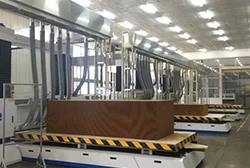

Aramid honeycomb core vs. aluminum honeycomb core
Aramid honeycomb core is better suited for applications prioritizing weight reduction, electrical insulation, corrosion resistance, and compatibility with composite materials.
Aluminum honeycomb core is more appropriate for architectural panels, metal-faced sandwich panels, and cost-sensitive, large-area applications.
Performance comparison between aramid honeycomb and 5052 aluminum honeycomb:
| Material | Aramid honeycomb | 5052 Aluminum Honeycomb |
| Cell Edge Length (mm) | 2.75 | 2.75 |
| Density (kg/m³) | 48 | 48 |
| Compressive Strength (psi) | 325 | 300 |
| Compressive Strength (MPa) | 2.24 | 2.06 |
| Compression Modulus (ksi) | 20 | 75 |
| Compression Modulus (GPa) | 0.13 | 0.51 |
| Shear Strength (psi) | 175 | 210 |
| Shear Strength (MPa) | 1.20 | 1.44 |
| Shear Modulus (ksi) | 6 | 45 |
| Shear Modulus (GPa) | 0.04 | 0.81 |
At the same cell edge length and density, aramid honeycomb exhibits higher compressive strength, while 5052 aluminum honeycomb offers superior compression modulus, shear strength, and shear modulus.
For a broader material selection comparison, see aramid honeycomb core vs aluminum honeycomb core.
Related honeycomb product solutions
In addition to aramid honeycomb core, Chalco can provide a range of honeycomb core materials and composite panel solutions tailored to your structural design, face sheet material, operating environment, and performance requirements.
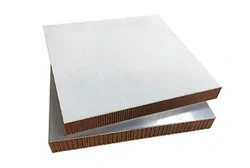
Aramid honeycomb
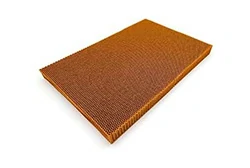
Aramid honeycomb panels
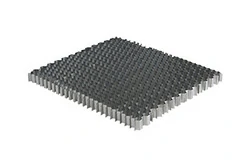
Aluminum honeycomb core
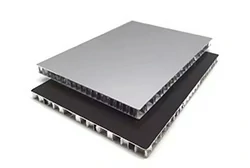
Aluminum honeycomb
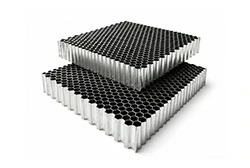
Stainless steel honeycomb
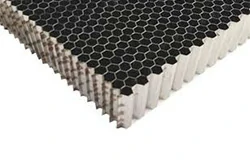
Carbon fiber honeycomb
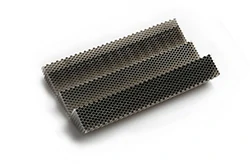
Honeycomb seal
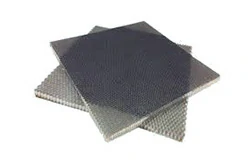
High temperature honeycomb
If you're unsure whether to choose aramid, aluminum, stainless steel, or carbon fiber honeycomb, please provide your application scenario, face sheet material, thickness, density, operating temperature, and drawing requirements.
Chalco can help identify the appropriate honeycomb core, sandwich panel configuration, or custom fabrication solution.
FAQs about aramid honeycomb core
What is the difference between para-aramid and meta-aramid honeycomb core?
Para-aramid offers higher strength and stiffness for structural panels. Meta-aramid provides better flame resistance and is often used for interior and fire-sensitive panels.
What are the main limitations of aramid honeycomb core?
It has an open-cell structure, so bonding and edge sealing are important in humid environments. It also costs more than some foam or aluminum honeycomb cores.
Which aramid honeycomb core has the best strength-to-weight ratio?
The 1.83-48 specification is a strong option for weight-sensitive structures, with tested specific compressive strength of 0.064 MPa·m³/kg.
What density should I choose for aerospace interior panels?
32–64 kg/m³ is commonly used for ceiling, side wall and partition panels. For floors or local loading areas, 80 kg/m³ or higher may be considered.
Can aramid honeycomb core be used in curved panels?
Yes. Over-expanded aramid honeycomb is suitable for single-curvature panels, but tight curves or complex shapes should be reviewed before production.
What sizes and cell shapes can Chalco supply?
Chalco supplies 2440 × 1220 × 914 mm standard blocks, 1.83–5.50 mm cell edges, 29–144 kg/m³ density, and regular hexagonal, over-expanded, pentagon or quadrilateral cells.
Request aramid honeycomb core specifications or quotation
Chalco supplies aramid honeycomb core for aerospace, rail transit, marine, yachts, sporting goods, and composite sandwich panel projects.
Please provide your required cell size, density, thickness, cell geometry, grade, and quantity. Our team will help confirm the suitable specification and provide a project quotation.
For custom projects, you may also share drawings, panel construction details, face sheet materials, and testing requirements to enable early evaluation of fabrication and supply options.