The way a honeycomb core is joined has a direct impact on core strength, interface stability, and the type of panel structure that can be built around it. In practice, the most common joining routes fall into three categories:
- Adhesive bonding: the standard choice for many lightweight sandwich structures, widely used with aluminum honeycomb cores and aramid honeycomb cores.
- Brazing: better suited to metal honeycomb systems that require higher compression strength, shear strength, peel resistance, and overall structural integrity.
- Welding: used more often in specialty metal honeycomb structures and typically not the mainstream route for standard honeycomb panel projects.
These joining methods influence not only core strength and failure behavior, but also how the final honeycomb panel is fabricated and which service conditions it is best suited for.
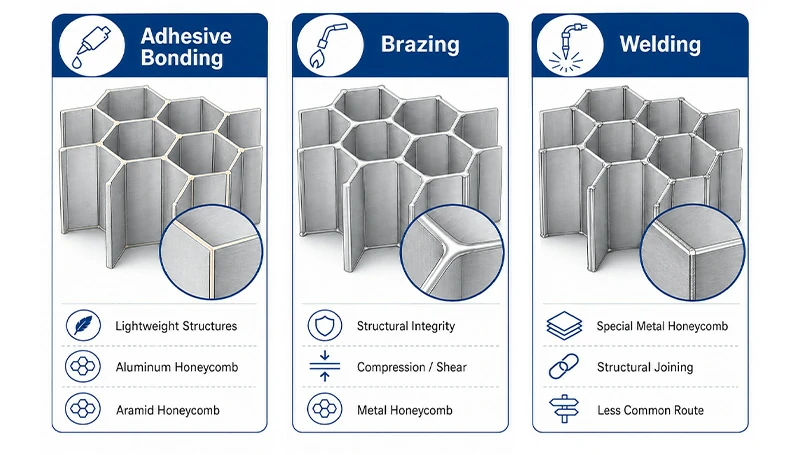
This is why, in real procurement and engineering evaluations, customers usually ask more than just what material the core is made of. They also want to know whether the core is adhesively bonded or brazed, and whether the nodes or interfaces have been verified through shear, peel, or equivalent validation testing. What matters in these questions is not the process name itself, but whether the joining method is stable enough for the intended service conditions and suitable for the final honeycomb panel or sandwich structure.
Why the honeycomb core bonding method deserves separate attention
Differences between honeycomb cores aren't just about material-they're often about bonding logic. Even with the same base material, different bonding methods can lead to significantly different performance in compression, shear, interface stability, failure behavior, and applicable service conditions.
This difference is most pronounced in metal honeycomb systems. Adhesively bonded structures are more limited by the adhesive layer and interface, whereas brazed structures typically transfer loads more effectively across the entire honeycomb core layer-resulting in different performance boundaries under demanding conditions. For aramid honeycomb cores, the bonding method has even broader implications: it affects not only node strength but also cell regularity and forming consistency.
That's why, in real-world projects, determining whether a honeycomb core is suitable requires looking beyond just the material name-you must also consider its bonding method. We'll start with the most common approach: adhesive bonding.
Adhesive bonding: The most common honeycomb core joining method
Adhesive bonding remains one of the most widely used and best-established methods for joining honeycomb cores. In standard lightweight sandwich structures, it is preferred because the process is mature, it works well with a wide range of face sheet systems, and it is relatively easy to integrate into conventional panel fabrication.
-
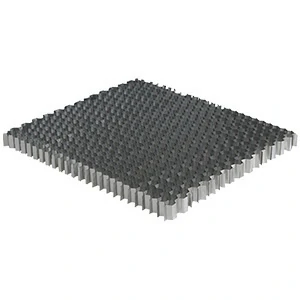
For aluminum honeycomb cores, adhesive bonding is more commonly used in standard aluminum honeycomb panels, decorative sandwich panels, industrial cladding panels, and other lightweight sandwich structures where composite compatibility, panel flatness, and batch-to-batch process stability are important.
-
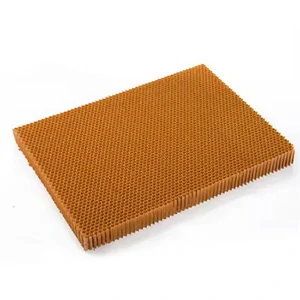
For aramid honeycomb cores, adhesive bonding is not only a joining method but also part of how the core is formed. As a result, it affects not only node adhesion, but also cell regularity and forming consistency.
The real issue with adhesive-bonded structures is not whether adhesive is used, but whether the adhesive layer and interface remain stable over time. In practice, many failures start not in the honeycomb core itself but in the adhesive layer, nodes, or interface. Studies show that adhesively bonded aluminum honeycomb panels are more prone to interfacial failure and debonding under shear loading, which means their performance limits are often governed by the adhesive layer.
For higher-demand projects, customers therefore tend to verify several points: whether the adhesive type is appropriate, whether the bondline is uniform, whether the nodes or interfaces are stable, and whether shear, peel, or equivalent validation testing has been performed.
Brazing: A better fit for high-performance metal honeycomb systems
Brazing is more commonly used with aluminum honeycomb cores, steel honeycomb cores, and stainless steel honeycomb cores. Compared with adhesive bonding, it is better suited to projects that demand stronger structural integrity, better interface bonding, and higher mechanical performance, making it a more suitable route for high-performance metal sandwich structures.
-
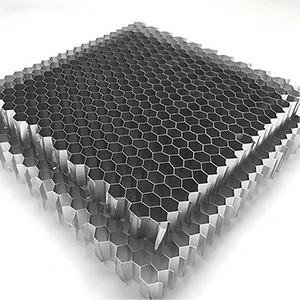
For aluminum honeycomb cores, brazing is typically preferred in high-performance metal sandwich structures, especially where stronger interface bonding and greater structural consistency are required.
-
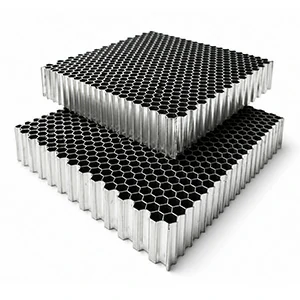
For steel and stainless steel honeycomb cores, brazing is generally a better fit for the joining characteristics of metal honeycomb systems and is more suitable for applications that demand higher strength and harsher operating conditions.
The main value of brazing lies in its ability to create a stable metallic bond that transfers load from the interface into the full honeycomb core layer, rather than letting performance be limited too early by an adhesive layer. Existing research shows that, at the same specifications, brazed aluminum honeycomb panels outperform adhesively bonded panels in flatwise compressive strength, plateau stress, shear strength, and roller peel strength. This is why brazing is often favored in high-demand metal honeycomb systems.
Of course, brazing does not guarantee better performance in every metric. In projects where modulus and structural stiffness are also critical, performance still needs to be judged against the specific material temper and actual service conditions.
Welding: A supplementary route for specialty metal honeycomb structures
Welding is more commonly used in specialty metal honeycomb systems such as steel/stainless steel honeycomb cores, titanium honeycomb cores, and certain superalloy honeycomb cores. While its application scope is narrower than adhesive bonding or brazing, it has a clear role in high-temperature, harsh-environment, and high-performance metal structures.
-
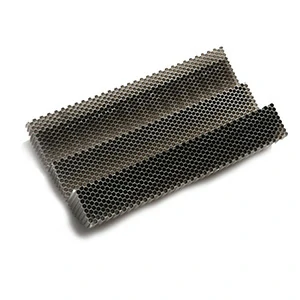
For titanium honeycomb cores, welding is better suited for structures requiring high specific strength, corrosion resistance, and elevated service temperatures;
-
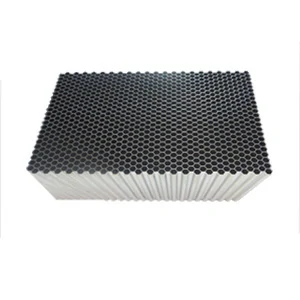
For superalloy honeycomb cores, it's preferred in applications demanding high-temperature stability, oxidation resistance, and long-term thermal performance;
-
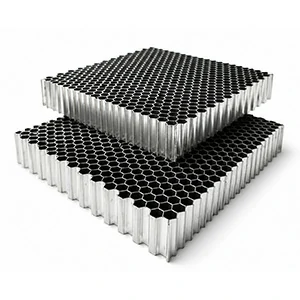
For stainless steel honeycomb cores, it leans toward metal honeycomb structures requiring corrosion resistance, impact tolerance, and higher structural integrity.
Welding is valuable not because it is more common, but because it is better suited to high-temperature or harsh service conditions where adhesive bonding may not be enough. In that sense, it should be understood as a supplementary route for specialty metal honeycomb structures, not the default path for standard honeycomb panel projects.
However, for most standard honeycomb sandwich projects, the two most relevant and frequently compared options remain adhesive-bonded honeycomb cores and brazed honeycomb cores.
Adhesive-bonded vs. brazed honeycomb cores: What's the difference?
| Comparison dimension | Adhesive-bonded honeycomb core | Brazed honeycomb core |
| Common core materials | Aluminum honeycomb core, aramid honeycomb core | Aluminum honeycomb core, steel honeycomb core, stainless steel honeycomb core |
| Bonding logic | Relies on adhesive layer and interface for bonding | Leans toward monolithic metal bonding |
| Advantages | Mature process, wide face sheet compatibility, excellent composite compatibility | Superior compression, shear, and peel resistance; higher interface bonding capability |
| Limitations | More susceptible to adhesive layer, node, and interface condition | Higher process requirements; may not offer better modulus performance in some cases |
| Failure tendency | More likely to fail first via debonding, interfacial failure, or adhesive issues | Tends to delay failure until it occurs at the overall honeycomb core level |
| Key evaluation terms | Lightweight, composite compatibility, standard sandwich | Compression resistance, shear resistance, peel resistance, structural integrity |
| Better-suited applications | Standard lightweight sandwich structures, designs requiring high composite compatibility | High-performance metal sandwich structures, designs demanding greater structural integrity |
| Key project verification points | Adhesive type, adhesive layer uniformity, node stability, shear/peel validation | Whether higher structural strength is truly needed and whether it matches target service conditions |
Adhesive-bonded honeycomb cores and brazed honeycomb cores are not simply a matter of one being "better" than the other. They reflect different structural priorities and different service-condition requirements.
- Adhesive-bonded honeycomb cores are better suited to standard lightweight sandwich structures where composite compatibility, process maturity, and stable performance in conventional applications matter most.
- Brazed honeycomb cores are better suited to metal honeycomb systems that require higher compression, shear, peel resistance, and stronger structural integrity.
The real decision point is not the process name by itself, but whether your project puts more weight on composite compatibility or overall bond strength.
So far, the discussion has focused on how honeycomb cores are joined. In real projects, however, users usually end up comparing not the core material alone, but the final panel structures created by different fabrication routes. That is why the joining method at the core level eventually needs to be understood in terms of the panel structures it leads to.
Why honeycomb panel fabrication methods directly influence structural outcomes
Honeycomb panels may all look like "face sheet + honeycomb core" sandwich structures, but the real difference often lies in how they are fabricated. In practice, the two main routes are adhesively bonded panels and brazed honeycomb panels.
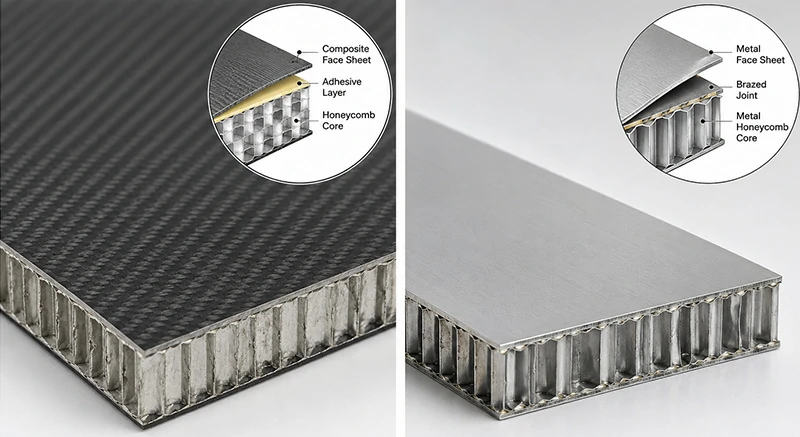
Adhesively Bonded Panels
These are more common in standard sandwich applications, with typical examples including aluminum honeycomb panels, aramid honeycomb sandwich structures, carbon fiber honeycomb panels, and fiberglass honeycomb panels.
What these panel types share is:
- greater flexibility in face sheet selection
- easier multi-material integration
- better suitability for lightweight and standard sandwich structures
- stronger emphasis on bonding compatibility and process stability
Brazed Honeycomb Panels
These are typically used in high-performance metal sandwich structures, with brazed aluminum honeycomb panels being the most representative example.
Compared to standard adhesively bonded panels, their defining features include:
- monolithic joint integrity
- interfacial strength and structural continuity
- stronger compression, shear, and peel performance
- suitability for demanding metal honeycomb systems and harsher service conditions
Put simply, adhesively bonded panels are more aligned with lightweight design and composite compatibility, while brazed honeycomb panels are more aligned with high-performance metal sandwich structures and stronger structural reliability.
Which honeycomb joining method fits your project best?
In honeycomb structures, the key difference often lies not only in the material, but in the joining route and fabrication logic behind it. Even with the same core or panel type, different joining methods lead to different structural limits, failure behavior, and service suitability.
- Adhesive bonding is usually the better fit for standard lightweight sandwich structures where bonding compatibility, process maturity, and stable performance in routine applications are the priorities.
- Brazing is usually the better fit for high-demand metal honeycomb systems where monolithic bond integrity and stronger compression, shear, and peel resistance matter more.
- Welding is mainly relevant to specialty metal honeycomb structures made from titanium, stainless steel, or high-temperature alloys, especially in harsh or high-temperature environments.
So the real question is not which process sounds better on paper. It is which route best matches your actual service conditions and structural priorities.