Aluminum heat sink extrusion is a cost-effective air-cooled solution for power supplies, inverters, LEDs and industrial control. It balances thermal performance, weight and cost.
Chalco supplies standard and custom aluminum heat sink extrusion profiles. We machine to your drawings with CNC and anodizing, from prototypes to mass production in one stop.
Overview and specifications of aluminum heat sink extrusion profiles
Chalco offers a full range of high-performance aluminum heat sink extrusions, including straight-fin, slanted-fin, pin-fin, and round / star / linear LED profiles. We cover multiple thermal performance levels, fin spacing, lengths and heights.
High aspect-ratio designs suit strong airflow or forced-air cooling, and we can customize them in our factory based on your operating conditions.
| Typical specifications | Capability range |
| Alloy materials | 6063-T5, 6061-T6, 6060, 1050 / 1050A |
| Heat sink width | Standard 6–188 mm, maximum profile width up to 609 mm (approx. 24") |
| Heat sink height | 4–40 mm, higher designs available on request |
| Base thickness | Typically ≥2.5–10 mm (optimized for heat load and threaded holes) |
| Fin thickness | 0.7–2.0 mm |
| Fin height | 10–60 mm |
| Fin height / fin thickness | About 17:1–22:1 with conventional extrusion (taller fins need thicker sections and lower tongue ratio) |
| Surface finish | Degreased as-extruded profiles as standard, natural or black anodizing and other finishes on request |
| Standard / Certification | RoHS compliant |
| Supply form | Supports heat sink extrusion by the foot, priced per meter/foot and cut to length / cut to size |
| Thermal data | On request we provide thermal resistance data (°C/W per inch of extrusion, vertical mount) for selection and thermal design |
These are typical design ranges, not fixed stock dies.
We refine the cross-section, fin height and spacing based on your drawings and thermal design needs.
Aluminum heat sink extrusion profile types
Straight fin heatsink extrusions
Straight-fin heatsinks are the most common and widely used aluminum heat sink extrusion type.
Their integrated structure and short thermal path suit most board-level and module-level cooling needs.
They work with thermal tape or spring clips for flexible mounting, making maintenance and upgrades easier.
Tall, dense straight fins offer large surface area in tight spaces, making them ideal for compact PCBs and power devices.
Contact Us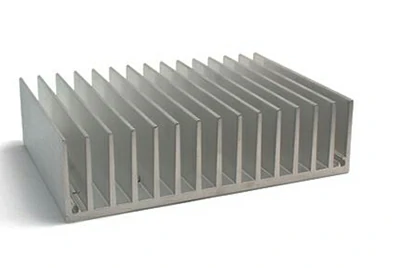
Features and advantages:
- High aspect-ratio straight fins improve convective cooling.
- Fins and base are one extrusion, giving low thermal resistance and high reliability.
- Lightweight and easy to machine, with much lower cost than copper heatsinks.
- Easy to assemble with thermal tape, Z-clips or screws.
Typical applications:
- Switch-mode power supplies, power modules, DC/DC converters
- IGBT / MOSFET, drivers, power modules
- Industrial control boards, servo drives, cabinet electronics
Size range:
- Component footprint: approx. 10 × 10 mm to 60 × 60 mm
- Heatsink height: approx. 2–25 mm (within our general 4–40 mm capability, higher designs available on request)
Slant fin heat sinks
Slant fins are arranged at an angle to increase effective surface area and create more airflow turbulence.
With fans or cabinet airflow channels, they deliver higher cooling performance than standard straight fins.
Slant-fin heatsinks provide a short thermal path, low resistance and light weight, while staying easy to machine for drilling, slotting and CNC work.
Contact Us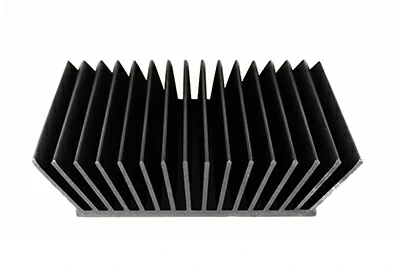
Features and advantages:
- Slanted fin design increases cooling surface area.
- One-piece aluminum extrusion with a continuous thermal path and low resistance; much lighter than copper.
- High performance with better cost efficiency than complex brazed or bonded structures.
- Compatible with thermal tape, Z-clips and screws for easy assembly and maintenance.
Typical applications:
- Forced-air cooling power supplies and DC/DC modules.
- IGBT drivers, servo systems and inverters.
- Telecom equipment and board-level cooling inside chassis with airflow channels.
Size range (customizable):
- Component size: approx. 10 × 10 mm to 60 × 60 mm.
- Heatsink height: approx. 2–25 mm.
Round / STAR LED aluminum heat sink profiles
Round, star and radial-fin LED heat sinks are round-section aluminum extrusions designed for downlights, spotlights and streetlights.
Radial fins spread around the circumference to maximize air contact, providing ample cooling area in compact lamp housings.
Contact Us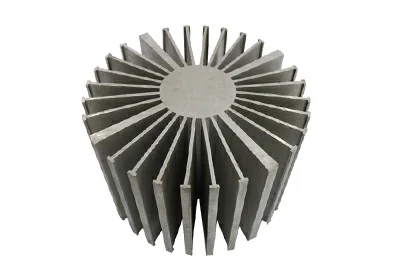
Using one-piece aluminum extrusion, the base and fins are formed from a single profile.
This shortens the thermal path, lowers resistance and reduces weight, making it ideal for turning, slotting, tapping and integrated lamp-body designs.
Internal or external threads can be reserved at the bottom for mounting lens holders, covers or brackets, simplifying full-lamp integration.
Features and advantages:
- Radial round-fin design supports multidirectional airflow.
- Purpose-built for LED lighting, balancing cooling, appearance and structural integration.
- One-piece aluminum extrusion with continuous thermal path; lightweight and easy for turning, drilling and CNC work.
- Flexible length, cut from approx. 18–1000 mm.
- Optional anodizing or coating for better corrosion resistance and emissivity.
Typical applications:
- LED downlights, spotlights, track lights.
- Industrial lights, tunnel lights, streetlights.
- Round power supplies and cylindrical electronic modules.
Customizable length:
- Length (A): 18.0–1,000.0 mm
- Width (B): 45.0–100.0 mm
Pin fin heat sinks
Pin-fin heat sinks mount directly on device packages and PCBs.
They are stamped or extruded and then cross-cut into pin structures that match TO-220, D2PAK, BGA, QFP and other package footprints.
With spring-clip holes or snap grooves, they make fast, reliable contact with the PCB or device for efficient mass assembly.
Pin-fin heat sinks place rows of aluminum "pins" on the base, in round, square or oval shapes.
Contact Us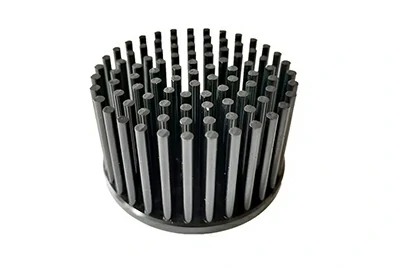
Compared with straight fins, pin-fin structures offer higher surface area, less sensitivity to airflow direction and lower pressure drop.
They are ideal for tight PCBs with complex or unclear airflow, such as inside enclosures or at duct bends.
Features and advantages:
- High-surface-area pin fins greatly increase convective cooling area.
- Friendly to multidirectional airflow, performing well in disturbed or low-airflow conditions.
- Low-pressure-drop design with smooth channels between pin arrays, reducing system duct resistance.
- One-piece aluminum for continuous conduction, short thermal path, low weight and better cost than copper heat sinks.
- Flexible mounting, supporting thermal tape, Z-clips, spring push-pins, MaxiGRIP and other fixings.
- Optional black anodizing for better corrosion resistance and surface emissivity.
Typical applications:
- DC/DC converter bricks (quarter-brick, half-brick, full-brick).
- FPGA, ASIC, CPU / GPU and other high-power BGA / QFP chips.
- Telecom, power, server and industrial control board-level cooling.
- High power-density modules with complex airflow and limited space.
Size matching:
- Device footprint: approx. 10 × 10 mm to 60 × 60 mm.
- Heat sink height: approx. 2–25 mm (customizable).
- Dedicated profiles and board-level heat sink solutions available for quarter-brick / half-brick / full-brick DC/DC modules.
Popular aluminum heat sink extrusion sizes
The sizes below are common and widely used aluminum heat sink extrusion profiles in the industry.
They are provided for quick selection and preliminary evaluation, and do not represent our in-stock dies.
If you need specific dimensions or a special cross-section, we can design and customize dies based on your drawings and application requirements.
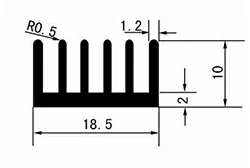
18.5 mm × 10 mm heat sink extrusion
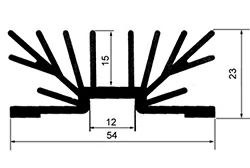
54 mm × 23 mm heat sink extrusion
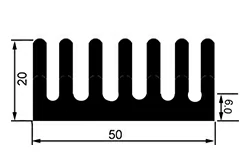
50 mm × 20 mm heat sink extrusion
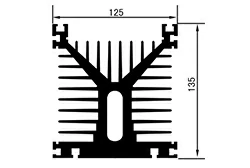
125 mm × 135 mm heat sink extrusion
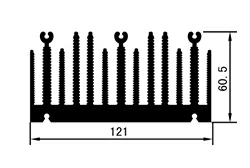
121 mm × 60.5 mm heat sink extrusion
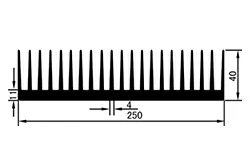
250 mm × 40 mm heat sink extrusion
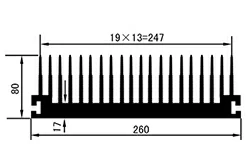
260 mm × 80 mm heat sink extrusion
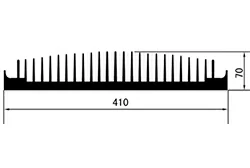
410 mm × 70 mm heat sink extrusion
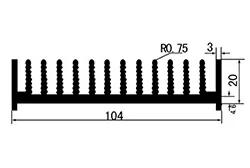
104 mm × 20 mm heat sink extrusion
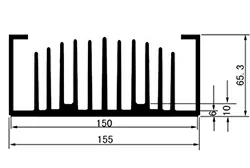
155 mm × 65.3 mm heat sink extrusion
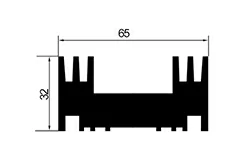
65 mm × 32 mm heat sink extrusion
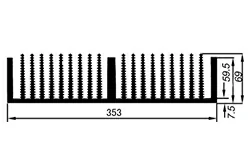
353 mm × 64 mm heat sink extrusion
If you need more heat sink profile and die size options, feel free to contact us anytime.
Common alloys for heatsink extrusions
6063-T5 heatsink extrusions
Good thermal conductivity, approx. 200 W/m·K.
Excellent extrudability for thin walls, tight fin spacing, complex geometries and high-surface-area profiles; superior anodizing appearance.
Suitable for: most straight-fin, slant-fin, round LED and pin-fin extruded heat sinks.
6061-T6 heatsink extrusions
Thermal conductivity is around 167 W/m·K, but it offers higher strength and rigidity with good impact and vibration resistance.
It also machines well.
Suitable for: large-size or load-bearing integrated heat sinks such as motor housings, chassis baseplates and structural frames with built-in cooling.
1050 / 1050A heatsink extrusions
High purity (~99.5%) with thermal conductivity up to 230 W/m·K, one of the best among common aluminum grades, but with lower strength.
Suitable for: extreme cooling or high power density with low mechanical load, reinforced through structural design if needed.
Other 6xxx alloys (such as 6060) can also be selected to balance thermal conductivity, strength and extrusion difficulty based on project needs.
For most extruded heatsinks, we recommend 6063-T5 as the default choice, balancing thermal performance, extrudability, appearance and cost.
Surface finishing for aluminum heat sink extrusions
All heat sink extrusions come in a degreased mill-finish state by default, with optional finishes available per project needs.
Mill finish (natural aluminum / uncoated)
Shipped after cleaning, deburring, alkaline etching and decontamination.
Suitable for cost-sensitive applications and indoor forced-air cooling systems.
Anodized aluminum heatsinks
Anodizing per MIL-A-8625 Type II is available in:
- Clear anodized aluminum heatsinks.
- Black anodized aluminum heatsinks.
- Gold and other optional colors aluminum heatsinks.
Chromate conversion coating
Per MIL-DTL-5541, we offer:
- Hexavalent chromium (traditional process, non-RoHS, used only for special requirements).
- Clear trivalent chromium / chromium-free conversion (RoHS compliant).
Ideal for heatsinks requiring surface conductivity and basic corrosion protection, and as a base layer before painting or powder coating.
Other optional finishes
- Hard anodizing
- Powder coating or painting
- Plating, silkscreen printing, laser marking, etc.
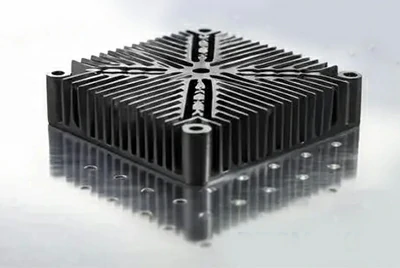
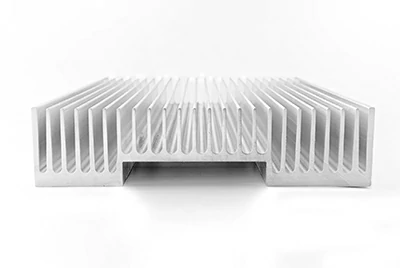
Custom aluminum heat sink extrusion solutions
For custom extruded aluminum heatsinks, we don't just sell profiles—we provide full support from thermal design to machining.
We support samples, small pilot runs and high-volume production, covering every stage from development to long-term supply.
Base plate design
- Typical base thickness: approx. 4–10 mm
- For high power or concentrated heat sources (IGBTs, motor drivers, industrial CPUs), a 6–10 mm base is recommended to allow heat spreading before it enters the fins and to avoid hot spots.
- For lighter loads or distributed heat sources, a thinner base can reduce weight and material cost.
You only need to provide device size, power and mounting method, and we will recommend the proper base thickness and any required holes, countersinks or features.
Fin design
We customize fin designs based on cooling method (natural convection or forced air), airflow direction and space limitations.
Fin shapes: straight fins, slant fins, radial fins, pin fins, etc.
Fin spacing:
- Natural convection: wider spacing (e.g., 8–10 mm) for smooth airflow.
- Forced air: higher fin density with tighter spacing (e.g., 2–3 mm) to increase surface area.
Maximum fin height-to-thickness ratio: up to 20:1.
Fin thickness: 0.8–2.0 mm
Fin height: 10–60 mm.
Function-integrated design
With aluminum extrusion, we can build many functions directly into the profile in one step, reducing extra parts and assembly cost, for example:
Integrating threaded mounting bosses, rails and slots.
Reserving cable channels and PCB slots.
Designing dedicated airflow channels and ribs for ducted cooling.
Combining with liquid tubes or cold plates to create hybrid cooling solutions.

This reduces part count at the same cooling performance and lowers assembly and maintenance cost.
You only need to share drawings or operating conditions, and we handle everything: thermal design optimization, alloy and surface finish selection, CFD simulation, extrusion and CNC machining, surface treatment and final assembly.
Secondary machining services for aluminum heat sink extrusions
Beyond extrusion, we provide full secondary machining and finishing services to turn profiles into ready-to-install heatsinks.
- Precision cutting and sawing: accurate length cutting, chamfering and deburring for proper fit and appearance.
- CNC milling / turning / drilling / tapping / slotting: machining mounting holes, threaded holes, countersinks, locating slots; creating airflow channels, rails and assembly steps.
- Complex geometry machining: 3-axis / 4-axis / 5-axis CNC centers for irregular surfaces, angles and cavities.
- Other metal processing: stamping, precision trimming, local grinding and more as required.
With these machining capabilities, we deliver "assembly-ready heatsink components," helping you reduce suppliers, shorten development cycles and speed up final assembly.
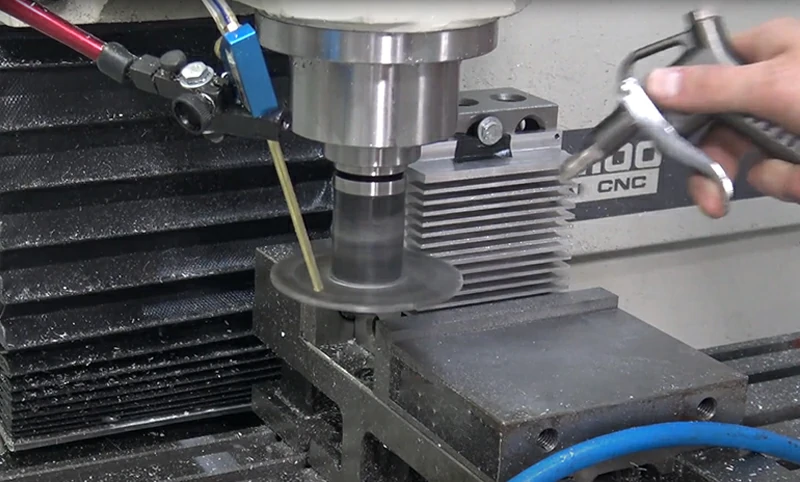
Frequently asked questions FAQ
Is aluminum a good heatsink?
Yes. It offers good thermal conductivity, low weight, easy extrusion for complex fins and lower cost than copper, which is why most heatsinks are made of aluminum.
What is the best metal for heatsinks?
Copper has the highest thermal conductivity, but considering performance, weight, cost and manufacturability, aluminum is the most practical and widely used material in engineering.
Which is better for heatsinks, copper or aluminium?
For small areas and extreme power density, copper performs better.
For large profiles, integrated structures, and applications requiring controlled weight and cost, aluminum heat sink extrusions are more suitable.
What is the purpose of the aluminum heat sink?
To pull heat away from chips or modules and transfer it into the air through fins, preventing overheating and extending device lifespan.
What are the common mounting methods for aluminum heatsinks?
Thermal double-sided tape, thermal adhesives/epoxy, Z-clips, spring push pins, and spring-loaded screws or standoffs, depending on package type and maintenance needs.
How to get a quote for aluminum heat sink extrusions
To speed up selection and quotation, please share:
- Heat source power and operating temperature target.
- Cooling method (natural convection or forced air, airflow direction if known).
- Available envelope size (L × W × H) and mounting method.
- Preferred alloy (6063 / 6061 / 1050) and surface finish (mill finish / anodized).
- Drawings (2D/3D) or reference photos if available.