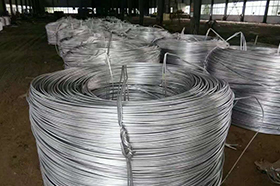
5356 aluminum filler rod is a non-heat-treatable, aluminum–magnesium (Al–Mg) alloy with a nominal magnesium content of approximately 5%. Under AWS A5.10 and international welding standards, its common designation is ER5356.
Chalco can supply a range of standard and custom sizes, with diameters covering approximately 0.9–9.5 mm (0.035"–3/8"). The standard length is 36" (about 914 mm), and 1000 mm or other specified lengths are also available. With a complete product specification range, it is suitable for different welding processes and application requirements. Non-standard diameters, cut-to-length service, and bulk customization can also be provided upon customer request.
Best-Selling Sizes of 5356 Aluminum Filler Rod
| Diameter × Length | Diameter | Length |
| 0.035" × 36" | 0.035"(≈0.9 mm) | 36"(≈914 mm) |
| 0.045" × 36" | 0.045"(≈1.2 mm) | 36"(≈914 mm) |
| 1/16" × 36" | 1/16"(≈1.6 mm) | 36"(≈914 mm) |
| 3/32" × 36" | 3/32"(≈2.4 mm) | 36"(≈914 mm) |
| 1/8" × 36" | 1/8"(≈3.2 mm) | 36"(≈914 mm) |
| 5/32" × 36" | 5/32"(≈4.0 mm) | 36"(≈914 mm) |
| 3/16" × 36" | 3/16"(≈4.8 mm) | 36"(≈914 mm) |
| 1/4" × 36" | 1/4"(≈6.4 mm) | 36"(≈914 mm) |
| 5/16" × 36" | 5/16"(≈7.9 mm) | 36"(≈914 mm) |
| 3/8" × 36" | 3/8"(≈9.5 mm) | 36"(≈914 mm) |
If the above sizes cannot meet your actual application requirements, please contact us for more sizes or customization support.
Diameter Selection Recommendations
When choosing a 5356 TIG filler rod diameter, focus on two key factors: how fine the weld bead needs to be and how fast you need to fill. The smaller the bead and the more you emphasize appearance and control, the smaller the diameter you should choose; the larger the bead and the more you prioritize deposition efficiency, the larger the diameter you should choose. Below are diameter selection recommendations for common conditions—you can choose directly by matching your bead size and filling requirements.
Thin sheet, small weld bead, appearance first
Suitable for applications that require finer bead control, better bead appearance, and easier heat input control. Typically, 1.6 / 2.0 / 2.4 mm (equivalent to 1/16", 3/32") are preferred.
Suggested use: For samples, small parts, decorative components, and structural parts sensitive to weld appearance, it is most reliable to start with 2.4 mm (3/32"). If it is still too thick, reduce to 1.6 or 2.0 mm.
General structural welding, medium deposition
This is the most common general-purpose range, offering good efficiency while keeping the weld bead well-filled. Typically, 2.4 / 3.2 mm (equivalent to 3/32", 1/8") are selected.
Suggested use: For standard brackets, frames, guardrails, and trailer/vehicle body structures, prioritize 3.2 mm (1/8") for higher efficiency. If you need finer shaping or a smaller bead, switch back to 2.4 mm (3/32").
Large weld bead, thick-section filling, efficiency first
When higher deposition volume, greater deposition efficiency, or a noticeably larger bead size is required, 3.2 / 4.0 mm (equivalent to 1/8", 5/32") are recommended.
Suggested use: For thick-plate joints, large beads, multi-pass filling, and production-focused shop welding, prioritize 3.2 mm. If deposition still feels slow or the bead is very large, step up to 4.0 mm (5/32").
5356 Filler Rod Product Overview
| Alloy | 5356 Aluminum Filler Rod(Alloy 5356 / ER5356 / R5356) |
| Used on | Suitable for welding magnesium-containing aluminum alloys: 5251 (N4), 5154 (N5), 5454 (N51); also suitable for heat-treatable aluminum alloys: 6063 (H9), 6061 (H20), 6082 (H30). |
| Cross-Reference of Specifications | DRU 1374;UNS A95356;DTD 279;ER5356 (AWS A5.10.92);R5356 (AWS A5.10.92);MSRR9500/38;(Replacement for 5056)(N6, NG6);W (N) 3.35566;DIN Al-Mg5;DE58;S Al5356;EN ISO 18273;BS 2901. |
| Sizes / Availability | Spools: 0.5kg, 2.5kg, 15kg; 1lb, 5lb, 25lb. Rods: 1kg, 2.5kg, 5kg, 10kg packs; 5lb. Length: 1000mm / 36". |
| Diameter Range | Best-selling diameters: 1.6mm / 2.4mm / 3.2mm; 1/16" / 3/32" / 1/8" / 5/32"; custom diameters and packaging available upon request. |
| Diameter Tolerance | Diameter tolerance is controlled according to applicable welding consumable standards/customer requirements to ensure stable wire feeding and consistent welding; customization is available to match equipment requirements. |
| Weld Properties | Melting temperature range: 575–633°C; density: 2.64 g/cc. 5356 is an Al-Mg-Mn (with Cr, Ti) welding alloy used for welding alloys with similar compositions; 5356 is increasingly used as a replacement for 5056. |
Key Features of 5356 Aluminum Filler Rod
As a widely used "general-purpose" filler metal, its alloy system is designed for high-strength joints. Unlike the silicon-based 4043 alloy, 5356 primarily relies on magnesium (Magnesium) as the main alloying element, which gives it the following distinct metallurgical characteristics:
- High-strength crystal structure: It is one of the highest-strength welding fillers among the 5xxx series aluminum alloys, and the weld metal's shear strength (Shear Strength) is typically twice that of the 4043 series.
- Grain-refining mechanism: A trace amount of titanium (Titanium, 0.06–0.20%) is intentionally added to the alloy composition. During solidification in TIG welding, titanium helps refine the grains, significantly reducing sensitivity to hot cracking and ensuring a dense weld interior.
- Non-heat-treatable strengthening characteristics: 5356 is a non-heat-treatable alloy, meaning it does not rely on subsequent heat treatment to obtain strength. Instead, through the alloy's own solid-solution strengthening and work-hardening capability, it can provide excellent mechanical properties in the as-welded condition.
5356 vs 4043: How to Choose the Right Aluminum Filler Rod?
In aluminum alloy welding, 5356 and 4043 are the two filler materials most often considered together. There is no absolute "better" or "worse" between them; instead, each is suitable for different base materials, service environments, and performance priorities.
- Color match: If post-weld anodizing is required and appearance consistency is critical, 4043 filler rod is generally not recommended. This silicon-based filler often shows a darker gray color difference after anodizing. In comparison, 5356 filler rod is more likely to achieve a closer color match to the base metal after anodizing.
- Temperature: In higher service-temperature applications, 4043 is generally more suitable. For 5356, due to its magnesium content characteristics (the typical feature of about 5% Mg), it is not recommended for high-temperature service, and selection should be evaluated based on the actual working temperature.
- Ductility: 4043 generally has lower ductility than 5356. If bending, flanging, or secondary forming is required after welding, the ductility difference should be considered; when "post-weld forming" requirements are higher, 5356 often has an advantage.
- Shear strength: 4043 has lower shear strength than 5356. When structural design involves fillet-weld loading, lap joints, or locations dominated by shear loading, the shear strength difference affects weld size and safety margin calculations and should be considered an important basis for selection.
- Alloy softness: Compared with 5356, 4043 is usually "softer" in the coiled filler wire (spool) form. In gas metal arc welding (GMAW/MIG), wire feeding performance is influenced not only by the contact tip, drive rolls, and liner, but also by the stiffness of the filler wire. Generally, the harder 5356 is more conducive to stable feeding; however, under normal setup and maintenance conditions, wire feeding is no longer a key factor limiting the use of 5356.
- Welding performance: 4043 typically offers higher "welding friendliness," with slightly lower crack sensitivity, smoother weld appearance, and less spatter and surface slag. Therefore, when weld handling feel, appearance quality, or on-site conditions fluctuate significantly, 4043 is often preferred by welders. While 5356 may be less "forgiving" than 4043 in handling and bead formation, it is more oriented toward applications requiring structural performance and corrosion resistance.
The table below shows the typical shear strength of various filler alloys. As shown, the transverse shear strength of 4043 alloy is 15 ksi, while the typical transverse shear strength of 5356 alloy in the same direction is 26 ksi.
When a filler alloy selection chart allows multiple filler rods (such as 4043, 5356, etc.) at the same time, customers can refer to the differences in typical shear strength of welds made with different filler alloys in this table as one of the key bases for selection decisions.
This comparison helps determine which filler rod better meets the requirements for weld load-bearing capacity, structural safety, or design margin under specific structural forms and loading conditions.
| Filler alloy | Longitudinal shear strength (KSI) | Transverse shear strength(KSI) |
| 1100 | 7.5 | 7.5 |
| 2319 | 16 | 16 |
| 4043 | 11.5 | 15 |
| 4643 | 13.5 | 20 |
| 5183 | 18.5 | 28 |
| 5356 | 17 | 26 |
| 5554 | 15 | 23 |
| 5556 | 20 | 30 |
| 5654 | 12 | 18 |
Key Selection Risks and Usage Precautions
When selecting 5356, you should consider both its advantages and its application limits. 5356 is a widely used general-purpose filler alloy, and in many cases it is preferred due to its relatively high shear strength.
However, note that when it is used for welding 5XXX-series base metals, if the magnesium content in the weld pool is higher than 3% and the service temperature of the component exceeds 65 °C, the risk of stress corrosion cracking (SCC) in the weld can increase significantly under certain stress conditions.
Therefore, for conditions involving high-temperature service, long-term loading, or high stress, it is not advisable to use "higher weld strength" as the only decision basis. Design temperature, stress level, and service environment (such as humidity or salt spray) should be evaluated together. If necessary, compare alternative filler material options or have the selection confirmed by a welding engineer.
Under conventional structural, marine, and general industrial conditions, as long as the design and process controls are appropriate, 5356 remains a mature, stable, and widely proven filler material, balancing corrosion resistance and engineering applicability.
Applications of ER5356 Aluminum Filler Rod
5356 filler rod is widely used in aluminum alloy welding applications with clear requirements for structural reliability and service life, thanks to its higher weld strength, good corrosion resistance, and stable welding performance. Compared with filler materials that prioritize formability, 5356 is more suitable for load-bearing and long-term service conditions.
-
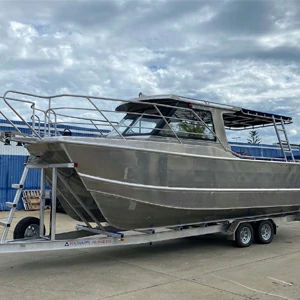 Marine and offshore engineering
5356 filler rod is commonly used for welding aluminum alloy hulls, deck structures, cabins, ladders, and supporting members. Its Al–Mg composition offers good corrosion resistance in seawater and high-humidity environments, making it suitable for small vessels, fishing boats, workboats, and related offshore structural components.
-
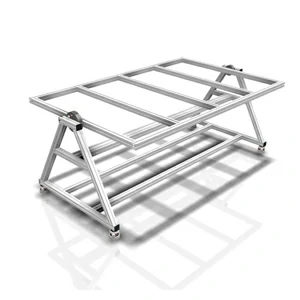 Aluminum structural parts and frames
In industrial equipment, platform structures, brackets, and load-bearing frames, 5356 filler rod is used to weld 5xxx-series aluminum structural components. It is especially suitable for fillet welds and load-bearing weld locations where weld strength and fatigue performance are required.
-
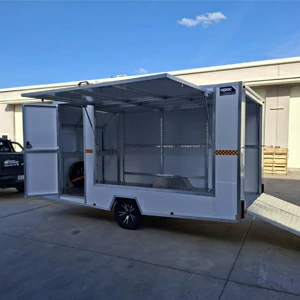 Transportation and vehicle manufacturing
5356 aluminum filler rod is widely used in aluminum alloy welding for truck bodies, trailers, box structures, and rail vehicle components. Its weld strength and consistency help meet vehicle structure requirements for safety and durability.
-
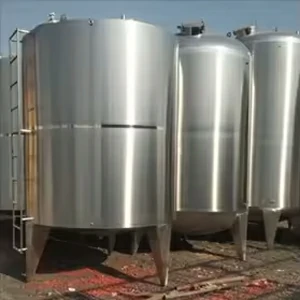 Pressure vessels and industrial containers
In aluminum alloy tanks, vessels, and related industrial equipment, 5356 filler rod is commonly used for welding areas with high requirements for structural integrity and long-term sealing performance, suitable for chemical, energy, and general industrial applications.
-
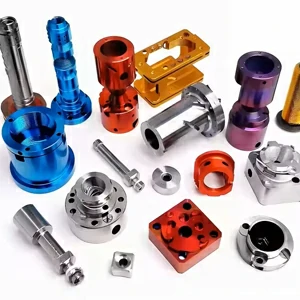 Anodized parts and appearance-critical components
For aluminum parts that require anodizing after welding, 5356 filler rod typically provides better color matching than silicon-based filler rods, making it more suitable for structural or decorative components with appearance consistency requirements.
Storage & Handling Recommendations
To ensure that 5356 aluminum filler rod remains in good condition in terms of stable wire feeding, consistent welding performance, and surface cleanliness, it is recommended to store and handle it according to the following principles. When not in use, the filler rod should be kept in its original packaging, intact and sealed as much as possible, to prevent moisture absorption or contamination caused by damaged packaging.
The storage environment should be a dry, enclosed area with relatively stable temperature, avoiding frequent temperature fluctuations that cross the dew point and create condensation. Recommended storage conditions are 4–49°C (40–120°F) with relative humidity not exceeding 80%.
Any form of moisture (such as dripping water, condensation, or immersion) may cause the filler rod surface to become damp, increasing the risk of welding defects and potentially affecting welding performance and warranty conditions.
When transferring filler rod from a low-temperature environment to a higher-temperature environment, it is not recommended to open and use it immediately. The filler rod should be left in the use environment for at least 24 hours to acclimate, reducing the risk of surface condensation and avoiding welding defects such as porosity caused by condensed water.
During handling and use, avoid contaminating the filler rod surface with oil, dust, or hand perspiration, and avoid touching the filler rod directly with bare hands or dirty gloves. In addition, keep contamination sources such as compressed air exhaust, grinding dust, paint, or lubricant spray away from the storage and use areas for the filler rod.
For spool-packaged products, avoid lifting by pulling on one side of the flange during handling to prevent flange deformation, which may lead to wire tangling, wire jumping, or poor wire feeding.
Physical Properties of 5356 Aluminum Filler Rod
| Melting range | 1060–1175°F (571–635°C) |
| Density at 68°F | 0.096 lb/in³ |
| Electrical conductivity (-O) | 29% IACS |
| Electrical conductivity (-H18) | 27% IACS |
| Corrosion resistance | A (Gen) / C (SCC) |
| Hardness (Brinell) | 105 (-H18) |
| Anodized color | White |
Chemical Composition of 5356 Aluminum Filler Rod
| Element | Composition |
| Al | Remainder |
| Si | 0.25 max |
| Fe | 0.40 max |
| Cu | 0.05 max |
| Mn | 0.5 – 1.1 |
| Mg | 1.6 – 2.5 |
| Cr | 0.3 max |
| Zn | 0.20 max |
| Ti | 0.15 max |
| Other (each) | 0.05 max |
| Others (total) | 0.15 max |
Other Welding Products You May Be Interested In
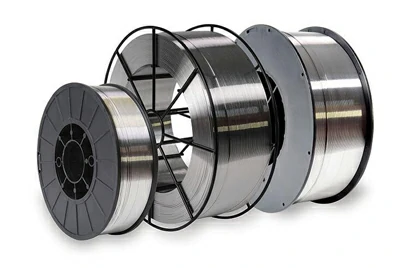
ER4047 Welding Wire
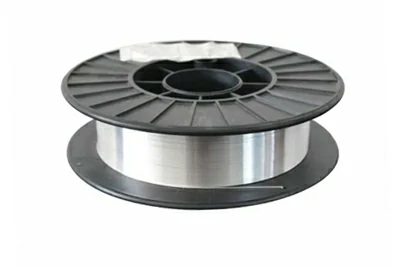
ER4043 Welding Wire
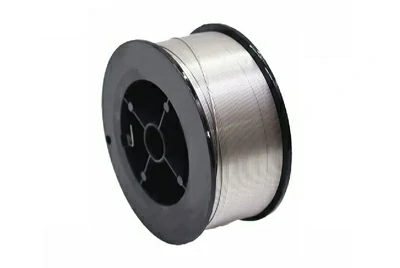
Aluminum Mig Tig Welding Wire
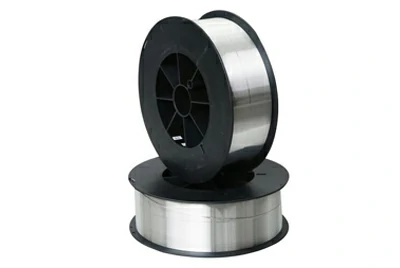
ER5356 Welding Wire
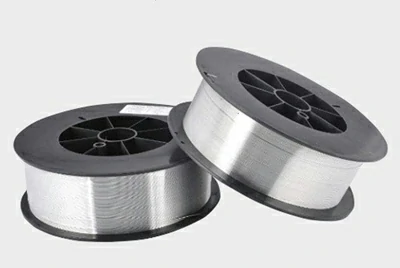
ER4943 Welding Wire
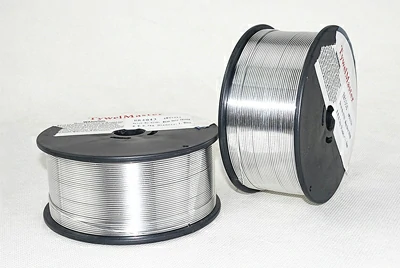
ER5183 Welding Wire
FAQ
What is the difference between 5356 aluminum filler rod and 5356 aluminum welding wire?
They are basically the same in chemical composition and welding performance. The main differences lie in form and the applicable welding processes. 5356 aluminum filler rod is in rod form and is typically used for manual welding such as TIG (GTAW), where the welder adds it by hand; 5356 aluminum welding wire is in wire form and is mainly used for MIG (GMAW) and other semi-automatic or automatic welding, where the equipment feeds the wire continuously for higher welding efficiency.
Which aluminum alloys is 5356 aluminum filler rod mainly used for welding?
5356 aluminum filler rod is mainly used for welding magnesium-containing aluminum alloys (5xxx series), such as 5251, 5154, and 5454. At the same time, when higher weld strength, structural reliability, or corrosion resistance is required, it is also commonly used for welding some 6xxx series aluminum alloys (such as 6061, 6063, and 6082).
What are the main differences between 5356 and 4043 in welding operation?
4043 aluminum filler rod is known for good weld fluidity and a more forgiving operating feel, making it easier to achieve a smooth weld appearance and less sensitive to variations in technique and process conditions. In comparison, 5356 has a slightly narrower operating window, but with proper parameter control it can provide higher weld strength and more stable structural performance.
Must 4043 be used when welding 6061 aluminum alloy?
Not necessarily. 4043 is commonly used for 6061 because it offers good weldability and lower crack sensitivity; however, in applications requiring higher weld strength, load-bearing capacity, or consistent anodized color after welding, 5356 is also a widely proven feasible option. The specific selection should be based on the service environment and performance priorities.
Is 5356 suitable for marine or high-humidity environments?
Yes. As an Al–Mg filler rod, 5356 has good corrosion resistance in seawater, high-humidity, and general industrial atmospheric environments, so it is often used in marine vessels, offshore structures, outdoor aluminum components, and transportation applications.
Can welds made with 5356 filler rod be anodized?
Yes. Compared with silicon-based filler rods, 5356 welds typically match the base metal color more closely after anodizing and are less likely to show obvious darkening or gray color differences, giving it an advantage in projects with appearance consistency requirements.
Is 5356 suitable for high-temperature or long-term service conditions?
For higher service temperatures or long-term high-stress conditions, selecting 5356 requires careful evaluation. Al–Mg weld metal may have a risk of stress corrosion cracking under certain conditions, so for high-temperature or special service environments, selection should be based on design codes, service conditions, and engineering experience rather than simply pursuing higher weld strength.
What should be noted for storage and use of 5356 aluminum filler rod?
5356 aluminum filler rod should be stored in a dry, enclosed environment with relatively stable temperature to avoid moisture and condensation. Before use, it should be sufficiently acclimated to the ambient temperature, and during operation, oil, dust, and hand perspiration should be avoided from contaminating the filler rod surface to ensure stable wire feeding and welding quality.
Do you support non-standard specifications or customized supply?
In addition to common diameters and standard packaging, 5356 aluminum filler rod typically supports customized diameters, lengths, packaging forms, and traceability labels to meet different welding equipment, process requirements, and project needs. Specific parameters can be confirmed during the inquiry stage.
Chalco can provide you the most comprehensive inventory of aluminum products and can also supply you customized products. Precise quotation will be provided within 24 hours.
Get a quote