



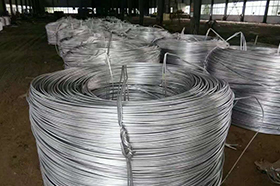
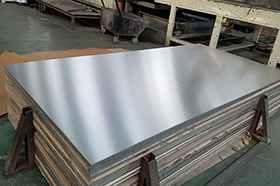

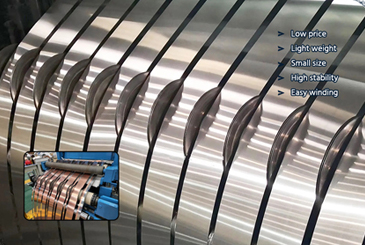


ACSR (Aluminum Conductor Steel Reinforced) is a widely used overhead transmission conductor featuring aluminum strands concentrically stranded around a high-strength steel core. The aluminum provides efficient electrical conductivity, while the steel core ensures tensile strength for long-span overhead lines.
ACSR conductors are commonly applied in power transmission and distribution systems across multiple voltage levels. Chalco supplies pre-stranded ACSR bare conductors with customizable core types and strand configurations to meet specific span, tension, and structural requirements of transmission projects.
In practical overhead line applications, ACSR conductors offer the following advantages:
- Its high mechanical strength makes it suitable for long-span and high-tensile-level track designs.
- Stable current-carrying capacity to meet the normal operating requirements of transmission and distribution lines.
- Controlled thermal elongation characteristics contribute to sag control and operational stability.
Structural composition of ACSR
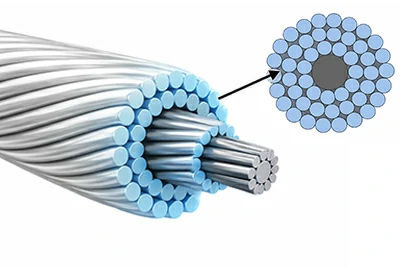
ACSR employs a concentric stranding structure, consisting of multiple layers of aluminum wire stranded around a central steel core. This structure exhibits excellent stability under axial stress and operational vibration conditions, meeting the basic requirements for long-term operational reliability of overhead transmission lines.
-
Outer aluminum wire
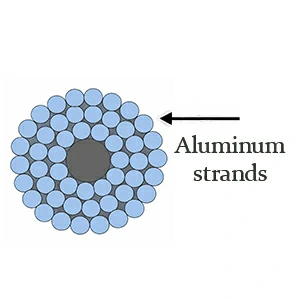
For functions involving current transmission, highly conductive aluminum is typically selected to meet the current-carrying capacity requirements of the line.
-
Central steel core
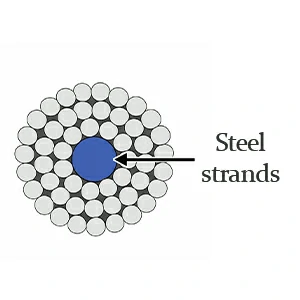
It provides the necessary mechanical strength and tensile strength to enable the conductor to adapt to larger spans and tension conditions.
By dividing the functions of the outer aluminum wire and the central steel core, the ACSR achieves a rational distribution of conductivity and mechanical properties in its structural design. The aluminum wire focuses on electrical performance, while the steel core focuses on load-bearing capacity and stability.
Both work collaboratively within the same stranded structure, ensuring that the conductor meets power transmission requirements while possessing a reliable structural safety margin. This clear structural logic provides the foundation for the widespread application of ACSR in various power transmission scenarios.
ACSR Conductor Structural Design and Steel Core Coating Options
Chalco offers pre-stranded ACSR bare conductors for overhead transmission and distribution projects. The conductors feature a concentric stranding structure, consisting of an outer layer of conductive aluminum wire and a central steel core. This provides the necessary mechanical strength while meeting the current-carrying requirements of the line, making them suitable for overhead lines with high span and tension requirements.
Outer conductive aluminum wire configuration
The outer aluminum wire carries current and is made of highly conductive aluminum, balancing performance, weight, and cost. It is typically used as a bare conductor, with material and surface condition confirmed per project requirements.
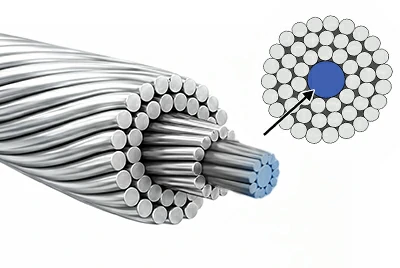
Steel core structure
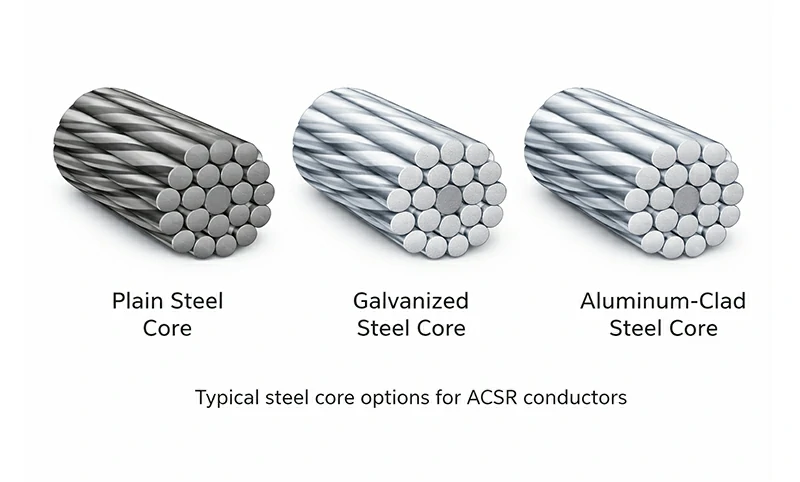
The central steel core provides the primary mechanical strength of ACSR, enhancing tensile capacity and supporting longer spans. It can be configured as conventional or aluminum-clad steel core to match different span and stress requirements.
To meet the corrosion resistance requirements under different operating environments, without changing the basic structure of the conductor, the steel core of the ACSR conductor can be selected with different surface coating forms according to the project conditions.
- Grade A (GA) galvanized steel core: Standard zinc coating, suitable for most normal environments.
- Grade B (GB) galvanized steel core: Thickened zinc coating, suitable for moderately corrosive environments.
- Grade C (GC) galvanized steel core: Thickest zinc coating, suitable for coastal or heavily corrosive areas.
- Aluminum-clad steel (AW): A steel core with an aluminum coating, suitable for zinc-sensitive or special corrosive environments.
- Zinc-aluminum alloy coatings (such as MA): Improve durability under specific corrosive conditions.
The specific coating type is usually selected based on the line operating environment, design specifications, and project technical requirements.
Chalco ACSR conductor supply form
ACSR conductors are manufactured using a concentric stranding method. The combination of aluminum wire and steel core strands can be configured according to project requirements to match the cross-sectional area, span requirements, and stress conditions. Chalco can provide pre-stretched conductors and supports common reel or spool packaging to suit different construction and laying conditions.
For project orders, we can assist with specification confirmation and batch consistency control to meet the conductor consistency requirements during construction and operation.
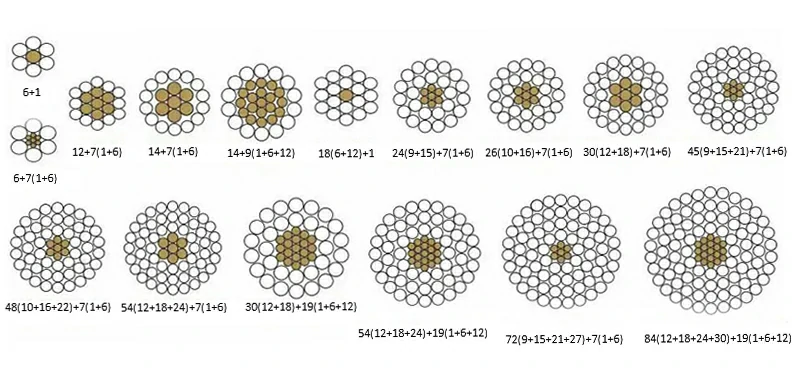
The table below lists some common ACSR specifications and their typical structural forms for engineering selection and size reference. Specific structural configurations and parameter ranges should be confirmed based on project requirements and applicable standards.
| Code Word | Size (AWG / kcmil) | Typical Stranding (Al / Steel) | Nominal OD (mm) | Nominal Weight (kg/km) |
| Turkey | 6 AWG | 6 / 1 | 5.0 | 54 |
| Swan | 4 AWG | 6 / 1 | 6.4 | 85 |
| Raven | 1/0 AWG | 6 / 1 | 10.1 | 216 |
| Penguin | 4/0 AWG | 6 / 1 | 14.3 | 433 |
| Linnet | 336.4 kcmil | 26 / 7 | 18.3 | 688 |
| Hen | 477 kcmil | 26 / 7 | 22.0 | 973 |
| Drake | 795 kcmil | 26 / 7 | 28.1 | 1628 |
| Condor | 795 kcmil | 54 / 7 | 27.7 | 1524 |
| Bluebird | 1113 kcmil | 54 / 7 | 34.0 | 2215 |
| Falcon | 1590 kcmil | 54 / 19 | 39.0 | 3170 |
The specifications above are common examples used to demonstrate the dimensions and structural coverage of ACSR conductors. For a complete list of dimensions and structural descriptions, please contact Chalco for project parameter confirmation and technical communication.
Common application scenarios of ACSR conductor
ACSRs are widely used in various overhead line scenarios due to their comprehensive balance between current carrying capacity and mechanical strength, and are especially suitable for engineering projects with specific requirements for span, tension and operational stability.
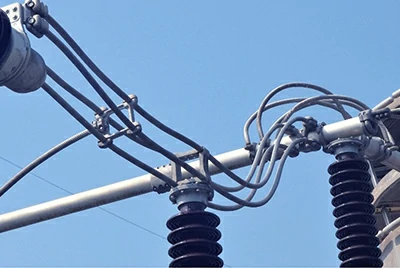
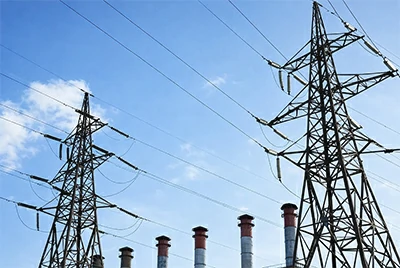
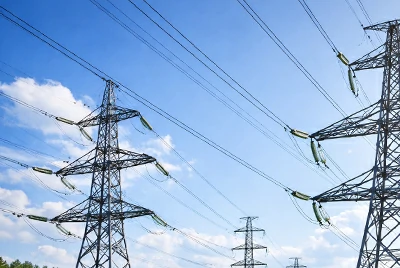
Overhead transmission lines: applicable to medium-voltage and ultra-high-voltage overhead transmission lines in scenarios with specific requirements for span and mechanical strength.
Overhead power distribution lines: used in power distribution line sections with large pole spacing or relatively complex stress conditions.
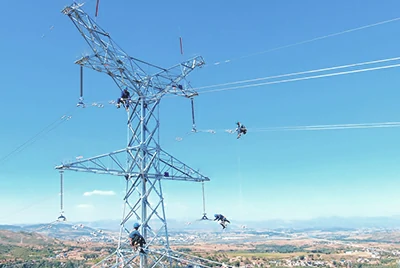
Long-span and complex terrain lines: suitable for line projects that require high tensile strength, such as those crossing rivers, valleys, and mountainous areas.
High wind, icing or high tension areas: can be used in overhead line environments with high wind load, ice load or high operating tension.
Existing line renovation and expansion projects: applicable to projects that upgrade or improve the performance of existing lines when tower conditions are limited.
ACSR Selection Guide: Comparison with Other Overhead Conductors
In overhead power transmission and distribution systems, different types of conductors have different focuses in terms of structural form and application orientation, and the actual selection needs to be comprehensively considered in conjunction with the line conditions. ACSR is usually used as a general-purpose solution that balances current carrying capacity and mechanical strength, and can be used in conjunction with other overhead conductors.
ACSR vs AAC:
AAC prioritizes conductivity and lightweight design, making it suitable for lines with shorter spans and lower mechanical stress requirements.
ACSR vs AAAC:
AAAC has advantages in corrosion resistance and is often used for lines in coastal or highly corrosive environments.
→Click to: [AAAC Overhead Conductors]
ACSR vs ACAR:
ACAR achieves optimized performance through its aluminum alloy core, making it suitable for engineering projects with specific structural and performance requirements.
→ Click to: [ ACAR Overhead Conductors ]
In real-world projects, conductor selection typically requires comprehensive consideration of line voltage levels, span conditions, environmental factors, and engineering design requirements. Chalco offers a variety of overhead conductor products and assists projects in making appropriate selections and configurations under different application conditions.
ACSR Implementation Standards and Technical References
In overhead power transmission and distribution projects, the structural form, performance parameters, and testing requirements of ACSR conductors typically need to comply with the relevant national or regional standards. Different markets differ in their standard systems, design methods, and testing requirements; therefore, in actual projects, the line design documents and applicable specifications should be the final basis.
- ASTM/ANSI Standards System (North America and Related Markets)
- IEC International Standards System
- European standards systems such as EN and BS
- National or regional power industry standards and project technical requirements
Under different standard conditions, even if the nominal size is the same, ACSR conductors may still differ in terms of aluminum/steel strand combination, steel core type and mechanical performance requirements. When selecting a conductor for an engineering project, it is necessary to confirm the specific standard clauses.
The table below lists typical performance ranges for common ACSR conductors in engineering applications to help understand the performance magnitudes under different sizes and structural conditions. Specific values should be confirmed after the conductor specifications, structural form, and applicable standards are determined.
| Performance Category | Parameters | Typical range (example) | Illustrate |
| Electrical properties | DC resistance (20°C) | 0.02 – 0.40 Ω/km | Related to conductor cross-sectional area, aluminum wire material and stranding structure |
| Electrical properties | Rated current carrying capacity | Approximately 200 – 1,500 A | Affected by ambient temperature, installation conditions and standard calculation methods |
| Mechanical properties | Calculate the breaking force (RBS). | Approximately 20 – 250 kN | It is mainly determined by the steel core structure and the combination of aluminum/steel strands. |
| Mechanical properties | Allowable working tension | RBS is approximately 15% – 25%. | The actual value is based on the line design specifications. |
| thermal properties | Continuous operating temperature | 75°C / 90°C / 100°C | Depends on conductor design and implementation standards |
| Structural parameters | unit weight | Approximately 50 – 3,500 kg/km | Coverage from power distribution to large cross-section transmission lines |
| The values shown are typical ranges for reference only. Final performance parameters shall be calculated and confirmed according to the defined conductor specifications, structural configuration, and applicable standards. | |||
In actual engineering implementation, the final structural configuration, performance indicators, and inspection requirements of ACSR conductors should be based on the line design specifications, bidding documents, and project technical conditions. Chalco can cooperate in technical communication and supply confirmation according to the project-specified standards, supporting engineering application needs under multiple standard systems.
Chalco ACSR Manufacturing & Project Capability
Chalco has established stable manufacturing capabilities and project coordination experience in the field of overhead transmission conductors, providing engineering-oriented support for ACSR conductors from structural confirmation to bulk supply. Based on the practical requirements of transmission and distribution projects, Chalco emphasizes structural consistency, process stability, and controlled project execution.
Stable Stranding and Manufacturing Capability
Chalco operates mature concentric stranding production lines and can configure aluminum/steel strand combinations, steel core types, and stranding structures according to project specifications. Structural integrity and product consistency are maintained throughout mass production.
Multi-Specification and Multi-Standard Project Experience
For various voltage levels, line structures, and standard requirements, Chalco supports specification confirmation and technical coordination for ACSR conductors. Supply can comply with ASTM, IEC, and other project-designated standards.
Project-Based Supply and Batch Control
For engineering orders, Chalco coordinates delivery schedules, specification locking, and batch consistency management to meet construction and operational stability requirements of transmission lines.
Technical Communication and Engineering Support
During both pre-project planning and execution phases, Chalco works closely with design institutes, contractors, and project owners to confirm conductor configurations, technical parameters, and supply conditions, ensuring reliable support for project implementation.
FAQ
What span conditions are suitable for ACSR?
ACSR is generally suitable for overhead lines with certain mechanical strength requirements. The specific span capacity needs to be confirmed in combination with conductor size, steel core structure and line design parameters.
Does the steel core affect conductivity?
The current carrying capacity of ACSR is mainly carried by the outer aluminum wire, while the steel core mainly provides mechanical strength. Its impact on the overall conductivity is usually considered comprehensively within the design scope.
How to choose between ACSR and AAAC in engineering?
The two differ in their mechanical properties and corrosion resistance. The actual selection is usually based on a comprehensive judgment of the line environment conditions, span requirements and design specifications.
Is it suitable for high-temperature or high-wind areas?
ACSR can be applied to a variety of operating environments, but its specific applicability needs to be confirmed in conjunction with the conductor design temperature, wind load conditions, and applicable standards.
Does the ACSR support customized structures according to project requirements?
The combination of aluminum/steel strands and the form of the steel core can be configured and confirmed according to project conditions. The specific feasibility needs to be evaluated in conjunction with the technical requirements.
Project Consulting and Collaboration
- Engineering-oriented conductor structure configuration support
- Stable stranding quality and batch consistency control
- Experience in coordinating and executing multi-standard power transmission projects
ACSR conductor selection involves multiple engineering parameters and must be confirmed according to line design conditions and operational requirements. Proper structural configuration directly affects line safety, construction efficiency, and long-term operational stability.
Based on transmission and distribution project needs, Chalco supports technical communication, structural confirmation, and supply coordination for ACSR conductors across different voltage levels, line conditions, and applicable standards.
Chalco also supplies a full range of overhead conductors, including AAC, AAAC, and ACAR, providing comprehensive conductor solutions for power transmission and distribution projects.
Chalco can provide you the most comprehensive inventory of aluminum products and can also supply you customized products. Precise quotation will be provided within 24 hours.
Get a quote