Aramid honeycomb panels, also known as aramid honeycomb sandwich panels, are finished composite panels made from an aramid honeycomb core, facing material, and an adhesive system. Unlike bare honeycomb core, they can be used directly as structural panels for project installation.
Chalco offers GFRP, carbon fiber, and aluminum facing options for rail transit, aerospace, marine, and industrial applications. Standard panel sizes, cut-to-size processing, and curved panel forming are available based on drawings and project requirements.
What are aramid honeycomb sandwich panels?
Aramid honeycomb panels are honeycomb sandwich panels composed of an aramid honeycomb core, skin (or facing) material, and an adhesive system.
After bonding and curing, the core and facing form a lightweight sandwich construction that can be supplied as a finished structural panel.
Unlike bare cores, aramid honeycomb sandwich panels do not require customers to perform additional facing, bonding, or curing steps.
The aramid honeycomb core provides a foundation of lightweight properties, low dielectric constant, and flame resistance, while the facing material influences surface strength, fire performance, impact resistance, and environmental suitability.
Chalco aramid honeycomb panel facing options
Chalco provides aramid honeycomb panels with different facing configurations based on project-specific environmental conditions, fire safety requirements, weight targets, and panel functions.
Common options include GFRP, carbon fiber, and aluminum facings, with custom panel structures also available upon request.
GFRP-faced aramid honeycomb panels
When projects require fire resistance, electrical insulation, and lightweight construction, phenolic GFRP is a common choice.
GFRP-faced aramid honeycomb panels combine glass fiber reinforced plastic (GFRP) facings with an aramid honeycomb core.
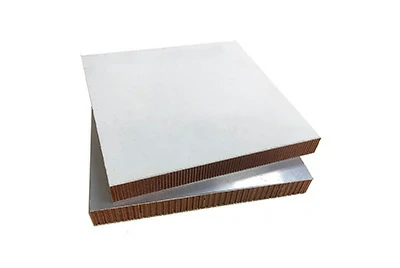
This configuration is commonly used for interior wall panels, ceiling panels, partitions in rail transit, aircraft cabin interior panels, and marine interior composite panels.
Total panel thickness, areal weight, and surface finish vary depending on core density, facing thickness, and adhesive system, and can be customized according to project drawings.
Carbon fiber-faced aramid honeycomb panels
Carbon fiber-faced aramid honeycomb panels use carbon fiber prepreg facings bonded to an aramid honeycomb core, delivering high specific strength and stiffness at low weight.
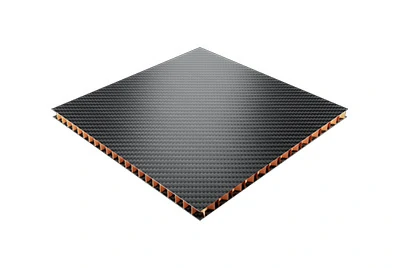
This configuration is suitable for aerospace structural components, flaps, access panels, motorsport body panels, UAV structures, and high-performance composite parts.
Note that carbon fiber facings are electrically conductive and are not recommended for radome or electromagnetic (EM) transparency applications.
When connected to aluminum or other metals, galvanic corrosion protection should also be considered. Layup styles such as unidirectional (UD), plain weave, or twill weave can be evaluated based on project requirements.
Aluminum-faced aramid honeycomb panels
Aluminum-faced honeycomb panels combine aluminum sheet facings with an aramid honeycomb core. The aluminum facing offers good surface wear resistance and supports anodized or coated finishes.
Contact us now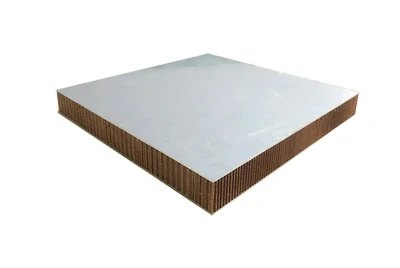
The aramid honeycomb core helps reduce overall panel weight, making it lighter than many all-metal honeycomb structures. This configuration is suitable for architectural interior modular panels, marine bulkhead joiner panels, industrial lightweight structural panels, and certain rail transit flooring or interior panel applications.
If you're unsure which configuration best suits your project, please share your application scenario, panel dimensions, facing requirements, and fire performance targets with Chalco. Our technical team can help recommend a suitable panel solution.
Panel specifications and standard sizes
Aramid honeycomb panels can be supplied in standard sheet sizes or customized based on drawings, panel thickness, facing material, and application requirements.
The following sandwich panel specifications are for reference only. Final specifications must be confirmed based on core, skin material, and adhesive system.
| Parameter | Range / Standard Value |
| Standard Panel Size | 2440 mm × 1220 mm; larger sizes available upon request |
| Core Thickness Range | 5–50 mm, customizable per project |
| Skin / Facing Thickness | 0.5–2.0 mm per side, depending on material and application |
| Total Panel Thickness | Starting from approximately 7 mm, customizable per project requirements |
| Aramid Honeycomb Core Density | 29–144 kg/m³ |
| Panel Weight | Depends on core density, facing material, and total thickness |
| Adhesive System | Compatible with most structural adhesives; mildew-resistant and non-corrosive to metals |
| Edge Treatment | Options include open edges, edge sealing, or potted edges |
| Surface Finish | Matte finish, sanded finish, or primer-ready surface, depending on facing material |
Panel thickness, weight, and structural configuration are all customizable. Final specifications should be confirmed based on project drawings, service environment, and applicable test requirements.
Edge sealing, curved panels, and hard-point reinforcement
Edge sealing
Aramid honeycomb has an open-cell structure. In marine, exterior rail transit, or humid environments, edge sealing helps minimize moisture ingress into the cells.
Chalco can provide sealed edges or potted edges based on project requirements.
Curved panels
Over-expanded cell aramid honeycomb is suitable for single-curvature panels. Achievable bend radius depends on core density, cell size, panel thickness, and facing material.
Hard-point reinforcement
Resin potting can be applied at fastener locations, embedded inserts, mounting holes, or other high-load areas to enhance local compression strength and connection load capacity.
Research on resin potting systems has shown that one-component flame-retardant polyurethane can provide strong compression performance while maintaining relatively low density.
Applications of aramid honeycomb sandwich panels
Aramid honeycomb sandwich panels are ideal for projects requiring lightweight structures, panel rigidity, fire resistance, and ready-to-install composite panels.
Chalco can recommend appropriate facing materials, edge treatments, and panel specifications based on the application environment.
Rail transit
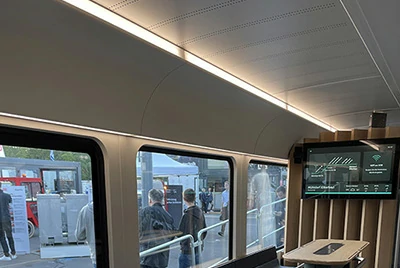
Aramid honeycomb sandwich panels can be used for interior wall panels, ceiling panels, partitions, and floor substrates in rail transit. Comparative data shows they typically reduce weight by 25–30% compared to similar aluminum honeycomb panel systems.
When paired with phenolic GFRP facing, the panel system can be configured to meet EN45545 or EN 17460 Class A1 fire safety requirements as needed.
Aerospace and aviation interiors
In aerospace and aviation interiors, aramid honeycomb sandwich panels are used for cabin partitions, overhead bin structures, galley panels, door liners, and lightweight interior components.
Phenolic GFRP facing is commonly used in panel systems requiring compliance with FAR 25.853 fire performance standards.
Marine and yachts
Aramid honeycomb panels are suitable for marine bulkhead joiner panels, cabin panels, and lightweight interior structures.
The non-metallic honeycomb core helps reduce galvanic corrosion risk in hybrid-material structures, but proper edge sealing and moisture protection design are essential in marine environments.
Construction and industrial
In construction and industrial applications, aramid honeycomb sandwich panels serve as lightweight modular panels, interior partitions, equipment covers, and structural decorative panels.
For projects requiring better surface durability, wear resistance, and easy finishing, aluminum-faced configurations are recommended.
Facing configuration, fire requirements, and technical parameters for specific applications can be evaluated based on drawings. Please share your project requirements with Chalco, and we'll assist in recommending a suitable panel structure.


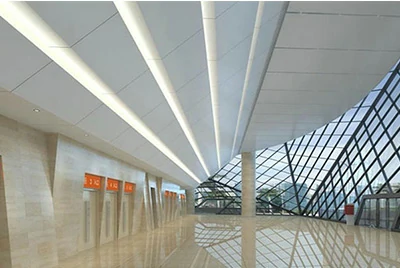
How to choose the right aramid honeycomb panel configuration?
When selecting a facing configuration for aramid honeycomb panels, consider fire regulations, panel weight, operating environment, and cost constraints together.
Below is a quick reference guide matching common project needs to recommended configurations.
| Primary Requirement | Recommended Facing | Typical Applications |
| Fire performance (EN45545 or FAR 25.853) | Phenolic GFRP | Rail transit interior panels, aircraft cabin panels |
| Minimum weight | Carbon fiber | Aerospace structural parts, drones, motorsport body panels |
| Cost control and corrosion resistance | GFRP or aluminum | Marine interior joiner panels, architectural modular panels |
| EM transparency (no electromagnetic shielding) | GFRP only | Radomes, antenna-related structures |
| Impact resistance and surface durability | Aluminum | Industrial flooring, transportation structural panels |
For projects requiring both lightweight design and fire performance-such as interior wall panels in rail transit-phenolic GFRP is typically a practical choice, balancing weight, fire smoke toxicity (FST) compliance, and cost.
If your project requires system-level certifications such as EN45545 or FAR 25.853, please specify this during the RFQ stage. Chalco can assist in evaluating suitable combinations of skins, core materials, and adhesive systems.
Aramid honeycomb panels vs bare core: which do you need?
Bare core is better suited for composite panel manufacturers with in-house capabilities for panel fabrication, skin bonding, and curing, allowing them to select facing materials, adhesive systems, and lamination methods based on their own processes.
Finished panels are ideal for system integrators, engineering contractors, and project procurement teams who prefer to source ready-made honeycomb sandwich panels, reducing downstream fabrication and bonding work.
For specifications, density options, and technical guidance on bare honeycomb cores, please visit Chalco's aramid honeycomb core page.
Fire compliance and quality documentation for panels
Aramid honeycomb panels can be configured to meet varying fire performance requirements based on the complete panel system.
Aramid honeycomb core itself exhibits self-extinguishing flame-retardant properties, but the final fire rating of the finished panel depends on testing of the full panel assembly-including core, skin material, and adhesive system.
For aircraft interior applications, FAR 25.853 Appendix F typically requires evaluation based on the complete panel assembly, with phenolic resin facing being a common configuration.
For rail transit projects, compliance with EN45545 and EN 17460 Class A1 must also be assessed at the full panel system level.
| Applications | Fire Standards | Panel System Requirements |
| Rail Transit | EN45545 / EN 17460 Class A1 | Tested as a complete panel assembly, including core, skin, and adhesive |
| Aerospace and Aviation Interiors | FAR 25.853 Appendix F | Typically configured with phenolic resin facing |
| Marine or Naval Vessels | SOLAS / IMO standards | Subject to confirmation based on specific project requirements |
For volume orders, Chalco can provide quality documentation including inspection reports, certificates of conformity, and packing lists.
Chalco operates under ISO 9001:2015 and EN 15085-2:2020 CL1 quality management systems, supporting supply chain documentation requirements for rail transit and engineering projects.
Related honeycomb product solutions
In addition to aramid honeycomb panels, Chalco offers a range of honeycomb core and composite panel solutions tailored to customer requirements for structural design, facing materials, operating environment, and performance criteria.
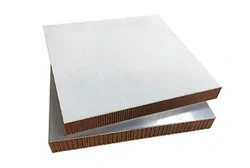
Aramid honeycomb
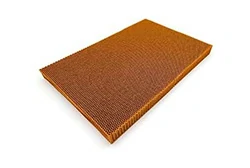
Aramid honeycomb core
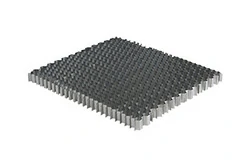
Aluminum honeycomb core
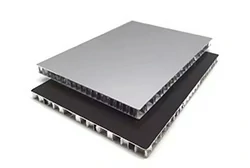
Aluminum honeycomb
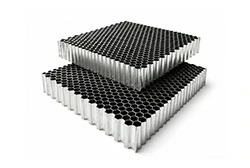
Stainless steel honeycomb
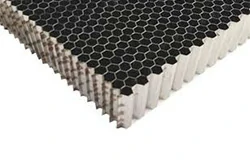
Carbon fiber honeycomb
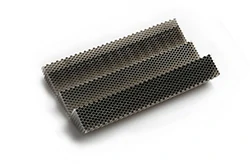
Honeycomb seal
High temperature honeycomb
If you're unsure whether to choose aramid, aluminum, stainless steel, or carbon fiber honeycomb structures, please provide details on your application, facing material, thickness, density, operating temperature, and drawings.
Chalco can help match the right honeycomb core, sandwich panel configuration, or custom fabrication solution.
FAQs about aramid honeycomb sandwich panels
What are aramid honeycomb sandwich panels?
They are finished panels made from aramid honeycomb core, facing material and adhesive system. Unlike bare core, they can be supplied as ready-to-use sandwich panels.
What facing materials are available?
Common options include GFRP facing, carbon fiber facing and aluminum facing. Other facing materials can be reviewed according to project requirements.
What fire rating can the panels meet?
Fire performance depends on the complete panel system. Phenolic GFRP can be specified for FAR 25.853, while EN45545 usually requires panel assembly testing.
Can aramid honeycomb panels be curved?
Yes. Over-expanded cell aramid honeycomb can support single-curvature panels. Small radius or complex curved panels need technical review.
What are the standard sizes?
Common standard size is 2440 mm × 1220 mm. Custom dimensions, cut-to-size panels, curved panels and machined parts can be supplied after drawing review.
How are they different from pure composite panels?
Honeycomb sandwich panels use a lightweight core between two skins to improve stiffness and reduce weight. Solid laminate panels are usually heavier.
Request specifications or quote for aramid honeycomb panels
Chalco can supply aramid honeycomb panels with GFRP, carbon fiber, or aluminum facings tailored to your application, panel structure, and fire performance requirements.
When requesting a quote, please provide the facing material, total thickness, panel dimensions or drawings, quantity, and required fire standard.
If your project requires edge sealing, curved panels, resin potting, or contour machining, please include these details to help us evaluate your solution more efficiently.