In semiconductor packaging, there is no single "best" material among gold, silver, copper, and aluminum bonding wires. Selection of semiconductor bonding materials depends not only on electrical conductivity and material cost, but also on hardness, surface stability, bonding method, pad structure, package environment, and requalification cost.
For fine-wire ball bonding, gold wire, silver alloy wire, bare copper wire, and palladium-coated copper (PCC) wire are more directly comparable. Aluminum wire is more commonly used for fine-wire wedge bonding, heavy-wire bonding, or power interconnects and should not be treated as an equivalent substitute.
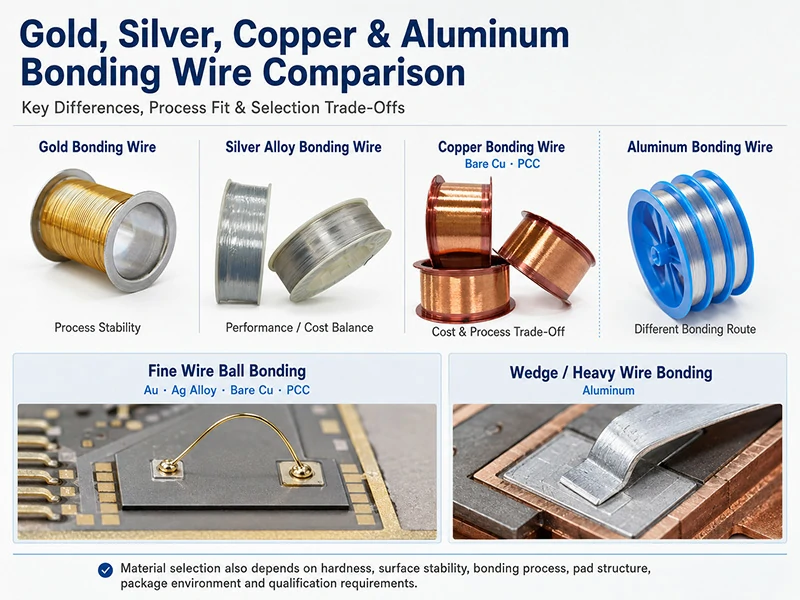
- Quickly compare key material differences
- Identify process and reliability risks
- Narrow the range of products and qualification work for further evaluation
Can Gold, Silver, Copper, and Aluminum Bonding Wires Be Compared Directly?
Yes, but first confirm that they are used in comparable bonding processes and interconnect structures. Gold wire, silver alloy wire, bare copper wire, and PCC are usually compared in fine-wire ball bonding, while aluminum wire is more commonly used for fine-wire wedge bonding or power interconnects.
| Your Interconnect Scenario | Material Routes Worth Evaluating | Key Selection Considerations |
| Fine-Wire Ball Bonding | Gold wire, silver alloy or coated silver wire, bare copper wire, PCC | FAB and second-bond performance, hardness, pad interaction, surface stability, and process window |
| Fine-Wire Wedge Bonding | Fine aluminum wire and other wedge-bonding-compatible wires | Oxide layer, wedge tool, ultrasonic parameters, pad compatibility, and bond consistency |
| Heavy-Wire or Bonding-Ribbon Power Interconnects | Heavy aluminum wire, heavy copper wire, aluminum ribbon, or copper ribbon | Current-carrying capability, bond area, package structure, and thermal/power cycling |
The same base metal can behave differently with changes in alloy composition, coating, wire diameter, or annealing condition. The comparison below focuses on selection trade-offs between material routes rather than ranking Au, Ag, Cu, and Al in absolute terms.
Further Reading: What Is the Difference Between Ball Bonding and Wedge Bonding?
Quick Comparison of Gold, Silver, Copper, and Aluminum Bonding Wires
The table below summarizes the primary value and validation focus of each material route. Actual performance still depends on alloy composition, coating, wire diameter, bonding process, and package conditions.
| Item | Gold Bonding Wire | Silver Alloy or Coated Silver Wire | Bare Copper or PCC Bonding Wire | Aluminum Bonding Wire (Application-Specific) |
| Use | Mature fine-wire ball bonding | Gold-wire replacement and cost-performance balance | Cost reduction or second-source qualification | Fine-wire wedge bonding; heavy-wire/ribbon power interconnects |
| Value | Mature process and stable surface | Balances performance, bondability, and cost | Potential conductivity and cost benefits | Suitable for wedge bonding and larger-cross-section interconnects |
| Concerns | Interface and package reliability | Alloy/coating design, sulfur- or chlorine-containing environments, and migration | Oxidation, pad stress, and second-bond performance | Fine wire: oxide layer and wedge-bonding window; heavy wire/ribbon: fatigue and cycling reliability |
| Checks | Wire, pad, and package compatibility | Surface stability, environment, and molding compound | FAB/EFO, atmosphere, tools, and parameters | Wire form, tools, and bond structure; power applications also require cycling validation |
Note: Fine aluminum wire, heavy aluminum wire, and aluminum ribbon are different product routes. When heavy wire and bonding ribbon are used for power interconnects, the material, cross-section, bond structure, and package design should be evaluated separately.
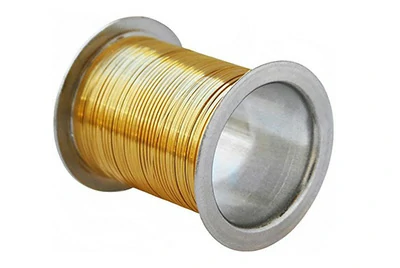
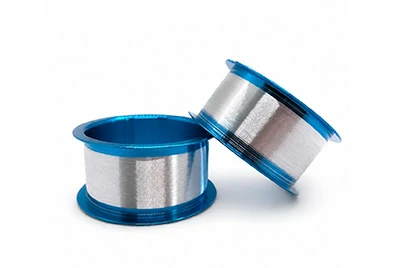
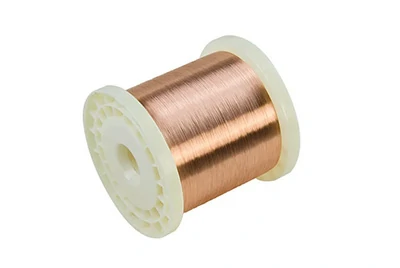
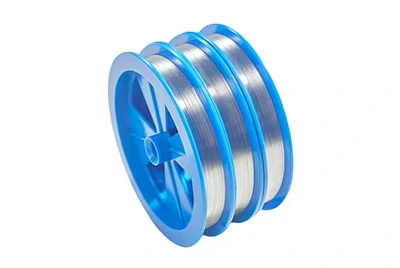
Six Key Differences When Comparing Bonding Wire Materials
Electrical and Thermal Conductivity: Why Pure-Metal Data Is Not Enough
Based on pure-metal data, silver and copper have lower electrical resistivity and higher thermal conductivity. At the same length and cross-sectional area, this can help reduce conductor resistance and heat buildup.
| Pure-Metal Reference Values at Room Temperature | Ag | Cu | Au | Al |
| Electrical resistivity (approx. ×10⁻⁸ Ω·m; lower is better) | 1.59 | 1.68 | 2.44 | 2.65 |
| Thermal conductivity (approx. W/m·K; higher is better) | 429 | 401 | 317 | 237 |
Note: The table lists pure-metal reference values at approximately 20–25°C to show general material trends. These values are not specifications for any particular bonding wire and can vary with purity, processing condition, and test temperature. Sources: NIST thermal-conductivity compilation and survey of pure-metal electrical resistivity.
Actual performance is also affected by alloying or coating, wire diameter, loop length, number of parallel wires, and bond interfaces. Increasing conductor cross-section or using bonding ribbon may be more effective than improving only the base-metal conductivity.
Selection point: Pure-metal data is useful for initial screening, but final evaluation should be based on the specific wire, interconnect design, and package electrical requirements.
Hardness, Strength, and Pad Impact
Published annealed-material reference data show that copper has approximately twice the Vickers hardness of gold and also a higher ultimate tensile strength. Greater hardness and strength generally increase wire stiffness, but may also increase the load on the bond pad and underlying structures.
| Annealed-Material Reference | Cu | Au |
| Vickers hardness (HV) | 50 | 25 |
| Ultimate tensile strength (psi) | 30,500 | 17,400 |
Note: These annealed-material reference values are from NASA NEPP's Body of Knowledge for Copper Wire Bonds. They are not guaranteed specifications for commercial bonding wire.
Selection point: Evaluate hardness, breaking load, elongation, and pad structure together to balance wire-forming stability with pad safety.
Oxidation, Corrosion, Sulfidation, and Ion Migration
Gold wire has relatively stable surface behavior. Bare copper requires tighter oxidation control, while PCC can improve surface protection but does not replace package-level validation. Silver alloy or coated silver wire should be evaluated for sulfidation, corrosion in chlorine-containing environments, and electrochemical migration according to the specific product.
The native oxide layer on aluminum wire also affects bondability, and its behavior is closely related to surface condition, ultrasonic energy, and wedge-bonding parameters.
Selection point: Confirm storage conditions, molding compounds, and exposure to humid, sulfur-containing, or chlorine-containing environments.
Bondability and Process-Window Sensitivity
Gold bonding wire generally has a mature ball-bonding baseline. Copper bonding wire and PCC usually require dedicated process windows for free-air ball (FAB) formation, electronic flame-off (EFO), shielding atmosphere, capillary selection, and bonding parameters; gold-wire settings cannot simply be copied.
Silver bonding wire behavior depends on the specific alloy and coating. Aluminum bonding wire requires a process window matched to the wedge tool, ultrasonic parameters, and wire form.
Selection point: The same wire diameter does not guarantee direct interchangeability; a material change usually requires a new process window.
Bond Interfaces and Long-Term Reliability
Long-term reliability depends on the wire, pad, intermetallic compounds (IMCs), molding compound, and operating environment. For fine-wire ball bonding, the main concerns include interface behavior, corrosion, and bond integrity.
For heavy-wire and bonding-ribbon power interconnects, heel cracking, wire lift-off, and cyclic fatigue also require attention.
Selection point: Reliability should not be ranked by base metal alone; it must be validated for the specific wire–pad–package system.
Wire Price and Total Conversion Cost
Gold wire usually carries a higher material cost. Copper, silver alloy, or aluminum wire may offer cost-reduction potential, but wire price alone does not equal final package cost.
A material change may also add costs for tool or atmosphere changes, process development, pilot-run losses, reliability qualification, and customer change approval.
Selection point: Compare the total cost after process conversion and qualification, not only the price per spool.
Common Material Comparisons in Practical Selection
Gold Bonding Wire vs Bare Copper or PCC Bonding Wire
This comparison is common in fine-wire IC packaging and other ball-bonding projects involving cost reduction, second-source qualification, or new-package introduction. The key trade-off is between a mature process baseline and the investment required for material conversion.
| Item | Gold Bonding Wire | Bare Copper or PCC |
| Value | Stable surface behavior and a mature process/qualification baseline | Attractive material-cost and electrical-performance potential |
| Process | Existing equipment and parameters can usually be retained with fewer changes | FAB, EFO, shielding atmosphere, capillary, and bonding parameters usually need to be re-matched |
| Checks | Interfaces, molding compound, and target reliability | Oxidation, pad stress, second-bond performance, and corrosion |
PCC can improve protection of the copper core surface, but it should still be evaluated separately from bare copper and should not be treated as a direct replacement for gold wire.
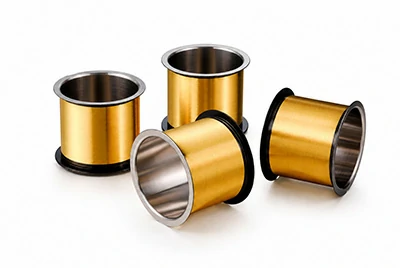
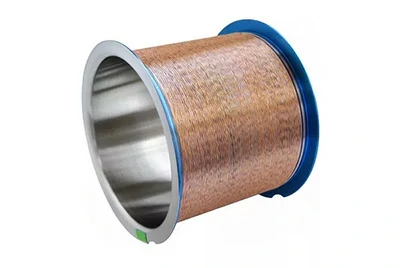
Selection point: Use the current gold-wire, pad, and package baseline to evaluate the specific bare-copper or PCC product and the conversion cost.
Gold Bonding Wire vs Silver Alloy Bonding Wire
This comparison is common in LED packaging and other fine-wire ball-bonding projects involving cost reduction, second-source qualification, or new product introduction (NPI). Gold wire offers a mature baseline, while silver wire aims to balance performance and cost within the same ball-bonding architecture.
| Item | Gold Bonding Wire | Silver Alloy or Coated Silver Wire |
| Value | Mature process and qualification baseline | Potential material-cost reduction compared with gold wire |
| Process | Existing baselines for FAB, loop formation, and second bond | Ball formation and bonding behavior depend on alloy and coating |
| Checks | Pad interface, molding compound, and target reliability | Surface stability and compatibility with the environment and molding compound |
Silver alloy wire and coated silver wire are not a single, uniform product category. Alloy composition, coating structure, wire diameter, and mechanical properties can all affect FAB formation, the process window, and reliability.
Selection point: When silver wire is a viable candidate, the final decision should still be based on specific product data and package-level validation.
Silver Alloy Bonding Wire vs Bare Copper or PCC Bonding Wire
Silver alloy wire, bare copper wire, and PCC can all be evaluated as alternatives to gold wire, but their risk profiles differ. Silver routes depend more on alloy/coating design and environmental compatibility, while copper routes place greater demands on oxidation control, pad compatibility, and process conversion.
| Item | Silver Alloy or Coated Silver Wire | Bare Copper or PCC |
| Value | Balances performance and cost in ball bonding | Clearer potential for cost reduction and electrical performance |
| Process | FAB, loop formation, and second-bond performance depend on the specific product | A process window is required for EFO, shielding atmosphere, capillary, and bonding parameters |
| Checks | Surface stability and compatibility with the environment and molding compound | Oxidation, pad stress, second-bond performance, and interface behavior |
Bare copper and PCC should also be evaluated separately. Palladium coating improves surface protection, but it does not eliminate the need for process and reliability validation.
Selection point: Silver routes emphasize alloy/coating design and environmental fit; copper routes emphasize oxidation control, pad compatibility, and conversion capability.
Heavy Aluminum Wire, Heavy Copper Wire, and Bonding Ribbon in Power Interconnects
In power modules and high-current wedge bonding, heavy aluminum wire is a mature route. Heavy copper wire or copper ribbon can reduce interconnect resistance, but their higher hardness and bonding loads may require re-evaluation of top-side metallization, pads, tooling, and ultrasonic parameters.
| Item | Heavy Aluminum Wire or Aluminum Ribbon | Heavy Copper Wire or Copper Ribbon |
| Value | Mature process that facilitates continuation of existing designs | Potential to reduce interconnect resistance and increase current-carrying capability |
| Process | Oxide layer, wedge-bonding parameters, wire/ribbon layout, and bond deformation | Bonding load, metallization strength, and tool wear |
| Checks | Heel cracking, wire lift-off, and cycling reliability | Pad loading, interfaces, top-side metallization, and cycling reliability |
Both round wire and bonding ribbon can be made from aluminum or copper. Actual performance depends on the material, cross-section, layout, and bond design.
Selection point: When changing the material or conductor form, revalidate top-side metallization, tooling, and cycling reliability.
What Should Be Re-Evaluated When Changing Bonding Wire Materials?
Changing bonding wire material is not simply a same-diameter substitution. Differences in alloy, coating, and mechanical properties can affect ball formation, pad loading, loop formation, second-bond performance, and long-term reliability. The change should be managed as a process change and qualification project.
| Item | Information to Confirm |
| Wire | Current and candidate materials, alloy/coating, wire diameter, breaking load, elongation, and hardness |
| Bonding | Ball or wedge bonding, tools, and parameters; for ball bonding, FAB, EFO, and shielding atmosphere |
| Pad/Package | Pad metallization, dimensions and underlying structure, molding compound, and loop clearance |
| Performance | Yield, resistance, visual criteria, applicable pull/shear test baselines, and environmental and cycling validation |
| Change | Pilot runs, multi-lot confirmation, customer approval, PCN, and second-source introduction |
The same diameter does not mean direct interchangeability. First establish the current baseline, then determine which parameters must change and which new validations are required.
Selection point: Along with material price, include process conversion, qualification, and customer-approval costs.
Frequently Asked Questions
Which Bonding Wire Material Is Best for Semiconductor Packaging?
There is no universal best material. First separate the application into fine-wire ball bonding, fine-wire wedge bonding, or power interconnects, then evaluate wire diameter, pad structure, package design, equipment, and reliability requirements.
Can Copper Bonding Wire Directly Replace Gold Bonding Wire?
Usually not. Bare copper or PCC may differ in hardness, oxidation control, FAB formation, pad loading, and second-bond behavior. A new process window and package-level qualification are generally required.
Can Silver Alloy Bonding Wire Replace Gold Bonding Wire?
It can be a candidate for some fine-wire ball-bonding projects, but it is not a universal replacement. Confirm the specific alloy or coating, mechanical properties, FAB behavior, environmental conditions, and molding compound.
Why Can't Aluminum Bonding Wire Always Be Compared Directly with Gold, Silver, and Copper?
Gold, silver, and copper are commonly compared in fine-wire ball bonding. Aluminum wire also covers fine-wire wedge bonding, heavy-wire bonding, and power interconnects. Because conductor form, tools, and dominant failure modes differ, the application scenario must be aligned before comparison.
What Is the Difference Between Bare Copper and Palladium-Coated Copper (PCC) Bonding Wire?
Bare copper has an exposed copper surface and is more sensitive to oxidation control. PCC uses a palladium coating to improve surface protection, but FAB formation, second-bond performance, and long-term reliability still require validation.
Need to Compare Two Bonding Wire Options?
Provide the current and candidate wire materials, wire diameter, bonding method, pad metallization, package type, and reason for the change so that the relevant product specifications, process differences, and validation items can be reviewed.
Recommended information: current datasheet, existing wire model, target material, wire diameter, ball/wedge process, and key validation requirements.
Chalco can provide you the most comprehensive inventory of aluminum products and can also supply you customized products. Precise quotation will be provided within 24 hours.
Get a quote